SSansFiction
The libraryCollectionsJournalStatsFor authors
Sign inJoin now
Sansfiction,

A digital library for books. Made by readers, for readers.

v 2.0 · 2026
The library
  • Discover
  • Collections
  • Book tracker
  • Journal
  • Stats
For authors
  • SF Links
  • Analytics
  • How it works
  • FAQ
Elsewhere
  • X / @sansfiction
  • Privacy
  • Terms
  • Contact
© 2026 SansFiction · Digital · GlobalA quiet room for your reading life.
The libraryCollectionsJournalStatsFor authors
Sign inJoin now →
Navigation
Library
Bookshelf
Journal
Discover
Collections
Tierlists
Stats
Profile
Author Page
Link Builder
Account
Sign in
S
G
BookscivilizationHomo Deus: A Brief History of Tomorrow
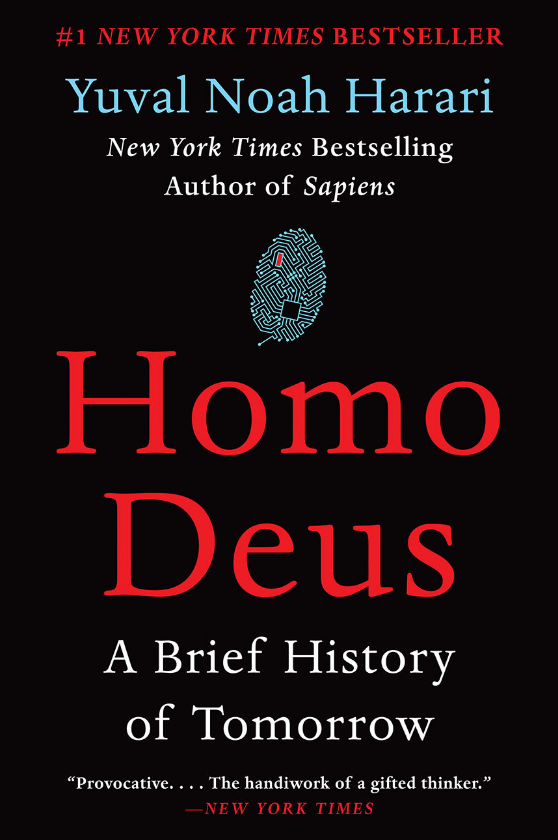
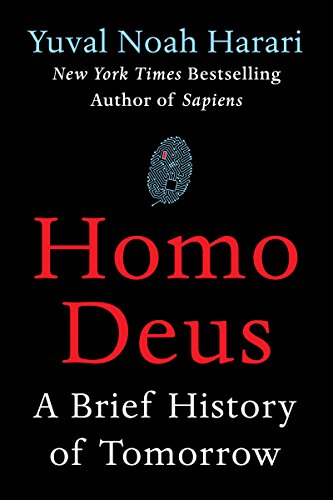
Cover of Homo Deus: A Brief History of Tomorrow by Yuval Noah Harari
№ 2 · Homo

Homo Deus: A Brief History of Tomorrow,

by Yuval Noah Harari

Ask AI
Rating4.2/ 5
Ratings614
Pages449
Reading Hours9h
Published2015
LanguageEnglish

§Synopsis

01

"Over the past century humankind has managed to do the impossible and rein in famine, plague, and war. This may seem hard to accept, but, as Harari explains in his trademark style--thorough, yet riveting--famine, plague and war have been transformed from incomprehensible and uncontrollable forces of nature into manageable challenges. For the first time ever, more people die from eating too much than from eating too little; more people die from old age than from infectious diseases; and more people commit suicide than are killed by soldiers, terrorists and criminals put together. The average American is a thousand times more likely to die from binging at McDonalds than from being blown up by Al Qaeda. What then will replace famine, plague, and war at the top of the human agenda? As the self-made gods of planet earth, what destinies will we set ourselves, and which quests will we undertake? Homo Deus explores the projects, dreams and nightmares that will shape the twenty-first century--from overcoming death to creating artificial life. It asks the fundamental questions: Where do we go from here? And how will we protect this fragile world from our own destructive powers? This is the next stage of evolution" -- provided by publisher.

§Our take

Homo Deus is Harari's turn from history to forecast: having argued in Sapiens that shared stories built human civilisation, he now argues that famine, plague and war have become manageable problems and that humanity's next projects are immortality, happiness and godlike power. Its boldest claim is that organisms are algorithms, and that a new 'Dataism' may replace humanism as the faith of the age. Whether that is science or a stretched metaphor is the book's live argument.

The writing is smooth and quotable; Kirkus called it relentlessly fascinating. Critics such as Simon Underdown in Times Higher Education found it thin on substance and blind to how unevenly old threats still fall around the world, and Harari himself later published an errata page correcting figures in early editions. Read it as a provocation to argue with, not a settled forecast.

§Themes

Old scourges tamed
Harari argues famine, plague and war are now manageable technical problems.
Humanism as a quasi-religion
Humanism puts human feelings and choices at the centre and is a modern faith.
Dataism as a candidate ideology
Harari treats information flow as the supreme value while noting consciousness may resist data‑based explanation.
Immortality and godlike abilities
Humanity may now chase happiness, immortality and godlike powers.

§How it was received

Kirkus praised the book as relentlessly fascinating and likely a bestseller, noting Harari’s smooth handling of heavy topics and respectful treatment of religion. Times Higher Education found it only partially successful, calling the premise interesting but the execution thin and reliant on sweeping generalisations, especially about uneven global impact.

§Read it if

  • You want a forward‑looking big‑picture work rather than a full history of the past.
  • You enjoy accessible writing that tackles big philosophical questions.
  • You’re comfortable with speculative scenarios presented as possibilities.

§Skip it if

  • You prefer tightly grounded analysis over sweeping generalisations.
  • You find the bleak, deterministic tone draining.

§Before you start

Reading experience
The book moves at a clear, conversational pace but can be dense in stretches as the argument builds across three parts.
Reading order
Book 2 of the informal Homo trilogy (after Sapiens, before 21 Lessons).
Content notes
Discussion of war, famine, plague and death statistics; Bleak outlook on human meaning.

§Common questions

Is Homo Deus a sequel to Sapiens?
Yes, it is the second book in the informal Homo trilogy, following Sapiens and preceding 21 Lessons.
Has Harari corrected any errors in the book?
He published an errata page listing corrections to editions before May 2017, including World War I casualty figures and suicide‑rate comparisons, but says the core arguments remain unchanged.
Is the book available in audiobook format?
Yes. Audiobooks and many translations exist.

§If you liked this

  • Sapiens: A Brief History of Humankind by Yuval Noah Harari — The predecessor; Homo Deus continues its big‑picture approach but looks forward.
  • 21 Lessons for the 21st Century by Yuval Noah Harari — The third book; turns from future scenarios to present‑day concerns.
  • The Better Angels of Our Nature by Steven Pinker — Steven Pinker's case that violence has declined is the closest relative of Harari's opening claim, built on far more data.
  • Data-ism by Steve Lohr — Steve Lohr's earlier book on how big data reshapes decisions, a useful grounding for Harari's idea of Dataism.
  • The Dawn of Everything by David Graeber and David Wengrow — A counterweight rather than a match: challenges the grand‑narrative approach of Harari's Sapiens.
Sources
  • Wikipedia
  • Kirkus Reviews
  • Times Higher Education (Simon Underdown)
  • Current Affairs (Darshana Narayanan)
  • Journal of Evolution and Technology (Allan McCay)
  • Catholic Medical Quarterly
  • Harari's official site
  • Harari's official site
  • Wikipedia
  • Wikipedia

Track this book

Add to your library to track progress and write reviews

§Genres
civilization1general anthropology1history1history of civilization & culture1imprint1modern1nature1
§Moods
challenging1dark1informative1reflective1
§Tags
#antropologie1#filozofie1#istorie1#nonfictiune1#sociologie1#stiinta1

§About the Author

Yuval Noah Harari
Yuval Noah Harari

20 books in catalog

Examining the sweeping trajectory of human evolution, social structures, and technological advancement, macro-historical non-fiction offers critical frameworks for understanding contemporary global challenges. Yuval Noah Harari brought large-scale historical analysis to a broad audience with Sapiens: A Brief History of Humankind, which explores how cognitive development, agricultural shifts, and shared cultural fictions shaped human society.

Career & Background

Born in Kiryat Atta, Israel, on February 24, 1976, Harari pursued advanced historical research at the University of Oxford, earning his doctorate in 2002. He subsequently joined the faculty at the Hebrew University of Jerusalem as a professor of history, specializing in world, medieval, and military history. His undergraduate lectures on world history served as the basis for his 2011 book Sapiens: A Brief History of Humankind. In 2019, Harari and Itzik Yahav co-founded Sapienship, a social impact company that develops projects in education and entertainment to address pressing global issues.

Writing Style & Themes

Harari combines history, evolutionary biology, and anthropology to address macro-historical questions regarding human existence. His writing analyzes how shared narratives, free will, consciousness, happiness, and suffering influence human behavior and social structures. In works such as Homo Deus: A Brief History of Tomorrow and Nexus: A Brief History of Information Networks from the Stone Age to AI, he examines the historical evolution of information networks and evaluates the existential risks associated with artificial intelligence and non-human decision-making systems.

Major Works

  • Sapiens: A Brief History of Humankind — Originally published in 2011 based on university lectures, this work traces the history of humanity from the evolution of archaic human species to modern technological societies.
  • Homo Deus: A Brief History of Tomorrow — Published in 2016, this book investigates the long-term future of humanity, examining how technology, data systems, and artificial intelligence may alter human ambitions and capabilities.
  • Nexus: A Brief History of Information Networks from the Stone Age to AI — Published in 2024, this narrative examines information networks across history, analyzing how information flows shape societies and warning of challenges posed by AI.
  • Sapiens: A Graphic History, Volume 1 - The Birth of Humankind — Created with artists David Vandermeulen and Daniel Casanave, this 2020 graphic adaptation presents human evolutionary history in a visual graphic novel format.
  • Sapiens: A Graphic History, Volume 2: The Pillars of Civilization — This graphic volume explores the Agricultural Revolution and how early human farming and settlement patterns transformed human social organization.

§Featured Series

Homo

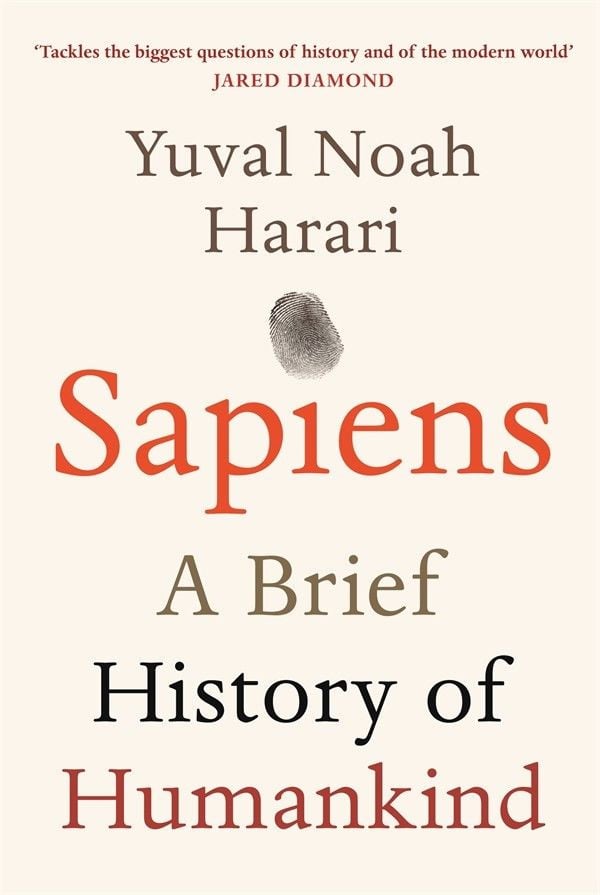
Cover of Sapiens: A Brief History of Humankind by Yuval Noah Harari

Sapiens: A Brief History of Humankind

Yuval Noah Harari, 2011
Cover of Homo Deus: A Brief History of Tomorrow by Yuval Noah Harari

Homo Deus: A Brief History of Tomorrow

Yuval Noah Harari, 2015

§Editions

Showing 3 of 77 editions
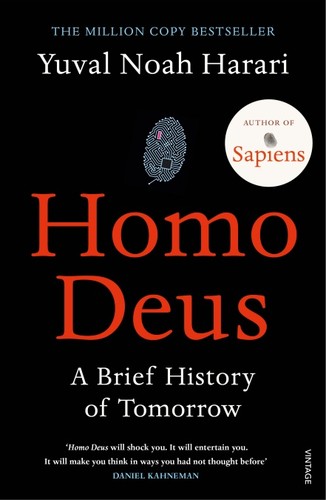
Cover of Homo Deus: A Brief History of Tomorrow

Homo Deus: A Brief History of Tomorrow

engPaperback
Random House (UK)20179781784703936
Cover of Homo Deus: A Brief History of Tomorrow

Homo Deus: A Brief History of Tomorrow

engKindleIllustrated
Harper2017B01BBQ33VE
Amazon
Cover of Homo Deus: A Brief History of Tomorrow

Homo Deus: A Brief History of Tomorrow

engKindle
Vintage Digital2016B019CGXTP0
Amazon
§Genres
civilization1general anthropology1history1history of civilization & culture1imprint1modern1nature1
§Moods
challenging1dark1informative1reflective1
§Tags
#antropologie1#filozofie1#istorie1#nonfictiune1#sociologie1#stiinta1

Metadata

ISBN-139781784703936
ISBN-101784703931
ASINB01BBQ33VE

Editions and availability

Find Homo Deus: A Brief History of Tomorrow Yuval Noah Harari in PDF, EPUB, ebook, audiobook, print, or library editions.

View on Amazon
Bookshop.orgGoogle Play BooksBarnes & NobleOpen Library