The renowned activist and public intellectual David Graeber teams up with the professor of comparative archaeology David Wengrow to deliver a trailblazing account of human history, challenging our most fundamental assumptions about social evolution—from the development of agriculture and cities to the emergence of "the state," political violence, and social inequality—and revealing new possibilities for human emancipation
For generations, our remote ancestors have been cast as primitive and childlike—either free and equal innocents, or thuggish and warlike. Civilization, we are told, could be achieved only by sacrificing those original freedoms or, alternatively, by taming our baser instincts. David Graeber and David Wengrow show how such theories first emerged in the eighteenth century as a conservative reaction to powerful critiques of European society posed by Indigenous observers and intellectuals. Revisiting this encounter has startling implications for how we make sense of human history today, including the origins of farming, property, cities, democracy, slavery, and civilization itself.
Drawing on pathbreaking research in archaeology and anthropology, the authors show how history becomes a far more interesting place once we learn to throw off our conceptual shackles and perceive what’s really there. If humans did not spend 95 percent of their evolutionary past in tiny bands of hunter-gatherers, what were they doing all that time? If agriculture, and cities, did not mean a plunge into hierarchy and domination, then what kinds of social and economic organization did they lead to? What was really happening during the periods that we usually describe as the emergence of "the state"? The answers are often unexpected, and suggest that the course of human history may be less set in stone, and more full of playful, hopeful possibilities, than we tend to assume.
The Dawn of Everything fundamentally transforms our understanding of the human past and offers a path toward imagining new forms of freedom, new ways of organizing society. This is a monumental book of formidable intellectual range, animated by curiosity, moral vision, and a faith in the power of direct action.
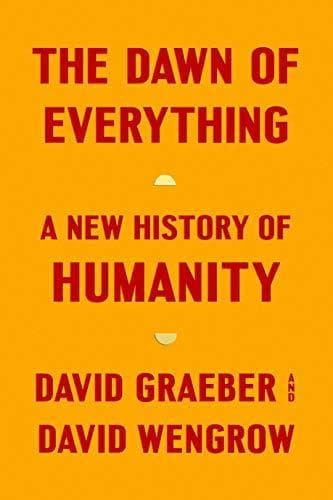
The renowned activist and public intellectual David Graeber teams up with the professor of comparative archaeology David Wengrow to deliver a trailblazing account of human history, challenging our most fundamental assumptions about social evolution—from the development of agriculture and cities to the emergence of "the state," political violence, and social inequality—and revealing new possibilities for human emancipation
For generations, our remote ancestors have been cast as primitive and childlike—either free and equal innocents, or thuggish and warlike. Civilization, we are told, could be achieved only by sacrificing those original freedoms or, alternatively, by taming our baser instincts. David Graeber and David Wengrow show how such theories first emerged in the eighteenth century as a conservative reaction to powerful critiques of European society posed by Indigenous observers and intellectuals. Revisiting this encounter has startling implications for how we make sense of human history today, including the origins of farming, property, cities, democracy, slavery, and civilization itself.
Drawing on pathbreaking research in archaeology and anthropology, the authors show how history becomes a far more interesting place once we learn to throw off our conceptual shackles and perceive what’s really there. If humans did not spend 95 percent of their evolutionary past in tiny bands of hunter-gatherers, what were they doing all that time? If agriculture, and cities, did not mean a plunge into hierarchy and domination, then what kinds of social and economic organization did they lead to? What was really happening during the periods that we usually describe as the emergence of "the state"? The answers are often unexpected, and suggest that the course of human history may be less set in stone, and more full of playful, hopeful possibilities, than we tend to assume.
The Dawn of Everything fundamentally transforms our understanding of the human past and offers a path toward imagining new forms of freedom, new ways of organizing society. This is a monumental book of formidable intellectual range, animated by curiosity, moral vision, and a faith in the power of direct action.
Add to your library to track progress and write reviews
Add to your library to track progress and write reviews
Find The Dawn of Everything: A New History of Humanity David Graeber in PDF, EPUB, ebook, audiobook, print, or library editions.
Find The Dawn of Everything: A New History of Humanity David Graeber in PDF, EPUB, ebook, audiobook, print, or library editions.

1 books in catalog
Groundbreaking anthropological studies on economic systems, bureaucracy, and human history have transformed contemporary social theory, most notably through the widely read work Debt: The First 5000 Years. Written by David Graeber, an influential American anthropologist and anarchist social activist, this body of work challenges deeply ingrained assumptions about money, state power, and workplace organization. Born in 1961 and active until his death in 2020, Graeber bridged academic research and public intellectual life to offer bold alternatives to modern economic institutions.
Born in New York City in 1961, David Graeber was raised in Chelsea by working-class parents with strong political commitments—his father Kenneth fought with the International Brigades in the Spanish Civil War, and his mother Ruth was a garment worker and union theater performer. Graeber pursued anthropology, earning his doctorate from the University of Chicago in 1996. He served as an assistant professor and associate professor of anthropology at Yale University from 1998–2007, specializing in theories of value and social theory. When Yale decided not to rehire him when he would otherwise have become eligible for tenure, the move sparked an academic controversy and a petition signed by more than 4,500 supporters. He subsequently served from 2007 to 2013 as Reader in Social Anthropology at Goldsmiths, University of London, before becoming a professor of anthropology at the London School of Economics, where he taught until his death in 2020.
Throughout his writings, David Graeber combined ethnography, history, and political philosophy to critique hierarchy and economic inequality. His work frequently re-examined foundational concepts such as debt, bureaucracy, work, and state control, exposing how contemporary social structures often serve administrative inertia rather than human needs. Writing in a direct, engaging style accessible to non-specialists, Graeber highlighted historical examples of egalitarian governance and mutual aid. His critique of economic orthodoxies and his active participation in social movements directly informed his published theoretical works, including Debt: The First 5000 Years (2011), The Utopia of Rules (2015), and Bullshit Jobs: A Theory (2018).
1 books in catalog
Groundbreaking anthropological studies on economic systems, bureaucracy, and human history have transformed contemporary social theory, most notably through the widely read work Debt: The First 5000 Years. Written by David Graeber, an influential American anthropologist and anarchist social activist, this body of work challenges deeply ingrained assumptions about money, state power, and workplace organization. Born in 1961 and active until his death in 2020, Graeber bridged academic research and public intellectual life to offer bold alternatives to modern economic institutions.
Born in New York City in 1961, David Graeber was raised in Chelsea by working-class parents with strong political commitments—his father Kenneth fought with the International Brigades in the Spanish Civil War, and his mother Ruth was a garment worker and union theater performer. Graeber pursued anthropology, earning his doctorate from the University of Chicago in 1996. He served as an assistant professor and associate professor of anthropology at Yale University from 1998–2007, specializing in theories of value and social theory. When Yale decided not to rehire him when he would otherwise have become eligible for tenure, the move sparked an academic controversy and a petition signed by more than 4,500 supporters. He subsequently served from 2007 to 2013 as Reader in Social Anthropology at Goldsmiths, University of London, before becoming a professor of anthropology at the London School of Economics, where he taught until his death in 2020.
Throughout his writings, David Graeber combined ethnography, history, and political philosophy to critique hierarchy and economic inequality. His work frequently re-examined foundational concepts such as debt, bureaucracy, work, and state control, exposing how contemporary social structures often serve administrative inertia rather than human needs. Writing in a direct, engaging style accessible to non-specialists, Graeber highlighted historical examples of egalitarian governance and mutual aid. His critique of economic orthodoxies and his active participation in social movements directly informed his published theoretical works, including Debt: The First 5000 Years (2011), The Utopia of Rules (2015), and Bullshit Jobs: A Theory (2018).