SSansFiction
The libraryCollectionsJournalStatsFor authors
Sign inJoin now
Sansfiction,

A digital library for books. Made by readers, for readers.

v 2.0 · 2026
The library
  • Discover
  • Collections
  • Book tracker
  • Journal
  • Stats
For authors
  • SF Links
  • Analytics
  • How it works
  • FAQ
Elsewhere
  • X / @sansfiction
  • Privacy
  • Terms
  • Contact
© 2026 SansFiction · Digital · GlobalA quiet room for your reading life.
The libraryCollectionsJournalStatsFor authors
Sign inJoin now →
Navigation
Library
Bookshelf
Journal
Discover
Collections
Tierlists
Stats
Profile
Author Page
Link Builder
Account
Sign in
S
G
Booksamerican fictionFoundation
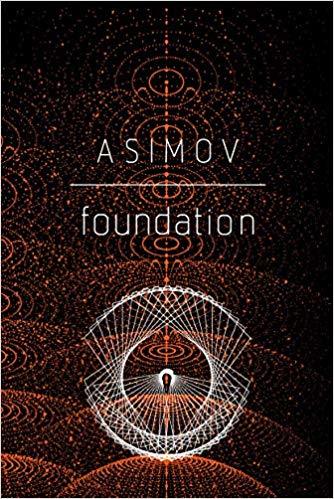
Cover of Foundation by Isaac Asimov
№ 1 · Foundation (Publication Order)

Foundation,

by Isaac Asimov

Ask AI
Rating4.0/ 5
Ratings1,747
Pages255
Reading Hours5h
Published1951
LanguageEnglish

§Synopsis

01

One of the great masterworks of science fiction, the Foundation novels of Isaac Asimov are unsurpassed for their unique blend of nonstop action, daring ideas, and extensive world-building.

The story of our future begins with the history of Foundation and its greatest psychohistorian: Hari Seldon. For twelve thousand years the Galactic Empire has ruled supreme. Now it is dying. Only Hari Seldon, creator of the revolutionary science of psychohistory, can see into the future--a dark age of ignorance, barbarism, and warfare that will last thirty thousand years. To preserve knowledge and save mankind, Seldon gathers the best minds in the Empire--both scientists and scholars--and brings them to a bleak planet at the edge of the Galaxy to serve as a beacon of hope for future generations. He calls his sanctuary the Foundation.

But soon the fledgling Foundation finds itself at the mercy of corrupt warlords rising in the wake of the receding Empire. And mankind's last best hope is faced with an agonizing choice: submit to the barbarians and live as slaves--or take a stand for freedom and risk total destruction.

§Our take

Foundation isn't a novel in the usual sense; it's a fix-up of five magazine stories and one written-for-the-book opening, and the seams show. The civilization is the protagonist, with a new lead every episode and Hari Seldon reduced to recorded cameos. That structure is the point: Asimov modelled the decline on Gibbon's Rome, so the story moves in generational jumps, each crisis solved by negotiation, bluff, or a priesthood built on atomic technology. Readers either love the puzzle-box thrill of watching clever men out-think a guaranteed outcome or find the pattern repetitive, especially in 'The Traders', which echoes 'The Mayors' and, per one critic, uncritically celebrates coercion. The prose is plain and efficient, the ideas bold for 1950s SF, but the cast is almost entirely men, the technology feels slide-rule era, and climaxes often happen off-page. A 2023 reread called it the strongest of the trilogy on repeat reading because the stories stand alone. Start with 'The Psychohistorians'; it shows Trantor and explains the project.

§Themes

Civilization as protagonist
The lead changes every episode; Seldon appears mainly as a recording, so the galaxy-spanning institution carries the arc.
Psychohistory's guarantee
The Foundation's survival is statistically certain, so tension comes from how each crisis is solved, not whether it will be.
Brains over guns
Crises are settled through negotiation, bluff, trade, and a manufactured religion, not space battles.
Religion as control mechanism
The Foundation turns its atomic monopoly into priestly authority over neighbours, then trade replaces that religious grip.
Gibbon's Rome in space
The decline-and-fall model drives the generational jumps and institutional focus.

§How it was received

Early reviewers were divided: Groff Conklin was enthusiastic, Anthony Boucher and J. Francis McComas found it competent but a bit dull, and P. Schuyler Miller liked it but thought the pieces fit together less smoothly than those in I, Robot. Kirkus judged that spanning more than a century of characters hurt the fiction, calling it stronger as science than as story. The trilogy went on to win the one-time Best All-Time Series Hugo in 1966, a prize Asimov reportedly assumed was meant for Tolkien.

§Read it if

  • You want a future history where the civilization is the hero and the cast rotates every chapter
  • You enjoy political puzzles solved by wit, trade, and manufactured religion instead of ray-gun battles
  • You like re-reading books that work as self-contained episodes rather than a single sprawling plot

§Skip it if

  • You need a central character to anchor you; the protagonist changes every episode and Seldon is mostly a recording
  • Dated gender politics and slide-rule technology will pull you out of the story

§Before you start

Reading experience
Five episodes jump decades ahead with new characters each time; conflicts resolve through conversation and scheming, often off-page, making it a puzzle series more than a character drama.
Reading order
Foundation is Book 1 in publication order and, within the original trilogy, in story order. Publication order: Foundation (1951), Foundation and Empire (1952), Second Foundation (1953), Foundation's Edge (1982), Foundation and Earth (1986), Prelude to Foundation (1988), Forward the Foundation (1993). Internal chronology puts the two prequels first. Reader advice leans towards publication order: the prequels were written in the 1980s for people who already knew the trilogy, and a roughly 30-year gap separates the two eras. The core trilogy stands alone without the Robot or Empire books.
Content notes
Mild interplanetary conflict, threats, and a blaster suicide with little gore; Very little profanity (mild words) and very little sexual content; Characters smoke, drink, and use snuff throughout; Nearly all-male cast with dated gender roles; coercion and nuclear technology treated uncritically.

§Common questions

Is Foundation a novel or a story collection?
It's a fix-up: four Astounding magazine stories from 1942 and 1944 plus a new opening part, 'The Psychohistorians', written for the 1951 book.
What's the best reading order for the series?
Most readers recommend publication order (Foundation, Foundation and Empire, Second Foundation, then the later sequels and prequels). The prequels were written decades later for existing fans.
How violent or mature is it?
Common Sense Media rates it 13+. Mild interplanetary conflict and a blaster suicide with little gore, very little profanity or sexual content, but characters smoke and drink throughout and the cast is nearly all male.

§If you liked this

  • The Decline and Fall of the Roman Empire by Edward Gibbon — The historical model Asimov said he drew on: civilizations as the subject, decline as the plot.
  • I, Robot by Isaac Asimov — Same period, same author, also a linked-stories structure; P. Schuyler Miller reportedly compared how smoothly the pieces fit.
  • Pebble in the Sky by Isaac Asimov — First Galactic Empire novel in Asimov's own suggested reading order, linking the broader future history.
Sources
  • Wikipedia
  • Wikipedia
  • Kirkus Reviews
  • Common Sense Media
  • Shmoop
  • Gizmodo
  • Cora Buhlert (blog)
  • Chad Orzel (Substack)
  • Goodreads (Evolution of SF group)
  • The Encyclopedia of Science Fiction
  • Hugo Awards (official)
  • Hugo Awards (official)
  • Hugo Awards (official)

Track this book

Add to your library to track progress and write reviews

§Genres
american fiction1classics1dystopian1forecasting1hard science fiction1romance1science fiction1
§Moods
challenging1funny1hopeful1inspiring1lighthearted1mysterious1reflective1
§Tags
#adventurous1#loveable characters1#medium-paced1#not diverse characters1#plot driven1#sci-fi1#space opera1

§About the Author

Isaac Asimov
Isaac Asimov

16 books in catalog

The Three Laws of Robotics and the vast interstellar narrative of the Foundation saga redefined mid-twentieth-century speculative fiction. Isaac Asimov (1920–1992) established an enduring legacy in hard science fiction and popular science exposition through hundreds of books that made complex scientific concepts accessible to general readers.

Career & Background

Born in Petrovichi, Russia, in 1920, Asimov immigrated with his family to the United States in 1923 and grew up in Brooklyn, New York, where he discovered science fiction through magazines sold in his father's candy store. He published his first short story, 'Marooned off Vesta,' in 1939 while contributing to science fiction pulp periodicals. During World War II, he worked at the Naval Aviation Experimental Station in Philadelphia alongside fellow authors Robert A. Heinlein and L. Sprague de Camp. Asimov earned his Ph.D. in biochemistry from Columbia University and went on to teach at Boston University School of Medicine. His debut novel, Pebble in the Sky, appeared in 1950, launching a prolific literary career that ultimately encompassed more than 500 written or edited books across science, history, literature, and religion before his death in 1992.

Writing Style & Themes

Renowned as one of the 'Big Three' science fiction writers of the twentieth century alongside Arthur C. Clarke and Robert A. Heinlein, Asimov pioneered rational, hard science fiction rooted in logical problem-solving and sociological systems. His fiction frequently explored artificial intelligence, robotics, and the mathematical prediction of future history through the discipline of psychohistory. In classic titles such as I, Robot and The Caves of Steel, he introduced structured ethical frameworks and science fiction mystery hybrids, while standalone works like The Gods Themselves examined parallel universes and human intellect. Beyond fiction, his clear, engaging prose style extended to non-fiction, spanning nine out of ten major categories in the Dewey Decimal Classification system.

Major Works

  • Foundation — The seminal opening novel of the Foundation Series, detailing mathematician Hari Seldon's creation of psychohistory to preserve human knowledge through the inevitable collapse of a Galactic Empire.
  • I, Robot — An influential collection of interconnected short stories that introduced the Three Laws of Robotics and examined the complex ethical interactions between humans and artificial intelligence.
  • The Caves of Steel — A groundbreaking science fiction detective novel pairing human detective Elijah Baley with robot partner R. Daneel Olivaw to solve a murder in a densely populated subterranean city.
  • The Gods Themselves — An award-winning novel featuring parallel universes, alien ecology, and humanity's pursuit of energy, winning both the Hugo and Nebula Awards.
  • The End of Eternity — A classic time-travel novel depicting Eternity, an organization outside time that manipulates human history to prevent disaster.

§Featured Series

Foundation (Publication Order)

Cover of Foundation by Isaac Asimov

Foundation

Isaac Asimov, 1951
Cover of Foundation and Empire by Isaac Asimov

Foundation and Empire

Isaac Asimov, 1945
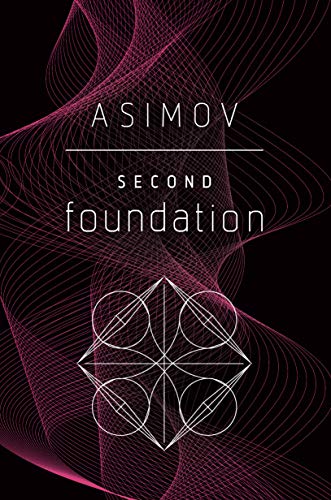
Cover of Second Foundation by Isaac Asimov

Second Foundation

Isaac Asimov, 1952
Cover of Foundation's Edge by Isaac Asimov

Foundation's Edge

Isaac Asimov, 1951
Cover of Prelude to Foundation by Isaac Asimov

Prelude to Foundation

Isaac Asimov, 1994
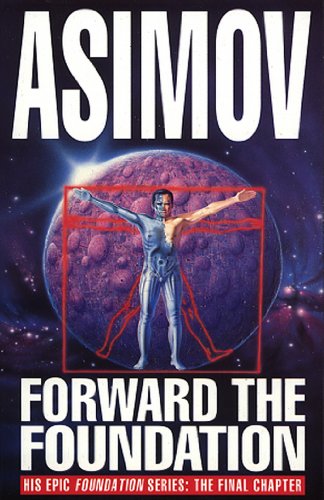
Cover of Forward the Foundation by Isaac Asimov

Forward the Foundation

Isaac Asimov, 1993
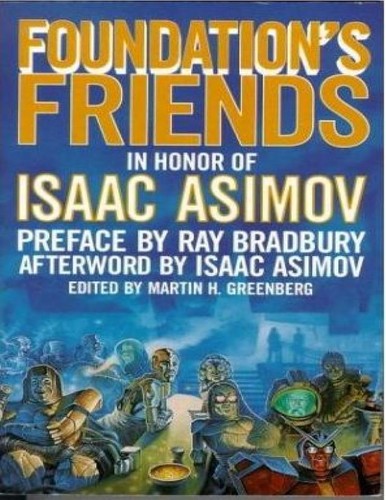
Cover of Foundation's Friends by Ben Bova, Pamela Sargent, Robert Silverberg, Edward Wellen, Harry Turtledove, Connie Willis, Mike Resnick, Barry N. Malzberg, Sheila Finch, Frederik Pohl, Poul Anderson, George Zebrowski, Robert Sheckley, Edward D. Hoch, Hal Clement, Harry Harrison, Orson Scott Card, Betsy Spiegelman Fein

Foundation's Friends

Ben Bova, 1989

§Also part of

Foundation (Chronological Order)Greater Foundation Universe

§Editions

Showing 3 of 94 editions
Cover of Foundation

Foundation

engAudiobook
Books on Tape19519780307749710
Amazon
Cover of Foundation

Foundation

engKindle
Spectra2004B000FC1PWA
Amazon
Cover of Foundation

Foundation

engMass Market Paperback
National Geographic Books20049780553293357
§Genres
american fiction1classics1dystopian1forecasting1hard science fiction1romance1science fiction1
§Moods
challenging1funny1hopeful1inspiring1lighthearted1mysterious1reflective1
§Tags
#adventurous1#loveable characters1#medium-paced1#not diverse characters1#plot driven1#sci-fi1#space opera1

Metadata

ISBN-139780307749710
ISBN-100307749711
ASINB003D8W5VS

Editions and availability

Find Foundation Isaac Asimov in PDF, EPUB, ebook, audiobook, print, or library editions.

View on Amazon
Bookshop.orgGoogle Play BooksBarnes & NobleOpen Library

Featured In Lists

Book cover from this collectionBook cover from this collectionBook cover from this collectionBook cover from this collection
Book cover from this collection

Sword And Laser

134 books
Book cover from this collectionBook cover from this collectionBook cover from this collectionBook cover from this collection
Book cover from this collection

List 1001 Books Boxall

1000 books
Book cover from this collectionBook cover from this collectionBook cover from this collectionBook cover from this collection
Book cover from this collection

Favorite Space Opera books

46 books
Book cover from this collectionBook cover from this collectionBook cover from this collectionBook cover from this collection
Book cover from this collection

Read or die top 5

5 books•@fgbytes