§Synopsis
01Charles "Fat Charlie" Nancy has spent his entire adult life attempting to be as unremarkable as possible. Living in London and working a modest job in accounts, he has carefully curated a life of quiet stability to distance himself from the memory of his father, a man whose penchant for public singing and flamboyant mischief was a constant source of mortification. Charlie’s world is one of spreadsheets, sensible shoes, and a looming marriage to his fiancée, Rosie. He believes that by leaning into the mundane, he can finally escape the shadow of a childhood defined by a father who never quite fit into the rules of the real world.
The fragile peace of Charlie’s existence shatters when news arrives that his father has passed away during a karaoke performance in Florida. Upon returning home for the funeral, Charlie discovers two things that defy his logical worldview: first, that his father was actually Anansi, the West African spider god of trickery and stories; and second, that he has a brother named Spider who inherited all of their father's divine charm and supernatural abilities. When Spider inevitably appears on Charlie's doorstep, the wall between the ordinary world and the realm of myth collapses, dragging Charlie into a chaotic struggle for his own identity and the remains of his sanity.
The Weaver’s Web: World Building
Gaiman constructs an urban fantasy landscape where the mythological is not hidden in another dimension, but rather woven into the fabric of everyday life. The setting transitions between the grey, bureaucratic streets of London and the vibrant, sun-drenched atmosphere of the Caribbean, suggesting that ancient magic persists wherever stories are told. The world operates on the "logic of stories," where the person who can spin the best narrative or outwit their opponent through cleverness holds more power than the one with the most physical strength. This isn't a world of epic battles, but one of social manipulation, legacies, and the inherent danger of a trickster’s whims.
Main Characters
- Fat Charlie Nancy: A repressed, anxious protagonist whose primary goal is to maintain a life of quiet dignity despite his chaotic heritage.
- Spider: Charlie’s long-lost brother; he is the embodiment of their father’s divine spark—charismatic, effortless, and dangerously impulsive.
- Rosie Noah: Charlie’s kind and organized fiancée, who finds herself caught in the crossfire of the brothers' escalating sibling rivalry.
- Grahame Coats: Charlie’s employer, a man of theatrical villainy and white-collar corruption whose mundane greed creates a different kind of threat.
- Mrs. Higgler: A family friend and practitioner of old-world traditions who serves as Charlie’s reluctant guide into the world of the gods.
Duality and the Shadow: Character Development
The narrative arc centers on the internal and external friction between Charlie and Spider. While they are brothers, they function as two halves of a single whole—Charlie represents the human struggle for order and the weight of embarrassment, while Spider represents the liberation of chaos and the lack of social consequence. Charlie’s development in the first half of the book is characterized by his desperate attempt to reclaim his life from Spider’s "help," which usually involves Spider usurping Charlie’s identity and improving his life in ways Charlie never asked for. This dynamic explores the tension between who we are and the versions of ourselves we project to the world.
Subverting the Mythic Quest: Major Tropes
The novel utilizes several classical tropes but strips them of their usual gravitas to focus on character and humor. While it employs the Secret Heritage trope, Charlie does not view his divine lineage as a gift or a call to adventure; he views it as a logistical nightmare. The Trickster archetype is explored not just through the deceased Anansi, but through the ripple effects his nature has on his children. Gaiman also plays with the Double/Doppelgänger motif, using Spider not as a traditional "evil twin," but as a catalyst for Charlie to confront his own passivity. The stakes are personal rather than global, focusing on whether a man can survive his own family history without losing his soul in the process.
§Our take
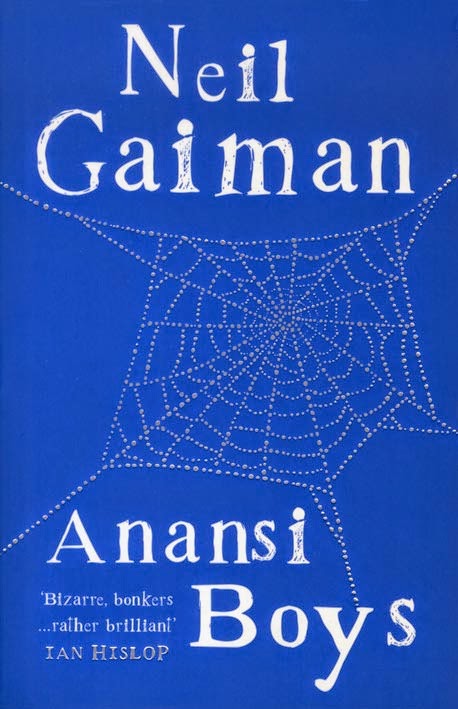
Anansi Boys is Gaiman in a lighter key: a family comedy about a man who has spent his life trying not to be noticed, and the brother who turns up to make that impossible. The pleasure is the collision between Charlie's careful London routine and the trickster energy of their late father, Anansi, with stories themselves treated as a kind of power worth fighting over.
It shares Mr. Nancy with American Gods but is not a sequel, and it reads very differently: warmer, funnier and lower in stakes for much of its length. Readers who prize Gaiman's darker work sometimes find it slight; others call it his most re-readable novel. Gaiman has pointed to Thorne Smith's comic fantasies of magic erupting into ordinary life, and that is the right expectation to bring.
§Themes
- Trickster mythology
- The Anansi-and-Tiger legend establishes that cleverness, not cruelty, is the mode of storytelling.
- Family inheritance
- Charlie and Spider embody opposite halves of one self: the cautious mortal and the free trickster.
- Tone
- Gaiman blends comic family dynamics with mythic undercurrents, echoing Thorne Smith's magic in everyday life.
- Relationship to American Gods
- Though sharing Mr. Nancy, this is a standalone domestic story, not a continuation of the larger epic.
§How it was received
Publishers Weekly hailed it as a brilliant mix of the everyday and the mythic, praising energetic prose and a relatable protagonist. Kirkus found it entertaining throughout but uneven and self-indulgent in spots, less dazzling than American Gods but more moving. PopMatters' reviewer enjoyed the humor and warmth but found the stakes low for much of the book and the late danger the weakest stretch. It debuted at number one on the New York Times bestseller list.
§Read it if
- You want a funny, folklore-driven family story that's more approachable than American Gods.
- You like mythic trickster tales rooted in West African folklore and urban fantasy settings.
- You don't mind a slow-ish opening if the humor and warmth carry you through.
§Skip it if
- You prefer darker, angst-driven Gaiman and find this book's understated humor flat.
- You want tight, fast pacing from page one; the first 100-150 pages feel reactive to some readers.
§Before you start
- Reading experience
- The opening drags as Charlie strives for the mundane, but the story finds its stride when Spider arrives.
- Content notes
- Dark and violent moments, including a murder; A character faces mortal danger from a predatory enemy.
§Common questions
- Is Anansi Boys a sequel to American Gods?
- No. It shares the trickster god Mr. Nancy but is a standalone domestic story that can be read first.
- Do I need to have read American Gods to enjoy Anansi Boys?
- No. The book is written so that prior reading isn't necessary.
- Is there an audiobook version?
- Yes. The best-known audiobook is narrated by Lenny Henry.
§If you liked this
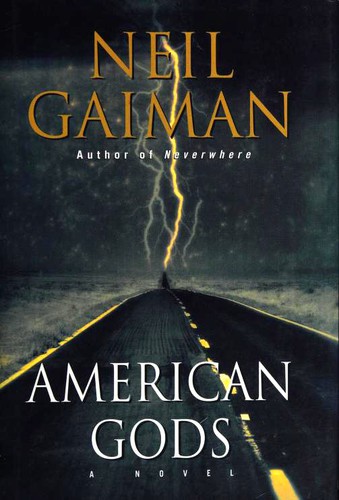
- American Gods by Neil Gaiman — Same author and shared trickster god, but darker and more epic; a natural comparison for readers seeking mythic scale.
- Good Omens by Terry Pratchett and Neil Gaiman — Gaiman and Pratchett's comic fantasy of the supernatural colliding with modern life, the closest match for the book's humour.
- Trickster Makes the World by Lewis Hyde — Lewis Hyde's nonfiction study of tricksters as disruptive but necessary figures, a natural companion to the book's mythology.
- Neverwhere by Neil Gaiman — Gaiman's darker London-set urban fantasy, which some readers prefer.
Track this book
Add to your library to track progress and write reviews