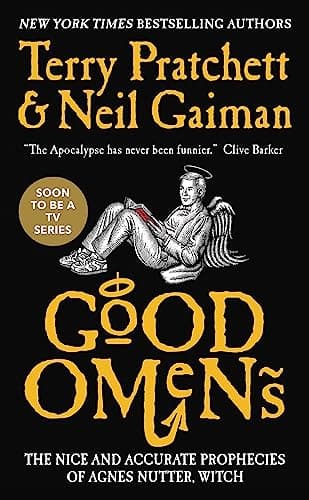
For six thousand years, the cosmic battle between Heaven and Hell has been a slow-burn bureaucracy of influence and counter-influence. Now, according to the cryptic and perfectly accurate prophecies of Agnes Nutter—a seventeenth-century witch who was significantly better at predicting the future than escaping a bonfire—the world is scheduled to end this Saturday. The armies of the Great Beyond are massing, the Four Horsepersons are mounting up, and the divine plan is moving toward its inevitable, fiery conclusion.
However, an unlikely alliance has formed between an angel who appreciates rare books and a demon who enjoys fast cars and Freddie Mercury. Having lived among humans since the Beginning, Aziraphale and Crowley have developed a problematic fondness for the mundane comforts of Earth. To prevent the Apocalypse, they must locate the Antichrist—a child who was misplaced during a hospital mix-up eleven years ago and is currently growing up in an unremarkable English village, blissfully unaware of his role in the end of everything.
The world functions on a logic where Fate is literal, yet prone to human and occult error. The atmosphere is one of impending doom filtered through the lens of British banality. Armageddon isn't just a spiritual event; it is presented as a logistical nightmare involving misfiled paperwork and cryptic quatrains that are perfectly accurate but nearly impossible to decipher until it is almost too late. The setting shifts between the celestial boardrooms of Heaven and Hell and the quiet, hedge-rowed lanes of Lower Tadfield, creating a contrast between cosmic stakes and small-town reality.
The central character dynamic revolves around the evolving partnership between Aziraphale and Crowley. Despite being ideological opposites, millennia of shared experience have made them more similar to one another than to their respective superiors. Their relationship is defined by a "gentleman’s agreement" to minimize each other's work, which eventually evolves into a frantic, joint effort to subvert the cosmic status quo. Parallel to this, the narrative explores the development of the young Antichrist, highlighting the tension between an inherent, terrifying destiny and the grounding, everyday influence of a normal childhood and a group of loyal friends.
The novel takes the "Omen" style horror trope and the epic "Chosen One" narrative and grounds them in the mundane. It subverts the classic Good vs. Evil dichotomy by suggesting that both sides are equally detached from the human experience they are fighting over. By utilizing the "Bumbling Bureaucracy" trope and applying it to cosmic entities, the story creates a world where the greatest threat isn't necessarily malice, but the rigid adherence to a grand plan that no longer accounts for human agency or the complexities of earthly life.
Add to your library to track progress and write reviews
Find Good Omens: The Nice and Accurate Prophecies of Agnes Nutter, Witch Neil Gaiman in PDF, EPUB, ebook, audiobook, print, or library editions.

44 books in catalog
Groundbreaking dark fantasy comic books and dark, whimsical prose fiction have reshaped speculative literature, most famously through the comic book series The Sandman. English author Neil Gaiman, born Neil Richard Gaiman on 10 November 1960, created this influential series before publishing widely acclaimed fantasy novels including Stardust, American Gods, Coraline, and The Graveyard Book.
Born Neil Richard Gaiman in Portchester, Hampshire, UK, he spent much of his childhood reading in public libraries, where he discovered the works of C.S. Lewis, J.R.R. Tolkien, Edgar Allan Poe, Ursula K. LeGuin, and G.K. Chesterton. He began his professional career in journalism before transitioning into comic book writing in the late 1980s, gaining prominence with Black Orchid in 1988 and launching The Sandman series for DC Comics' Vertigo imprint in 1989. Over the subsequent decades, he expanded into writing novels, short fiction, audio theatre, screenplays, and films, eventually taking up residence in the United States near Minneapolis.
His fiction has earned widespread critical recognition, receiving Hugo, Nebula, and Bram Stoker awards. In 2008, he published The Graveyard Book, becoming the first author to win both the American Newbery Medal and the British Carnegie Medal for the same work. In 2013, his novel The Ocean at the End of the Lane was voted Book of the Year in the British National Book Awards. His extensive bibliography and media adaptations continued to draw major critical attention through 2017 and beyond.
Gaiman's literary work is noted for combining imaginative fantasy with a darkly humorous tone, fusing modern settings with classical mythology, folklore, and fairy tale motifs. His stories frequently explore themes of memory, childhood innocence, ancient gods navigating contemporary society, and the fundamental power of stories. Across all age categories, his narratives balance gothic atmosphere with warm human empathy and sharp observational wit.