SSansFiction
The libraryCollectionsJournalStatsFor authors
Sign inJoin now
Sansfiction,

A digital library for books. Made by readers, for readers.

v 2.0 · 2026
The library
  • Discover
  • Collections
  • Book tracker
  • Journal
  • Stats
For authors
  • SF Links
  • Analytics
  • How it works
  • FAQ
Elsewhere
  • X / @sansfiction
  • Privacy
  • Terms
  • Contact
© 2026 SansFiction · Digital · GlobalA quiet room for your reading life.
The libraryCollectionsJournalStatsFor authors
Sign inJoin now →
Navigation
Library
Bookshelf
Journal
Discover
Collections
Tierlists
Stats
Profile
Author Page
Link Builder
Account
Sign in
S
G
BooksbusinessHow to Win Friends and Influence People
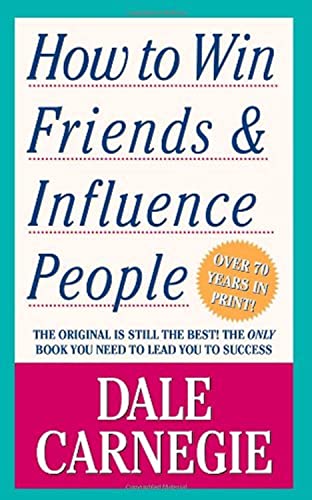
Cover of How to Win Friends and Influence People by Dale Carnegie

How to Win Friends and Influence People,

by Dale Carnegie

Ask AI
Rating3.9/ 5
Ratings850
Pages288
Reading Hours6h
Published1913
LanguageEnglish

§Synopsis

01

Simple and timeless tools for success and happiness For more than eighty years, millions of people from Warren Buffett to Oprah Winfrey have benefited from the remarkable wisdom of Dale Carnegie. Intended as a basic sales primer, How to Win Friends and Influence People quickly exploded into an overnight success—selling more than fifteen million copies worldwide and becoming one of the most influential books of all time. With an enduring grasp of human nature, Dale Carnegie’s How to Win Friends and Influence People shows you how to be more persuasive and effective, a better leader and manager, and happier at home and at work. This special new edition of the beloved classic includes an exclusive foreword by Terry O’Reilly.

§Our take

Carnegie’s advice still sounds obvious until the book asks you to practice it: don’t criticize, listen, and make people feel valued. That usefulness is why the ethical discomfort keeps surfacing. Carnegie insists the techniques must come from genuine interest in others; some critics hear a polished manual for getting people to do your bidding.

The book began as lecture notes from a New York YMCA speaking course, which explains its rule-per-chapter shape and fondness for repeated anecdotes. Biographer Steven Watts sees it as part of a Depression-era shift from character and thrift toward warmth, likability and social skill. Ian Frazier finds both sincere hope and a sharper view of human nature. That tension is the book. Read it as practical advice, but keep the question in view: does the method change the motive, or can a sincere person also use it well?

§Themes

Sincerity or salesmanship
Carnegie says the methods require real interest in other people, while many readers hear a tool for getting your way.
Warmth as social capital
The book argues that warmth and social skill can carry more weight in success than hard work and moral character alone.
Rules in miniature
Each numbered principle arrives with a simple rule and a string of anecdotes from business, history and Carnegie’s classes.
Personality over character
Watts places the book in a Depression-era shift toward the polished social self as a route to success.
Friendship with an agenda
The title promises friendship, though business, sales and influence dominate the practical advice.

§How it was received

The book became an immediate bestseller in 1936 and was being parodied almost as soon as it appeared. Carnegie denied he was teaching flattery, while Steven Watts later read the book as a marker of a Depression-era shift from character and thrift toward likability. A 1937 New York Times review praised its insight but called the advice simple, and readers still split over whether the techniques are sincere or manipulative.

§Read it if

  • You want straightforward rules for listening, avoiding criticism and earning goodwill
  • You can handle dated examples and enjoy tracing how a Depression-era self-help book became a modern classic
  • You’re willing to test Carnegie’s claims against your own motives and ask where sincerity ends

§Skip it if

  • You need a research-based account of persuasion. This is practical advice built from rules, anecdotes and classroom lore.
  • Repetition, dated examples or advice that sounds like people-pleasing will make you quit.

§Before you start

Reading experience
Short chapters, clear rules and a dip-in structure make the book easy to sample, though repeated anecdotes can make it feel longer than its core message.
Content notes
The original 1936 text includes period gender assumptions, especially examples built around male businessmen and housewives.

§Common questions

Which edition should I read?
The familiar 1981-based text uses gender-neutral wording and newer examples. The 2022 edition, supervised by Donna Dale Carnegie, includes material the publisher says was restored from the 1936 text.
Is the advice manipulative?
That is the enduring argument. Carnegie says the techniques work only when rooted in sincere interest in people; many readers think the flattery and strategic listening cross the line.
Is it still relevant?
The advice on listening, avoiding criticism and making people feel valued still lands with readers, though the anecdotes and period assumptions can feel dated.

§If you liked this

  • Influence: The Psychology of Persuasion by Robert B. Cialdini — The evidence-driven counterpart: Cialdini explains why people say yes while sharpening suspicion of tactics meant to make them do so.
  • The 7 Habits of Highly Effective People by Stephen R. Covey — A principle-based ethical foundation for readers who want more guidance on the motive behind Carnegie’s techniques.
  • Crucial Conversations by Kerry Patterson, Joseph Grenny, Ron McMillan and Al Switzler — The place to turn when the conversation is high-stakes and emotionally charged, rather than a matter of everyday rapport.
  • Never Split the Difference by Chris Voss — A more tactical and adversarial negotiation manual, with listening treated as a move at the table.
  • Getting to Yes by Roger Fisher and William Ury — A formal method for negotiating interests that shares Carnegie’s focus on understanding the other side.
Sources
  • Wikipedia
  • Wikipedia
  • The New York Review of Books (Ian Frazier)
  • City Journal (Laura Vanderkam)
  • Goodreads
  • Internet Archive catalog record

Track this book

Add to your library to track progress and write reviews

§Genres
business1business communication1general1interpersonal relations1philosophy1psychology1
§Moods
informative2inspiring2medium-paced2lighthearted1reflective1

§About the Author

Dale Carnegie
Dale Carnegie

2 books in catalog

American author and lecturer Dale Harbison Carnegie developed famous instructional courses in self-improvement, salesmanship, interpersonal skills, and public speaking, codifying techniques that helped millions of adults build self-confidence and converse effectively. His 1936 book How to Win Friends and Influence People provided concrete strategies for interpersonal communication that remain widely read across corporate and personal development settings.

Career & Background

Born into poverty on a farm in Maryville, Missouri, on November 24, 1888, Carnegie grew up in rural Missouri before his family moved to Belton. He attended the State Normal School in Warrensburg, Missouri—now the University of Central Missouri—where he commuted from home because he could not afford room and board. After working as a traveling salesman, he moved to New York City and began teaching public speaking classes at a local YMCA. Originally named Dale Carnagey, he changed the spelling of his surname to Carnegie around 1922 while expanding his educational programs into corporate training, salesmanship, and leadership instruction.

Carnegie believed that historical biographies offered valuable insights into human achievement, leading him to research and publish Lincoln the Unknown in 1932. As his public speaking courses gained popularity, he founded the Dale Carnegie Institute to export his training methodologies globally. Throughout his career until his death on November 1, 1955, in Forest Hills, Queens, New York, Carnegie authored multiple foundational books on self-improvement and stress management, including How to Stop Worrying and Start Living in 1948.

Writing Style & Themes

Carnegie's instructional style emphasized practical, real-world application over theoretical psychology, relying on clear anecdotes, direct advice, and repeatable behavioral principles. His writings focus on active listening, genuine appreciation of others, stress reduction, and structured verbal delivery, providing readers with systematic methods to overcome social anxiety and project authority.

A core theme across his bibliography is the belief that persuasion and leadership stem from empathetic understanding rather than aggressive confrontation. Carnegie urged speakers and professionals to view situations from the perspective of their listener, framing arguments around mutual benefit and personal encouragement to foster meaningful professional and personal relationships.

Major Works

  • How to Win Friends and Influence People — Published in 1936, this classic guide outlines fundamental principles for effective communication, relationship building, and leadership, helping readers improve their personal and professional interactions.
  • The Art of Public Speaking — Co-authored as an early comprehensive manual, this work offers foundational techniques for voice control, audience engagement, speech preparation, and overcoming stage fright.
  • How to Stop Worrying and Start Living — Released in 1948, this practical self-help volume delivers strategies for eliminating chronic anxiety, managing workplace stress, and cultivating a positive mindset.
  • Lincoln the Unknown — Published in 1932, this biography examines the life and character of Abraham Lincoln, highlighting the personal traits and communication habits that contributed to his historical leadership.

§Editions

Cover of How to Win Friends and Influence People

How to Win Friends and Influence People

eng288 pgs
Harper Collins19369781443438186
§Genres
business1business communication1general1interpersonal relations1philosophy1psychology1
§Moods
informative2inspiring2medium-paced2lighthearted1reflective1

Metadata

ISBN-139781443438186
ISBN-101443438189

Editions and availability

Find How to Win Friends and Influence People Dale Carnegie in PDF, EPUB, ebook, audiobook, print, or library editions.

Bookshop.orgGoogle Play BooksBarnes & NobleOpen Library

Featured In Lists

Book cover from this collectionBook cover from this collectionBook cover from this collectionBook cover from this collection
Book cover from this collection

Corporate Coggery

35 books
Book cover from this collectionBook cover from this collectionBook cover from this collectionBook cover from this collection
Book cover from this collection

Non-fiction books that expanded your understanding of the world

100 books