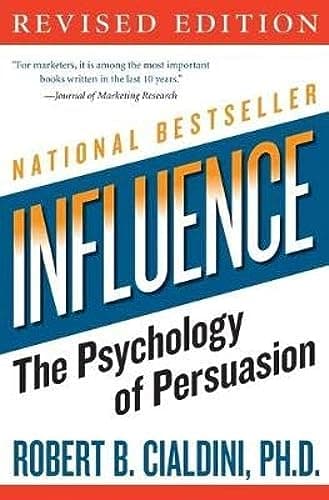
Influence, the classic book on persuasion, explains the psychology of why people say "yes"—and how to apply these understandings. Dr. Robert Cialdini is the seminal expert in the rapidly expanding field of influence and persuasion. His thirty-five years of rigorous, evidence-based research along with a three-year program of study on what moves people to change behavior has resulted in this highly acclaimed book.
You'll learn the six universal principles, how to use them to become a skilled persuader—and how to defend yourself against them. Perfect for people in all walks of life, the principles of Influence will move you toward profound personal change and act as a driving force for your success.
Add to your library to track progress and write reviews
Find Influence: The Psychology of Persuasion Robert B. Cialdini in PDF, EPUB, ebook, audiobook, print, or library editions.

2 books in catalog
The study of human decision-making and interpersonal compliance was reshaped by empirical social psychology research into why individuals accede to requests. Robert B. Cialdini conducted decades of field studies and laboratory experiments examining the psychological mechanisms of persuasion, negotiating strategies, and behavioral compliance.
His work translated complex behavioral science into actionable principles for business, leadership, and ethical communication. Central to his foundational literature is the seminal text Influence: The Psychology of Persuasion, which outlines the core psychological triggers that drive human action.
Born on April 27, 1945, Cialdini completed his undergraduate education at the University of Wisconsin in 1967 before earning his Ph.D. in social psychology from the University of North Carolina at Chapel Hill in 1970. Following postgraduate study at Columbia University, he joined Arizona State University, where he served as Regents' Professor Emeritus of Psychology and Marketing. Throughout his academic career, he held positions including visiting professor of marketing, business, and psychology at Stanford University, and was elected president of the Society of Personality and Social Psychology.
Beyond his university appointments, Cialdini founded INFLUENCE AT WORK, serving as its President and CEO to train organizations in applying ethical persuasion techniques. His scientific contributions led to election into the National Academy of Sciences and the American Academy of Arts and Sciences. He has received numerous academic honors, including the Distinguished Scientific Achievement Award from the Society for Consumer Psychology, the Donald T. Campbell Award, the Peitho Award, and the Lifetime Contributions Award from the Western Psychological Association.
Cialdini's writing bridges decision-making research and explanatory prose for general and professional audiences. Rather than relying on anecdotal advice, his books draw directly from controlled laboratory experiments, observational field studies, and covert investigations of real-world compliance practitioners. His work systematically categorizes the psychological factors behind decision-making, emphasizing ethical applications to ensure persuasion builds trust rather than manipulation.
A major theme in his research is the identification of core principles of persuasion, such as reciprocity, social proof, authority, consistency, liking, and scarcity. His later writings expand on timing and context, demonstrating how pre-framing moments before a message is delivered can significantly alter how that message is received.