SSansFiction
The libraryCollectionsJournalStatsFor authors
Sign inJoin now
Sansfiction,

A digital library for books. Made by readers, for readers.

v 2.0 · 2026
The library
  • Discover
  • Collections
  • Book tracker
  • Journal
  • Stats
For authors
  • SF Links
  • Analytics
  • How it works
  • FAQ
Elsewhere
  • X / @sansfiction
  • Privacy
  • Terms
  • Contact
© 2026 SansFiction · Digital · GlobalA quiet room for your reading life.
The libraryCollectionsJournalStatsFor authors
Sign inJoin now →
Navigation
Library
Bookshelf
Journal
Discover
Collections
Tierlists
Stats
Profile
Author Page
Link Builder
Account
Sign in
S
G
BooksclassicsGod Emperor of Dune
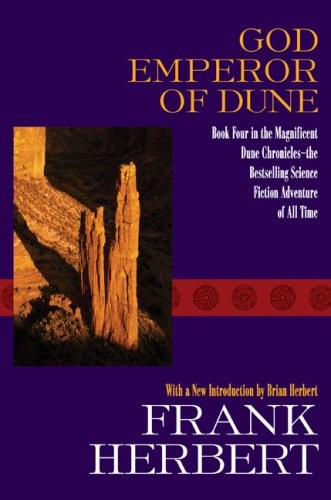
Cover of God Emperor of Dune by Frank Herbert
№ 4 · Dune

God Emperor of Dune,

by Frank Herbert

Ask AI
Rating3.8/ 5
Ratings469
Pages423
Reading Hours9h
Published1981
Language—

§Synopsis

01

Three and a half millennia have passed since the desert world of Arrakis was a wasteland of spice and sand. Under the absolute rule of Leto II, the son of Paul Atreides, the planet has been transformed into a lush, green paradise. Yet this ecological victory has come at a staggering cost: the giant sandworms are extinct, the spice melange is a hoarded relic of the past, and the once-fierce Fremen have become "Museum Fremen," performing hollow rituals for tourists. Leto II reigns from his throne not merely as a monarch, but as a physical god, enforcing a "forced peace" that has suppressed human conflict and interstellar travel for thirty-five centuries.

The narrative explores the tension between Leto’s "Golden Path"—a mysterious, millennia-spanning vision for human survival—and the growing desperation of those living under his absolute control. As the God Emperor manages the stagnation of the human race, a new rebellion rises, led by those who share his own bloodline. The story functions as a deep dive into the psychological burden of near-immortality and the moral paradox of a tyrant who claims his oppression is the only thing standing between humanity and total extinction.

World Building: The Green Arrakis and the Golden Path

In this era, the universe is unrecognizable from the days of the first Dune. The Empire is held together by Leto’s monopoly on the remaining spice stocks and his all-female army, the Fish Speakers, who provide a more stable and fanatical peace than the male-dominated militaries of old. Arrakis itself is now a planet of rivers and forests, with the exception of the Sareer, a small patch of desert maintained as a ceremonial reminder of the past. The "rules" of this world are dictated by Leto's prescience; because he can see almost every possible future, he has eliminated the unpredictability of human history, creating a state of tranquil but suffocating stability designed to "teach" humanity a lesson it will never forget.

Main Characters

  • Leto II Atreides: The God Emperor, a hybrid being who has traded his physical humanity for a lifespan of thousands of years to guide his "Golden Path."
  • Siona Atreides: A rebellious descendant of the Atreides line who seeks to overthrow Leto and restore human agency to the universe.
  • Duncan Idaho: A ghola (clone) of the original Atreides swordmaster, frequently re-grown by the Tleilaxu to serve as Leto’s Guard Commander and moral foil.
  • Moneo Atreides: Leto’s loyal Chief of Staff and Siona’s father, who acts as the primary bridge between the God Emperor’s cosmic perspective and human reality.
  • Hwi Noree: An ambassador from the Ixians specifically designed to possess qualities that challenge Leto’s emotional isolation.

Character Development and Dynamics

The central dynamic of the first half of the book is the friction between Leto and his latest Duncan Idaho ghola. Every Duncan Idaho brought back to life eventually struggles with the realization that the Atreides family they once died for has become a source of ultimate tyranny. Parallel to this is the relationship between Moneo and Siona; Moneo represents the "enlightened" subject who obeys out of a fear of the alternative, while Siona represents the primal, revolutionary spirit that Leto simultaneously fears and encourages. Leto’s own arc is one of profound loneliness; he is a creature who remembers being human but is increasingly alienated by his own physical and mental evolution.

Subverting Major Tropes

Frank Herbert uses this installment to deconstruct several common science fiction tropes:

  • The Philosopher King: While many stories frame a wise, immortal ruler as a "utopian" ideal, Herbert presents the God Emperor as a nightmare of stagnation, questioning if absolute peace is actually a form of biological death for a species.
  • The Chosen One: If the first Dune warned against following heroes, God Emperor examines the horrific long-term consequences of a "Chosen One" actually succeeding in his mission.
  • The Benevolent Tyrant: The book forces the reader to grapple with a moral dilemma: if a tyrant truly is the only person who can see a coming extinction event, does that justify three thousand years of oppression? Herbert subverts the trope by making the "villain" of the story its most essential protector.

Track this book

Add to your library to track progress and write reviews

§Genres
classics1classique1dune (imaginary place)1dystopian1fantasy1fiction1history1
§Content Warnings
§Moods
adventurous2challenging1dark1funny1hopeful1mysterious1reflective1
§Tags
#diverse characters1#loveable characters1#not diverse characters1#plot driven1#slow-paced1

§About the Author

Frank Herbert
Frank Herbert

22 books in catalog

The desert planet of Arrakis, with its giant sandworms, complex ecology, and political factions vying for control over the spice melange, remains one of the most thoroughly detailed world-building achievements in speculative fiction. American author Frank Herbert introduced this setting in his seminal 1965 novel Dune, creating an expansive universe that transformed epic science fiction by weaving together ecology, philosophy, religion, and political intrigue.

Career & Background

Born in Tacoma, Washington in 1920, Herbert spent his youth in the Pacific Northwest and worked on local newspapers as a teenager. He attended the University of Washington in Seattle and worked a wide variety of jobs throughout his early adult life, including time as a TV cameraman, radio commentator, oyster diver, jungle survival instructor, lay analyst, and creative writing teacher. He also worked as a reporter and later editor of a number of West Coast newspapers before becoming a full-time writer. Herbert began publishing science fiction in 1952 with his short story 'Looking for Something?' in Startling Stories. His research into the Oregon Dunes during the 1950s served as a primary catalyst for his ecological themes. He achieved widespread fame more than ten years later following the serial publication in Analog of 'Dune World' and 'The Prophet of Dune', which were amalgamated into the novel Dune in 1965.

Writing Style & Themes

Herbert's fiction is distinguished by its intricate world-building, ecological awareness, and deep examination of human potential and institutional vulnerability. Rather than relying solely on technological advancement, his narrative focus often centers on human adaptability, psychological conditioning, religious mythmaking, and the perilous consequences of messianic leadership. He frequently explored how harsh environments shape cultures, social structures, and survival strategies, a focus prominently displayed in novels such as Destination: Void and The Jesus Incident alongside his desert sagas.

Major Works

  • Dune — Published in 1965 after being serialized in Analog as 'Dune World' and 'The Prophet of Dune', this novel explores Paul Atreides's journey on the desert planet Arrakis amid feudal galactic politics and ecological struggle.
  • Dune Messiah — The second novel in the series continues the narrative of Paul Atreides, examining the tragic consequences of imperial power and religious fervor.
  • Children of Dune — The third installment focuses on Paul's twin children, Leto II and Ghanima, as they navigate the shifting ecological and political landscape of Arrakis.
  • Destination: Void — A standalone science fiction novel exploring artificial intelligence, human consciousness, and survival aboard a crewed starship.
  • The Jesus Incident — Co-authored with Bill Ransom, this novel expands upon the themes of artificial intelligence, worship, and ecological adaptation on an alien ocean world.

§Featured Series

Dune

Cover of Dune by Frank Herbert

Dune

Frank Herbert, 1965
Cover of Dune Messiah by Frank Herbert

Dune Messiah

Frank Herbert, 1965
Cover of Children of Dune by Frank Herbert

Children of Dune

Frank Herbert, 1975
Cover of God Emperor of Dune by Frank Herbert

God Emperor of Dune

Frank Herbert, 1981
Cover of Heretics of Dune by Frank Herbert

Heretics of Dune

Frank Herbert, 1984
Cover of Chapterhouse: Dune by Frank Herbert

Chapterhouse: Dune

Frank Herbert, 1985
Cover of Hunters of Dune by Brian Herbert, Kevin J. Anderson

Hunters of Dune

Brian Herbert, 2006
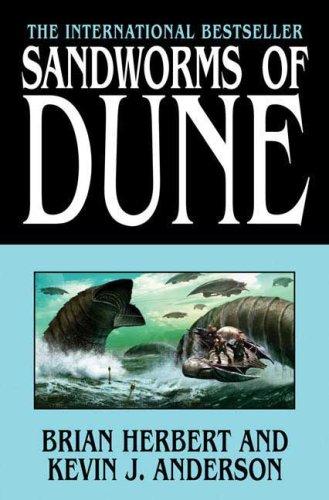
Cover of Sandworms of Dune by Brian Herbert, Kevin J. Anderson

Sandworms of Dune

Brian Herbert, 2007

§Also part of

Dune Universe (Publication Order)Dune Universe (Chronological)

§Other Editions

Showing 2 of 57 editions
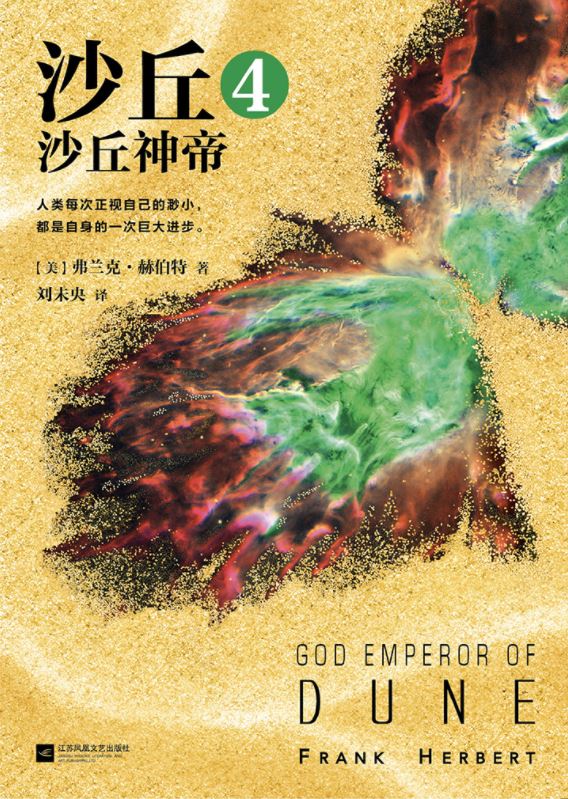
Cover of 沙丘4: 沙丘神帝

沙丘4: 沙丘神帝

PaperbackFirst Edition
江苏凤凰文艺出版社20189787559415738
Cover of God Emperor of Dune

God Emperor of Dune

Paperback
Turtleback Books19819780606348157
§Genres
classics1classique1dune (imaginary place)1dystopian1fantasy1fiction1history1
§Content Warnings
§Moods
adventurous2challenging1dark1funny1hopeful1mysterious1reflective1
§Tags
#diverse characters1#loveable characters1#not diverse characters1#plot driven1#slow-paced1

Metadata

ISBN-139780441016310
ISBN-100441016316
ASINB001F0WXX6

Editions and availability

Find God Emperor of Dune Frank Herbert in PDF, EPUB, ebook, audiobook, print, or library editions.

View on Amazon
Bookshop.orgGoogle Play BooksBarnes & NobleOpen Library