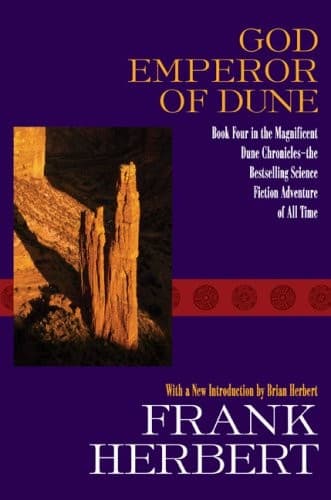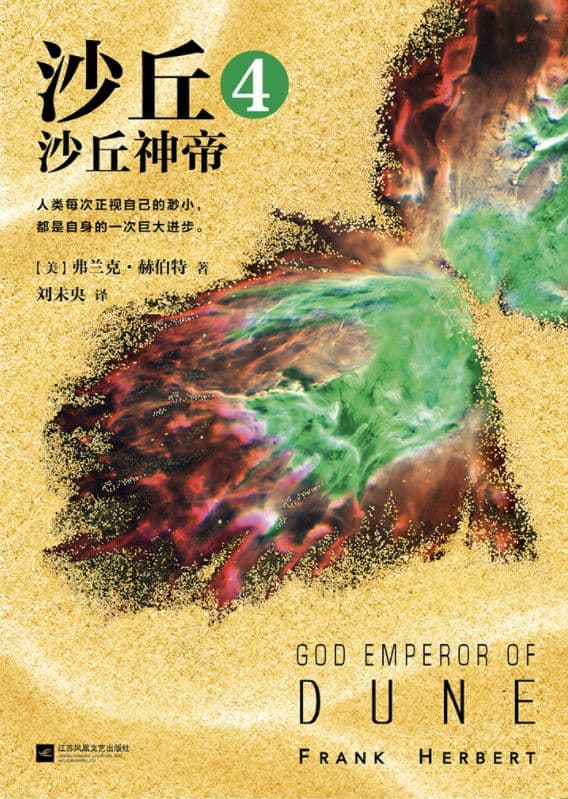
Three and a half millennia have passed since the desert world of Arrakis was a wasteland of spice and sand. Under the absolute rule of Leto II, the son of Paul Atreides, the planet has been transformed into a lush, green paradise. Yet this ecological victory has come at a staggering cost: the giant sandworms are extinct, the spice melange is a hoarded relic of the past, and the once-fierce Fremen have become "Museum Fremen," performing hollow rituals for tourists. Leto II reigns from his throne not merely as a monarch, but as a physical god, enforcing a "forced peace" that has suppressed human conflict and interstellar travel for thirty-five centuries.
The narrative explores the tension between Leto’s "Golden Path"—a mysterious, millennia-spanning vision for human survival—and the growing desperation of those living under his absolute control. As the God Emperor manages the stagnation of the human race, a new rebellion rises, led by those who share his own bloodline. The story functions as a deep dive into the psychological burden of near-immortality and the moral paradox of a tyrant who claims his oppression is the only thing standing between humanity and total extinction.
In this era, the universe is unrecognizable from the days of the first Dune. The Empire is held together by Leto’s monopoly on the remaining spice stocks and his all-female army, the Fish Speakers, who provide a more stable and fanatical peace than the male-dominated militaries of old. Arrakis itself is now a planet of rivers and forests, with the exception of the Sareer, a small patch of desert maintained as a ceremonial reminder of the past. The "rules" of this world are dictated by Leto's prescience; because he can see almost every possible future, he has eliminated the unpredictability of human history, creating a state of tranquil but suffocating stability designed to "teach" humanity a lesson it will never forget.
The central dynamic of the first half of the book is the friction between Leto and his latest Duncan Idaho ghola. Every Duncan Idaho brought back to life eventually struggles with the realization that the Atreides family they once died for has become a source of ultimate tyranny. Parallel to this is the relationship between Moneo and Siona; Moneo represents the "enlightened" subject who obeys out of a fear of the alternative, while Siona represents the primal, revolutionary spirit that Leto simultaneously fears and encourages. Leto’s own arc is one of profound loneliness; he is a creature who remembers being human but is increasingly alienated by his own physical and mental evolution.
Frank Herbert uses this installment to deconstruct several common science fiction tropes:
Add to your library to track progress and write reviews
Find 沙丘4: 沙丘神帝 Frank Herbert in PDF, EPUB, ebook, audiobook, print, or library editions.

22 books in catalog
The desert planet of Arrakis, with its giant sandworms, complex ecology, and political factions vying for control over the spice melange, remains one of the most thoroughly detailed world-building achievements in speculative fiction. American author Frank Herbert introduced this setting in his seminal 1965 novel Dune, creating an expansive universe that transformed epic science fiction by weaving together ecology, philosophy, religion, and political intrigue.
Born in Tacoma, Washington in 1920, Herbert spent his youth in the Pacific Northwest and worked on local newspapers as a teenager. He attended the University of Washington in Seattle and worked a wide variety of jobs throughout his early adult life, including time as a TV cameraman, radio commentator, oyster diver, jungle survival instructor, lay analyst, and creative writing teacher. He also worked as a reporter and later editor of a number of West Coast newspapers before becoming a full-time writer. Herbert began publishing science fiction in 1952 with his short story 'Looking for Something?' in Startling Stories. His research into the Oregon Dunes during the 1950s served as a primary catalyst for his ecological themes. He achieved widespread fame more than ten years later following the serial publication in Analog of 'Dune World' and 'The Prophet of Dune', which were amalgamated into the novel Dune in 1965.
Herbert's fiction is distinguished by its intricate world-building, ecological awareness, and deep examination of human potential and institutional vulnerability. Rather than relying solely on technological advancement, his narrative focus often centers on human adaptability, psychological conditioning, religious mythmaking, and the perilous consequences of messianic leadership. He frequently explored how harsh environments shape cultures, social structures, and survival strategies, a focus prominently displayed in novels such as Destination: Void and The Jesus Incident alongside his desert sagas.
Dune