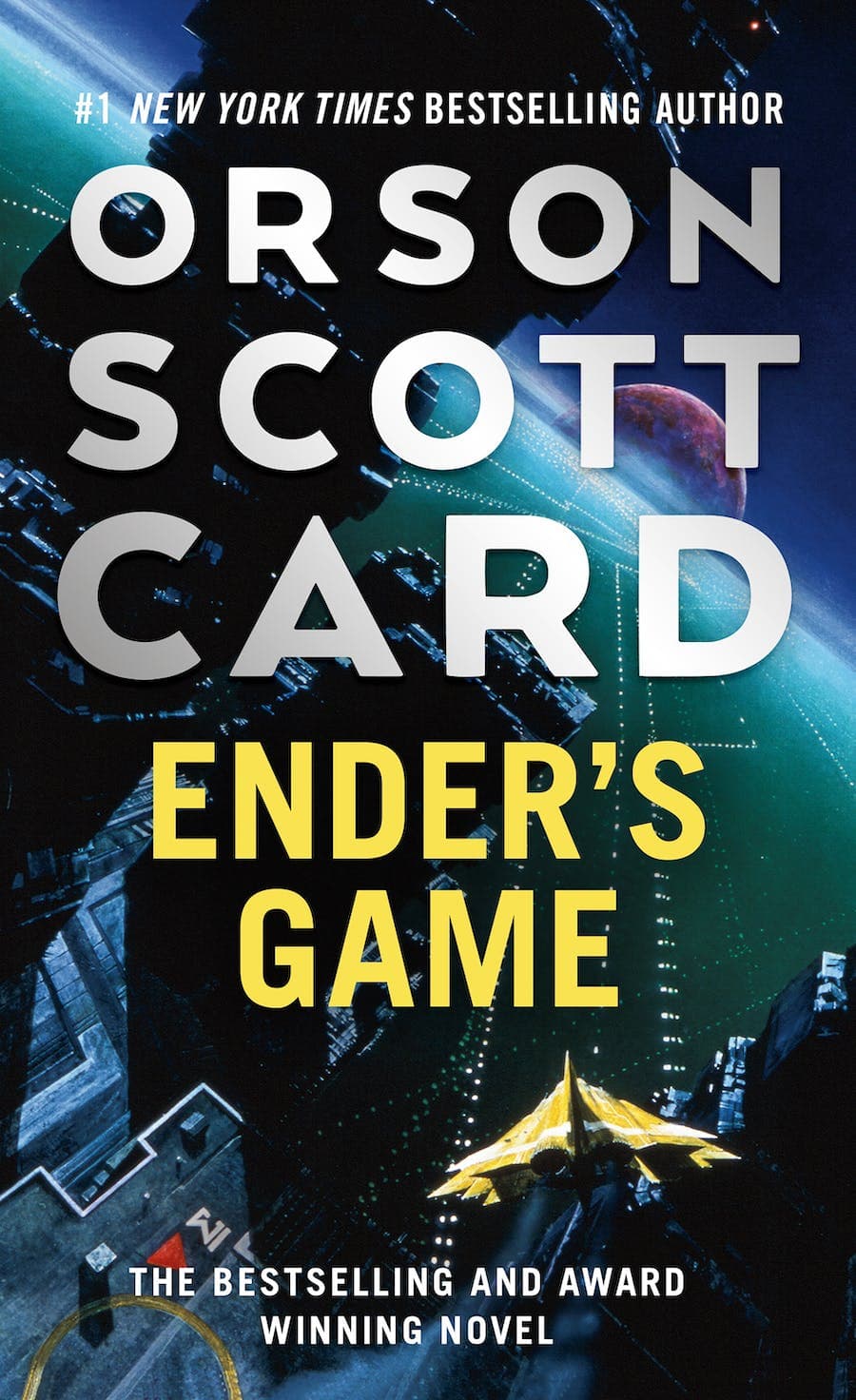
In order to develop a secure defense against a hostile alien race's next attack, government agencies breed child geniuses and train them as soldiers. A brilliant young boy, Andrew "Ender" Wiggin lives with his kind but distant parents, his sadistic brother Peter, and the person he loves more than anyone else, his sister Valentine. Peter and Valentine were candidates for the soldier-training program but didn't make the cut—young Ender is the Wiggin drafted to the orbiting Battle School for rigorous military training.
Ender's skills make him a leader in school and respected in the Battle Room, where children play at mock battles in zero gravity. Yet growing up in an artificial community of young soldiers Ender suffers greatly from isolation, rivalry from his peers, pressure from the adult teachers, and an unsettling fear of the alien invaders. His psychological battles include loneliness, fear that he is becoming like the cruel brother he remembers, and fanning the flames of devotion to his beloved sister.
Is Ender the general Earth needs? But Ender is not the only result of the genetic experiments. The war with the Buggers has been raging for a hundred years, and the quest for the perfect general has been underway for almost as long. Ender's two older siblings are every bit as unusual as he is, but in very different ways. Between the three of them lie the abilities to remake a world. If, that is, the world survives.
Adults isolate a child on purpose, and critics have argued for decades about what he does under the pressure. Some say the book lets its hero commit violence while staying morally clean; scholar Mike Ryder reads it instead as a condemnation of the manipulation itself. Kirkus, reviewing it at the time, found the training passages skillful but the adult subplots distracting and the hero thin. Readers tend to describe a protagonist with real psychological depth and plain, fast prose, though some find the zero-gravity battle sequences hard to picture. The moral stance stays contested, and that argument is a big part of why the book is still read.
It won the 1985 Nebula for Best Novel and the 1986 Hugo, over a field that included Greg Bear's Blood Music, David Brin's The Postman and Niven and Pournelle's Footfall. Kirkus praised the training scenes but called the hero one-dimensional; readers, by contrast, credit Ender with psychological depth. Critics have kept arguing over the book's moral stance.
Add to your library to track progress and write reviews
Find Ender's Game Orson Scott Card in PDF, EPUB, ebook, audiobook, print, or library editions.

10 books in catalog
Science fiction literature was profoundly shaped by the publication of landmark speculative novels exploring military strategy, moral responsibility, and empathy across alien species. American novelist, critic, public speaker, essayist, and columnist Orson Scott Card achieved widespread acclaim with his novel Ender's Game in 1985 and its sequel Speaker for the Dead in 1986. Both books won the Hugo and Nebula Awards, making Card the only author to win both of science fiction's top U.S. prizes in consecutive years.
Beyond the main narrative sequence of The Ender Quintet and parallel storylines like Ender's Shadow, Card's extensive bibliography spans science fiction, frontier fantasy, biblical historical fiction, contemporary fantasy, and stage plays.
Born in Richland, Washington, in 1951, Card grew up in Utah and California. While attending Brigham Young University, his original plays were performed on stage, starting a long period of theatrical work that included dozens of plays and musical comedies produced throughout the 1960s and 1970s. After serving as an LDS Church missionary in Brazil, where he directed a community theater for two summers, Card made his fiction debut in 1977 with the short story 'Gert Fram' and the original novelet version of 'Ender's Game' in Analog magazine. He published 27 short stories between 1978 and 1979, won the John W. Campbell Award for Best New Writer in 1978, and completed a master's degree in English at the University of Utah in 1981.
Card's writing often focuses on exceptionally intelligent, emotionally burdened young protagonists who must navigate high-stakes ethical dilemmas, military training, and societal demands. His speculative fiction emphasizes empathy, redemption, and the complexities of human and alien interaction, combining tactical precision with character-driven reflection. In addition to space opera, he developed American frontier fantasy in The Tales of Alvin Maker series—including Seventh Son, Red Prophet, and Prentice Alvin—as well as contemporary fantasy novels such as Lost Boys and Enchantment.
Ender's Saga