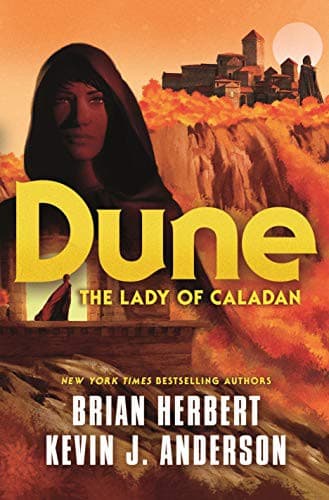
№ 1 · Dune Universe (Publication Order)
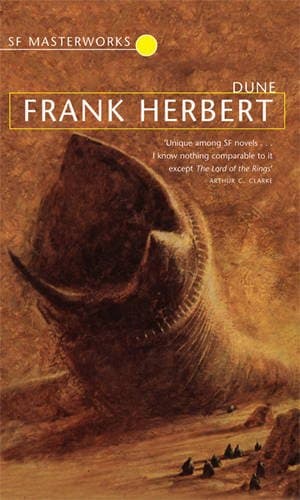
In a future where humanity has discarded "thinking machines" in favor of the hyper-developed potential of the human mind, power resides in the control of a single resource: the spice melange. Found only on the unforgiving desert world of Arrakis, this substance grants the longevity and prescience necessary to navigate the stars, making it the essential cornerstone of a precarious galactic feudalism. When Duke Leto Atreides is ordered by the Padishah Emperor to seize Arrakis from his sworn enemies, the Harkonnens, he enters a political landscape where the environment is as lethal as the assassins lurking in the shadows.
At the center of this transition is Paul Atreides, the Duke's heir, who is burdened by a genetic legacy he doesn't fully understand and a planet that views him through the lens of ancient, manufactured prophecies. As House Atreides attempts to establish a foothold on the "dune" planet, they must contend with extreme water scarcity, the presence of gargantuan sandworms, and the indigenous Fremen—a people who have adapted to the desert’s brutality through a combination of religious fervor and technological ingenuity. The narrative is a clinical study of how human systems—be they religious, ecological, or political—converge to trap individuals in the currents of history.
The world of Arrakis is governed by the absolute rule of scarcity. Water is not merely a resource; it is the primary currency and the focal point of all cultural ritual. Herbert constructs a "closed loop" ecology where the survival of the human population depends on stillsuits—specialized garments that reclaim the body's moisture—and a deep understanding of the desert’s apex predator, the Shai-Hulud. The atmosphere is defined by a tension between the clinical, technological requirements of spice mining and the mystical, harsh reality of the deep desert, where the rules of the Imperial Court no longer apply.
Paul Atreides begins the story not as a warrior, but as a student of history, linguistics, and the "Prana-Bindu" mental disciplines. His development is defined by a shift from theoretical knowledge to the visceral reality of survival. His relationship with his mother, Jessica, is particularly complex; she is both his parent and his instructor in the "Weirding Way," a deadly style of combat. As Paul moves from the lush, water-rich world of Caladan to the arid wastes of Arrakis, his arc focuses on the terrifying realization that his path may be predestined by centuries of genetic manipulation and religious engineering.
While Dune utilizes the "Chosen One" trope, it does so to analyze the dangers of such figures. The book explores the "Missionaria Protectiva"—a system where a religious order plants myths on primitive worlds to be used by their members later for protection. This introduces a cynical layer to the protagonist's "destiny," suggesting that heroism is often a manufactured tool of social control. Furthermore, the novel subverts the traditional "civilization vs. nature" trope; here, the "civilized" Great Houses are decaying and stagnant, while the "primitive" Fremen possess the most sophisticated ecological understanding and social cohesion.
Is Paul Atreides a hero or a trap? Scholars writing for JSTOR Daily read Dune as a caution against messiahs: a leader's mistakes multiply through followers who stop questioning him. Plenty of readers root for Paul all the way, and the novel supports both readings, because his competence and his followers' surrender of judgment are the same machinery. The desert came first. Herbert started with a 1957 assignment about moving sand threatening Florence, Oregon; the article never ran, but the research became Arrakis, where water scarcity shapes every custom. The Encyclopedia of Science Fiction credits the book mainly with bringing ecology into mainstream SF, and readers say the interlocking politics, religion and environment are its strongest element.
Add to your library to track progress and write reviews
Early response was mixed and Chilton's first printing sold poorly. The genre's institutions moved faster: it won the first Best Novel Nebula in March 1966 and shared a Hugo with Zelazny's This Immortal. Sales only took off after a cheap 1967 paperback, after which Kirkus reports it became the best-selling science fiction novel in the world.
Find Dune: The Gateway Collection Frank Herbert in PDF, EPUB, ebook, audiobook, print, or library editions.

22 books in catalog
The desert planet of Arrakis, with its giant sandworms, complex ecology, and political factions vying for control over the spice melange, remains one of the most thoroughly detailed world-building achievements in speculative fiction. American author Frank Herbert introduced this setting in his seminal 1965 novel Dune, creating an expansive universe that transformed epic science fiction by weaving together ecology, philosophy, religion, and political intrigue.
Born in Tacoma, Washington in 1920, Herbert spent his youth in the Pacific Northwest and worked on local newspapers as a teenager. He attended the University of Washington in Seattle and worked a wide variety of jobs throughout his early adult life, including time as a TV cameraman, radio commentator, oyster diver, jungle survival instructor, lay analyst, and creative writing teacher. He also worked as a reporter and later editor of a number of West Coast newspapers before becoming a full-time writer. Herbert began publishing science fiction in 1952 with his short story 'Looking for Something?' in Startling Stories. His research into the Oregon Dunes during the 1950s served as a primary catalyst for his ecological themes. He achieved widespread fame more than ten years later following the serial publication in Analog of 'Dune World' and 'The Prophet of Dune', which were amalgamated into the novel Dune in 1965.
Herbert's fiction is distinguished by its intricate world-building, ecological awareness, and deep examination of human potential and institutional vulnerability. Rather than relying solely on technological advancement, his narrative focus often centers on human adaptability, psychological conditioning, religious mythmaking, and the perilous consequences of messianic leadership. He frequently explored how harsh environments shape cultures, social structures, and survival strategies, a focus prominently displayed in novels such as Destination: Void and The Jesus Incident alongside his desert sagas.
Dune Universe (Publication Order)