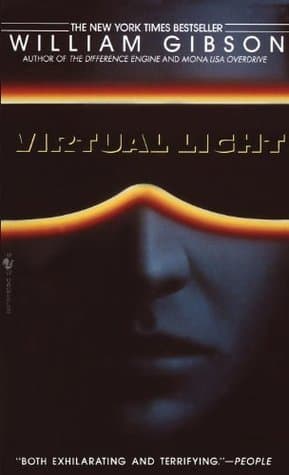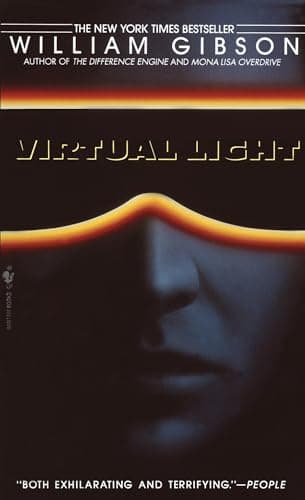
California, the not so distant future. Berry, ex-cop/private security, looking to just make ends meet. Chevette, a young bicycle messanger. A murder, a secret missing, and a murderer closing in on Chevette. Berry is the only thing standing between him and Chevette. Can he keep her alive long enough to figure why, and how to stop it? Multi-national corporations, reality tv, a world gone just a bit more ragged than our own. Murder, mystery, real people just trying to get by or survive another day in an harsh world. Big dome private communities and shanty towns built on the discarded remains of a bridge we all know. High tech meets duct tape and superglue. With his unique style and flair, Gibson spins a tale set in a world just to the left of ours.
California, the not so distant future. Berry, ex-cop/private security, looking to just make ends meet. Chevette, a young bicycle messanger. A murder, a secret missing, and a murderer closing in on Chevette. Berry is the only thing standing between him and Chevette. Can he keep her alive long enough to figure why, and how to stop it? Multi-national corporations, reality tv, a world gone just a bit more ragged than our own. Murder, mystery, real people just trying to get by or survive another day in an harsh world. Big dome private communities and shanty towns built on the discarded remains of a bridge we all know. High tech meets duct tape and superglue. With his unique style and flair, Gibson spins a tale set in a world just to the left of ours.
Add to your library to track progress and write reviews
Add to your library to track progress and write reviews
Find Virtual Light William Gibson in PDF, EPUB, ebook, audiobook, print, or library editions.
Find Virtual Light William Gibson in PDF, EPUB, ebook, audiobook, print, or library editions.

10 books in catalog
Speculative fiction that mapped the digital realm before the world wide web existed reshaped science fiction by fusing noir storytelling with visions of global computer networks. William Gibson introduced readers to the concept of virtual environments and coined the term "cyberspace" in his 1982 short story Burning Chrome, establishing a blueprint for the cyberpunk subgenre. His groundbreaking debut novel Neuromancer defined the iconography of the Information Age and demonstrated how emerging technology and human culture would collide.
Born in Conway, South Carolina, in 1948, Gibson relocated to Canada in 1968 and later settled in Vancouver, British Columbia, where he earned a Bachelor of Arts in English from the University of British Columbia in 1977. Beginning his writing career in the late 1970s, he emerged from obscurity in 1984 with the publication of his debut novel Neuromancer. The book achieved an unprecedented sweep of speculative fiction's top honors, winning the Hugo, Nebula, and Philip K. Dick Awards and establishing his reputation as a major voice in modern fiction.
Beyond his early fiction, Gibson expanded his output across multiple media, writing screenplays such as the film adaptation of his short story Johnny Mnemonic and co-authoring the Victorian alternate-history novel The Difference Engine with Bruce Sterling. The Guardian dubbed him the most important novelist in the last two decades of the 20th century for providing a vast renovation to science fiction and offering a fresh framing to understand the dawning Internet era.
Gibson's narrative approach is defined by a distinct combination of lowlife and high tech, blending gritty noir aesthetics with near-future explorations of cybernetics, artificial intelligence, and vast computer networks. His stories frequently center on disenfranchised protagonists—such as hackers, mercenaries, and data thieves—navigating urban squalor and corporate espionage within landscapes dominated by global digital infrastructure.
Rather than focusing on distant technological utopias, his fiction investigates the immediate social and psychological effects of network technology on human identity. His work caromed across digital media and literature, framing modern reality through dense, sensory prose that anticipated virtual reality and the pervasive connectivity of the late twentieth century.
10 books in catalog
Speculative fiction that mapped the digital realm before the world wide web existed reshaped science fiction by fusing noir storytelling with visions of global computer networks. William Gibson introduced readers to the concept of virtual environments and coined the term "cyberspace" in his 1982 short story Burning Chrome, establishing a blueprint for the cyberpunk subgenre. His groundbreaking debut novel Neuromancer defined the iconography of the Information Age and demonstrated how emerging technology and human culture would collide.
Born in Conway, South Carolina, in 1948, Gibson relocated to Canada in 1968 and later settled in Vancouver, British Columbia, where he earned a Bachelor of Arts in English from the University of British Columbia in 1977. Beginning his writing career in the late 1970s, he emerged from obscurity in 1984 with the publication of his debut novel Neuromancer. The book achieved an unprecedented sweep of speculative fiction's top honors, winning the Hugo, Nebula, and Philip K. Dick Awards and establishing his reputation as a major voice in modern fiction.
Beyond his early fiction, Gibson expanded his output across multiple media, writing screenplays such as the film adaptation of his short story Johnny Mnemonic and co-authoring the Victorian alternate-history novel The Difference Engine with Bruce Sterling. The Guardian dubbed him the most important novelist in the last two decades of the 20th century for providing a vast renovation to science fiction and offering a fresh framing to understand the dawning Internet era.
Gibson's narrative approach is defined by a distinct combination of lowlife and high tech, blending gritty noir aesthetics with near-future explorations of cybernetics, artificial intelligence, and vast computer networks. His stories frequently center on disenfranchised protagonists—such as hackers, mercenaries, and data thieves—navigating urban squalor and corporate espionage within landscapes dominated by global digital infrastructure.
Rather than focusing on distant technological utopias, his fiction investigates the immediate social and psychological effects of network technology on human identity. His work caromed across digital media and literature, framing modern reality through dense, sensory prose that anticipated virtual reality and the pervasive connectivity of the late twentieth century.
Bridge
Bridge