§Synopsis
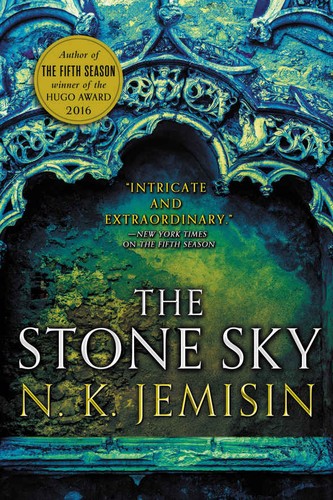
01The Moon will soon return. Whether this heralds the destruction of humankind or something worse will depend on two women.
Essun has inherited the power of Alabaster Tenring. With it, she hopes to find her daughter Nassun and forge a world in which every orogene child can grow up safe.
For Nassun, her mother's mastery of the Obelisk Gate comes too late. She has seen the evil of the world, and accepted what her mother will not admit: that sometimes what is corrupt cannot be cleansed, only destroyed.
§Our take
The Stone Sky is a finale that treats survival as the easy question. Once the Moon returns, the harder issue is whether a society built on slavery and the cruel training of orogene children deserves to continue. Amal El-Mohtar's NPR review saw that as the trilogy's sharpest provocation, and it is the book's real achievement: catastrophe is the normal condition of this world, so preserving it cannot simply mean preserving the status quo.
The family at its centre makes the argument intimate rather than abstract. Kirkus praised its clear-eyed portrait of a dysfunctional family and prejudice as a destructive force. Readers have praised the emotional payoff, while others complain about pacing, dense terminology and a predictable finale. Jemisin's shifting narrators keep the book restless, with Essun's second-person present conveying her disconnection from herself. This is a demanding conclusion, but its refusal of painless moral answers is the point.
§Themes
- A system, not a villain
- Orogene fear, enslavement and killing make the oppressive social order itself the antagonist.
- Mother versus daughter
- Essun and Nassun's conflict turns the trilogy's politics into a moral argument about protection, corruption and survival.
- Who deserves a future
- The returning Moon forces the question of whether a world built on oppression and genocide should be saved.
- The fractured narrator
- Essun's second-person present conveys her disconnection from herself, while first- and third-person narrators widen the perspective.
- History in the way
- The extended obelisk flashback can deepen the world or interrupt the present-day momentum, depending on the reader.
§How it was received
It won the 2018 Hugo Best Novel and the Nebula Best Novel for 2017. Its Hugo made Jemisin the first author to win Best Novel three years in a row, one for each volume of the trilogy. Kirkus called it painful and powerful, praising its clear-eyed treatment of family dysfunction and prejudice; Amal El-Mohtar's NPR review called the trilogy magnificent, while readers differ over the ending, with some praising its completeness and others its predictability.
§Read it if
- You want a trilogy finale where prejudice and oppressive systems supply the central conflict rather than one villain
- You value emotionally heavy, non-escapist fiction that refuses easy moral answers
- You can handle shifting narrators, including second person, and dense invented terminology
§Skip it if
- You want a brisk, uncomplicated plot. The travel-heavy present and long obelisk flashback can drag.
- You dislike dense terminology, geology passages or a finale you can see coming
§Before you start
- Reading experience
- The travel-heavy present can slow the pace, while the long obelisk flashback, dense terminology, geology passages and shifting narrators make this a demanding finale.
- Reading order
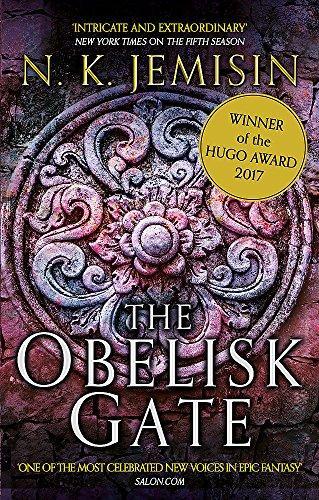
- Book 3 of 3 in the Broken Earth trilogy, after The Fifth Season (2015) and The Obelisk Gate (2016). It is the conclusion, not a starting point.
- Content notes
- Slavery involving orogenes; Cruel training and abuse of orogene children; Amputation and body horror; Murder and torture.
§Common questions
- Do I need to read the first two Broken Earth books?
- Yes. This is the third and final novel, and it continues the story and multi-perspective structure established in the first two books.
- Is the ending satisfying?
- Some readers call it a complete, emotionally affecting wrap-up; others find it predictable.
- Is there a film or TV adaptation?
- Sony's TriStar acquired the screen rights in 2021, with Jemisin adapting, but production status is unknown.
§If you liked this
- The Fifth Season by N. K. Jemisin — The trilogy's necessary starting point, establishing the world and conflicts this finale resolves.
- Parable of the Sower by Octavia E. Butler — A strong companion for readers drawn to survival after social collapse and building something new.
- The Dispossessed by Ursula K. Le Guin — A useful counterpoint for anyone who likes speculative fiction testing a social order from within.
Track this book
Add to your library to track progress and write reviews