SSansFiction
The libraryCollectionsJournalStatsFor authors
Sign inJoin now
Sansfiction,

A digital library for books. Made by readers, for readers.

v 2.0 · 2026
The library
  • Discover
  • Collections
  • Book tracker
  • Journal
  • Stats
For authors
  • SF Links
  • Analytics
  • How it works
  • FAQ
Elsewhere
  • X / @sansfiction
  • Privacy
  • Terms
  • Contact
© 2026 SansFiction · Digital · GlobalA quiet room for your reading life.
The libraryCollectionsJournalStatsFor authors
Sign inJoin now →
Navigation
Library
Bookshelf
Journal
Discover
Collections
Tierlists
Stats
Profile
Author Page
Link Builder
Account
Sign in
S
G
BooksadulteThe Stone Sky
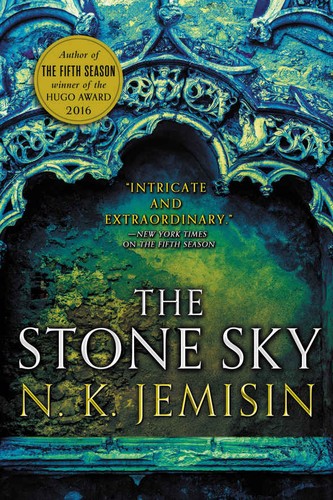
Cover of The Stone Sky by N. K. Jemisin
№ 3 · The Broken Earth

The Stone Sky,

by N. K. Jemisin

Ask AI
Rating4.3/ 5
Ratings772
Pages464
Reading Hours10h
Published2017
LanguageEnglish

§Synopsis

01

The Moon will soon return. Whether this heralds the destruction of humankind or something worse will depend on two women.

Essun has inherited the power of Alabaster Tenring. With it, she hopes to find her daughter Nassun and forge a world in which every orogene child can grow up safe.

For Nassun, her mother's mastery of the Obelisk Gate comes too late. She has seen the evil of the world, and accepted what her mother will not admit: that sometimes what is corrupt cannot be cleansed, only destroyed.

§Our take

The Stone Sky is a finale that treats survival as the easy question. Once the Moon returns, the harder issue is whether a society built on slavery and the cruel training of orogene children deserves to continue. Amal El-Mohtar's NPR review saw that as the trilogy's sharpest provocation, and it is the book's real achievement: catastrophe is the normal condition of this world, so preserving it cannot simply mean preserving the status quo.

The family at its centre makes the argument intimate rather than abstract. Kirkus praised its clear-eyed portrait of a dysfunctional family and prejudice as a destructive force. Readers have praised the emotional payoff, while others complain about pacing, dense terminology and a predictable finale. Jemisin's shifting narrators keep the book restless, with Essun's second-person present conveying her disconnection from herself. This is a demanding conclusion, but its refusal of painless moral answers is the point.

§Themes

A system, not a villain
Orogene fear, enslavement and killing make the oppressive social order itself the antagonist.
Mother versus daughter
Essun and Nassun's conflict turns the trilogy's politics into a moral argument about protection, corruption and survival.
Who deserves a future
The returning Moon forces the question of whether a world built on oppression and genocide should be saved.
The fractured narrator
Essun's second-person present conveys her disconnection from herself, while first- and third-person narrators widen the perspective.
History in the way
The extended obelisk flashback can deepen the world or interrupt the present-day momentum, depending on the reader.

§How it was received

It won the 2018 Hugo Best Novel and the Nebula Best Novel for 2017. Its Hugo made Jemisin the first author to win Best Novel three years in a row, one for each volume of the trilogy. Kirkus called it painful and powerful, praising its clear-eyed treatment of family dysfunction and prejudice; Amal El-Mohtar's NPR review called the trilogy magnificent, while readers differ over the ending, with some praising its completeness and others its predictability.

§Read it if

  • You want a trilogy finale where prejudice and oppressive systems supply the central conflict rather than one villain
  • You value emotionally heavy, non-escapist fiction that refuses easy moral answers
  • You can handle shifting narrators, including second person, and dense invented terminology

§Skip it if

  • You want a brisk, uncomplicated plot. The travel-heavy present and long obelisk flashback can drag.
  • You dislike dense terminology, geology passages or a finale you can see coming

§Before you start

Reading experience
The travel-heavy present can slow the pace, while the long obelisk flashback, dense terminology, geology passages and shifting narrators make this a demanding finale.
Reading order
Book 3 of 3 in the Broken Earth trilogy, after The Fifth Season (2015) and The Obelisk Gate (2016). It is the conclusion, not a starting point.
Content notes
Slavery involving orogenes; Cruel training and abuse of orogene children; Amputation and body horror; Murder and torture.

§Common questions

Do I need to read the first two Broken Earth books?
Yes. This is the third and final novel, and it continues the story and multi-perspective structure established in the first two books.
Is the ending satisfying?
Some readers call it a complete, emotionally affecting wrap-up; others find it predictable.
Is there a film or TV adaptation?
Sony's TriStar acquired the screen rights in 2021, with Jemisin adapting, but production status is unknown.

§If you liked this

  • The Fifth Season by N. K. Jemisin — The trilogy's necessary starting point, establishing the world and conflicts this finale resolves.
  • Parable of the Sower by Octavia E. Butler — A strong companion for readers drawn to survival after social collapse and building something new.
  • The Dispossessed by Ursula K. Le Guin — A useful counterpoint for anyone who likes speculative fiction testing a social order from within.
Sources
  • Wikipedia
  • The Hugo Awards (official site)
  • Worlds Without End
  • SFWA Nebula Awards (official site)
  • Kirkus Reviews
  • Amal El-Mohtar (repost of NPR review)
  • Elitist Book Reviews
  • Nylon
  • Wikipedia (Jemisin / Broken Earth section)

Track this book

Add to your library to track progress and write reviews

§Genres
adulte1adventure1dystopian1fantasy1general1lgbtq1philosophy1
§Moods
dark2emotional2adventurous1challenging1hopeful1inspiring1mysterious1
§Tags
#audiobook1#diverse characters1#loveable characters1#n/a driven1#strong character development1

§About the Author

N. K. Jemisin
N. K. Jemisin

8 books in catalog

Speculative fiction featuring complex power structures, environmental disaster, and marginalized protagonists forms the foundation of the acclaimed Broken Earth series, beginning with The Fifth Season. The author N. K. Jemisin achieved widespread acclaim when all three installments of the trilogy won the Hugo Award for Best Novel in three consecutive years. A 2020 MacArthur Fellow, she has published novels and short fiction that have sold over two million copies worldwide, with most of her major works being optioned for television or film adaptation.

Career & Background

Nora Keita Jemisin was born in Iowa City, Iowa, in 1972. Before embarking on a full-time writing career, she spent twenty years working in higher education as an applied counseling psychologist. Her professional writing career began in the early 2000s, publishing short fiction in pro, semipro, podcast, and print anthology markets such as Clarkesworld, Tor.com, WIRED, and Popular Science. In 2010, she published her debut novel, The Hundred Thousand Kingdoms, which launched The Inheritance Trilogy and earned widespread critical attention. She retired from counseling in 2016 to dedicate herself entirely to writing, teaching creative writing, and public speaking. Outside of writing, she enjoys tabletop and video games, biking, fanfiction, and urban gardening, residing in Brooklyn, New York, with her son and two cats.

Writing Style & Themes

Jemisin's speculative works explore systemic oppression, cultural conflict, structural racism, family dynamics, loneliness, and belonging. Her world-building regularly challenges traditional epic fantasy tropes centered on medieval European settings and male-dominated casts. Rather than relying on familiar genre conventions, her stories construct intricate magic systems and societies populated by characters resisting institutional exploitation. Alongside these heavy sociopolitical themes, Jemisin frequently incorporates creative playfulness in her narrative concepts, guided by the recurring motif of exploring absurd or unconventional speculative scenarios.

Major Works

  • The Fifth Season — Published in 2015, this novel opens the Broken Earth series and made Jemisin the first Black author to win the Hugo Award for Best Novel in 2016. It introduces a world subjected to periodic catastrophic climate events known as Fifth Seasons.
  • The Obelisk Gate — The 2016 second installment in the Broken Earth series continues the story of atmospheric destruction and magical oppression, winning the Hugo Award for Best Novel in 2017.
  • The Stone Sky — Concluding the Broken Earth trilogy, this 2017 novel secured Jemisin's historical third consecutive Hugo Award for Best Novel in 2018.
  • The Hundred Thousand Kingdoms — Released in 2010, this debut novel begins The Inheritance Trilogy and features a high-fantasy setting where mortal intrigue intersects with captive gods.
  • The Inheritance Trilogy — This fantasy series explores divine politics, captive deities, and human ambition across three interconnected novels.
  • The City We Became — This urban fantasy novel explores human connection and living municipal avatars fighting ancient cosmic threats across New York City.
  • Mass Effect: Initiation — Co-authored in the sci-fi universe of Mass Effect, this tie-in novel expands the backstory of key game characters and lore.

§Featured Series

The Broken Earth

Cover of The Fifth Season by N. K. Jemisin

The Fifth Season

N. K. Jemisin, 2015
Cover of The Obelisk Gate by N. K. Jemisin

The Obelisk Gate

N. K. Jemisin, 2016
Cover of The Stone Sky by N. K. Jemisin

The Stone Sky

N. K. Jemisin, 2017
§Genres
adulte1adventure1dystopian1fantasy1general1lgbtq1philosophy1
§Moods
dark2emotional2adventurous1challenging1hopeful1inspiring1mysterious1
§Tags
#audiobook1#diverse characters1#loveable characters1#n/a driven1#strong character development1

Metadata

ISBN-139780316229241
ISBN-100316229245

Editions and availability

Find The Stone Sky N. K. Jemisin in PDF, EPUB, ebook, audiobook, print, or library editions.

Bookshop.orgGoogle Play BooksBarnes & NobleOpen Library

Featured In Lists

Book cover from this collectionBook cover from this collectionBook cover from this collectionBook cover from this collection
Book cover from this collection

The 100 Best Fantasy Books of All Time by Time Magazine

93 books
Book cover from this collectionBook cover from this collectionBook cover from this collectionBook cover from this collection
Book cover from this collection

Hugo Award for Best Novel (1953 to 2025)

75 books
Book cover from this collectionBook cover from this collectionBook cover from this collectionBook cover from this collection
Book cover from this collection

Hugo Award Best Novel Nominees and Winners ( 1953 - present )

348 books
Book cover from this collectionBook cover from this collectionBook cover from this collectionBook cover from this collection
Book cover from this collection

Nebula Award for Best Novel (1965 to 2024)

61 books