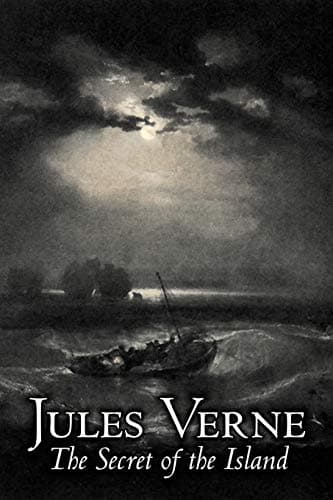
LOST ON AN ISLAND Five Union soldiers in the American Civil War escape in a balloon. Driven by tremendous find themselves castaways on a strange island somewhere deep in the Pacific Ocean. They call it Lincoln Island -- and through luck, pluck and the help from a mysterious hidden benefactor, they not only survive but become more like colonists than castaways. With their leader -- an engineer named Cyrus Smith -- they recreate the wonders of nineteenth century civilization with what they find on the island. Along the way, the "colonists" rescue Ayrton (a character from another Jules Verne novel, "In Search of the Castaways") who has been living like a wild creature. In this book, the third part of "The Mysterious Island," they must deal with Ayrton's former shipmates -- bloodthirsty pirates . . . and discover "The Secret of the Island." Namely, their mysterious benefactor, who turns out to be none other than one of the most famous characters of science fiction -- with his wonderful invention!
Add to your library to track progress and write reviews
Find The Secret of the Island Jules Verne in PDF, EPUB, ebook, audiobook, print, or library editions.

12 books in catalog
Navigable aircraft, practical submarines, and space flight were still far off in the nineteenth century when adventurous fiction began depicting extraordinary journeys into uncharted realms, most famously in Around the World in Eighty Days. French author Jules Verne wrote extensively about underwater, aerial, and astronomical travel decades before these technologies existed, earning him recognition alongside H. G. Wells as a pioneer often called the Father of science fiction.
Born on February 8, 1828, in Nantes, France, Jules Verne was sent to Paris by his father to complete law studies, expecting him to take over a solicitor's practice. Instead, Verne turned toward literature and the theatre, serving as secretary of the Théâtre Lyrique from 1852 to 1854 while publishing plays, short stories, and scientific essays. His trajectory changed in 1861 when he met publisher Pierre-Jules Hetzel, who published Five Weeks in a Balloon and went on to publish the popular series known as the Voyages Extraordinaires.
Verne's popularity grew rapidly through his collaboration with Hetzel, earning him recognition from the Académie française, which awarded him the Montyon Award in 1872. Over his career, he authored scores of adventure and speculative novels that reached global audiences. He spent his later years in Amiens, France, where he died on March 24, 1905, leaving behind a vast body of literature that continued to be translated and published long after his death.
Verne's narrative approach combined rigorous geographic and technological detail with imaginative speculation. His stories frequently centered on intrepid expeditions, technological innovations, and the exploration of uncharted environments. By grounding extraordinary voyages—such as deep-sea dives or lunar projectiles—in the scientific knowledge of his era, Verne created plausible depictions of future technologies long before they became practical realities.
Capitaine Nemo