SSansFiction
The libraryCollectionsJournalStatsFor authors
Sign inJoin now
Sansfiction,

A digital library for books. Made by readers, for readers.

v 2.0 · 2026
The library
  • Discover
  • Collections
  • Book tracker
  • Journal
  • Stats
For authors
  • SF Links
  • Analytics
  • How it works
  • FAQ
Elsewhere
  • X / @sansfiction
  • Privacy
  • Terms
  • Contact
© 2026 SansFiction · Digital · GlobalA quiet room for your reading life.
The libraryCollectionsJournalStatsFor authors
Sign inJoin now →
Navigation
Library
Bookshelf
Journal
Discover
Collections
Tierlists
Stats
Profile
Author Page
Link Builder
Account
Sign in
S
G
BooksfictionThe Second Great Dune Trilogy
Cover of The Second Great Dune Trilogy by Frank Herbert
№ 4 · Dune

The Second Great Dune Trilogy,

by Frank Herbert

Ask AI
Rating5.0/ 5
Ratings1
Pages912
Reading Hours19h
Published2022
Language—

§Synopsis

01

Thousands of years have passed since the desert winds first carried the name of Atreides across the dunes of Arrakis. The Second Great Dune Trilogy—comprising God Emperor of Dune, Heretics of Dune, and Chapterhouse: Dune—shifts the focus from the rise of a messiah to the grueling, multi-millennial consequences of absolute prescience. The central tension rests on the "Golden Path," a rigorous and controversial necessity intended to ensure the long-term survival of the human species by forcing it through a period of extreme social and political stagnation.

While the first trilogy explored the mechanics of becoming a legend, these final movements in Frank Herbert’s saga examine the burden of immortality and the evolution of power structures over eons. The empire is no longer a collection of warring houses but a singular, monolithic entity held in a state of forced peace. As the environment of Arrakis transforms from a wasteland to a verdant paradise, the internal landscape of humanity undergoes a parallel shift, grappling with the loss of the old ways and the terrifying uncertainty of a future no longer dictated by a single vision.

The Mechanics of a Millennial Empire

The world-building in this sequence operates on a staggering scale of time and biology. The once-hostile desert of Arrakis has been terraformed into a garden, yet this ecological victory comes with a heavy price: the near-extinction of the giant sandworms and the scarcity of the spice melange. The socio-political landscape is defined by the "Peace of Leto," a period of enforced stability where space travel is restricted and the various factions—the Bene Gesserit, the Ixians, and the Tleilaxu—must navigate a world where their traditional avenues of influence have been systematically dismantled. Later in the sequence, the scope expands into "The Scattering," a chaotic outward migration of humanity into the deep reaches of space, leading to the return of lost civilizations with radically different social structures and predatory intent.

Main Characters

  • Leto II Atreides: The absolute sovereign of the known universe, he has ruled for millennia with a singular focus on the "Golden Path" to prevent human extinction.
  • Duncan Idaho: A recurring commander and soldier whose various incarnations serve as a foil to the ruling power, representing the tactical and moral sensibilities of a bygone era.
  • Siona Atreides: A rebellious descendant of the royal line who seeks to overthrow the current regime, representing the inherent human drive for agency and unpredictability.
  • Mother Superior Taraza: A high-ranking leader of the Bene Gesserit who must navigate the Order through a period of profound existential threat and shifting alliances.
  • Darwi Odrade: A formidable Sister of the Bene Gesserit whose unique insights into the nature of power and ancestry become vital as the Order faces its greatest crisis.

The Evolution of the Internal Narrative

Character development in these volumes is less about traditional coming-of-age arcs and more about the struggle against ancestral memory and the weight of history. The protagonists are often products of intense biological and psychological conditioning, forced to reconcile their individual desires with the survival of their respective institutions. The central dynamic often involves the tension between the "Old Empire" sensibilities—loyalty, honor, and tradition—and the "New Empire" requirements of cold, calculated evolutionary necessity. This creates a recurring motif of characters attempting to find a sense of self within a universe where their every move may have been anticipated or engineered centuries prior.

Deconstructing the Messiah and the Bureaucracy

Frank Herbert utilizes these novels to subvert the "Chosen One" and "Galactic Empire" tropes prevalent in mid-century science fiction. Instead of a hero bringing balance to the universe, the narrative presents the "Hero" as a stagnant force that humanity must eventually outgrow. The trilogy serves as a deconstruction of institutional power; the Bene Gesserit, once shadow-manipulators, find themselves vulnerable to the very forces of chaos they attempted to control. By shifting the genre from an epic adventure to a philosophical and sociopolitical treatise, Herbert explores the "mortal trap" of security and the essential, often violent, necessity of human unpredictability and freedom.

Track this book

Add to your library to track progress and write reviews

§Genres
fiction1

§About the Author

Frank Herbert
Frank Herbert

22 books in catalog

The desert planet of Arrakis, with its giant sandworms, complex ecology, and political factions vying for control over the spice melange, remains one of the most thoroughly detailed world-building achievements in speculative fiction. American author Frank Herbert introduced this setting in his seminal 1965 novel Dune, creating an expansive universe that transformed epic science fiction by weaving together ecology, philosophy, religion, and political intrigue.

Career & Background

Born in Tacoma, Washington in 1920, Herbert spent his youth in the Pacific Northwest and worked on local newspapers as a teenager. He attended the University of Washington in Seattle and worked a wide variety of jobs throughout his early adult life, including time as a TV cameraman, radio commentator, oyster diver, jungle survival instructor, lay analyst, and creative writing teacher. He also worked as a reporter and later editor of a number of West Coast newspapers before becoming a full-time writer. Herbert began publishing science fiction in 1952 with his short story 'Looking for Something?' in Startling Stories. His research into the Oregon Dunes during the 1950s served as a primary catalyst for his ecological themes. He achieved widespread fame more than ten years later following the serial publication in Analog of 'Dune World' and 'The Prophet of Dune', which were amalgamated into the novel Dune in 1965.

Writing Style & Themes

Herbert's fiction is distinguished by its intricate world-building, ecological awareness, and deep examination of human potential and institutional vulnerability. Rather than relying solely on technological advancement, his narrative focus often centers on human adaptability, psychological conditioning, religious mythmaking, and the perilous consequences of messianic leadership. He frequently explored how harsh environments shape cultures, social structures, and survival strategies, a focus prominently displayed in novels such as Destination: Void and The Jesus Incident alongside his desert sagas.

Major Works

  • Dune — Published in 1965 after being serialized in Analog as 'Dune World' and 'The Prophet of Dune', this novel explores Paul Atreides's journey on the desert planet Arrakis amid feudal galactic politics and ecological struggle.
  • Dune Messiah — The second novel in the series continues the narrative of Paul Atreides, examining the tragic consequences of imperial power and religious fervor.
  • Children of Dune — The third installment focuses on Paul's twin children, Leto II and Ghanima, as they navigate the shifting ecological and political landscape of Arrakis.
  • Destination: Void — A standalone science fiction novel exploring artificial intelligence, human consciousness, and survival aboard a crewed starship.
  • The Jesus Incident — Co-authored with Bill Ransom, this novel expands upon the themes of artificial intelligence, worship, and ecological adaptation on an alien ocean world.

§Featured Series

Dune

Cover of Dune by Frank Herbert

Dune

Frank Herbert, 1965
Cover of Dune Messiah by Frank Herbert

Dune Messiah

Frank Herbert, 1965
Cover of Children of Dune by Frank Herbert

Children of Dune

Frank Herbert, 1975
Cover of God Emperor of Dune by Frank Herbert

God Emperor of Dune

Frank Herbert, 1981
Cover of Heretics of Dune by Frank Herbert

Heretics of Dune

Frank Herbert, 1984
Cover of Chapterhouse: Dune by Frank Herbert

Chapterhouse: Dune

Frank Herbert, 1985
Cover of Hunters of Dune by Brian Herbert, Kevin J. Anderson

Hunters of Dune

Brian Herbert, 2006
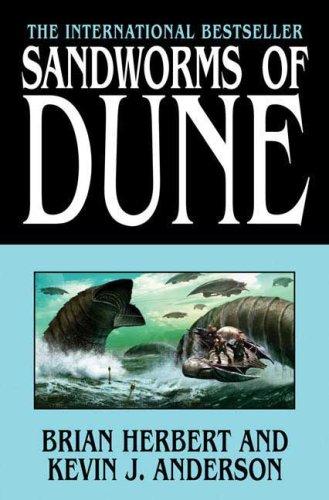
Cover of Sandworms of Dune by Brian Herbert, Kevin J. Anderson

Sandworms of Dune

Brian Herbert, 2007

§Also part of

Dune Universe (Chronological)Dune Universe (Publication Order)

§Other Editions

Showing 2 of 3 editions
Cover of The Second Great Dune Trilogy

The Second Great Dune Trilogy

20229781399605151
Cover of The Second Great Dune Trilogy

The Second Great Dune Trilogy

20189781473226586
§Genres
fiction1

Metadata

ISBN-139781399605175
ISBN-101399605178

Editions and availability

Find The Second Great Dune Trilogy Frank Herbert in PDF, EPUB, ebook, audiobook, print, or library editions.

Bookshop.orgGoogle Play BooksBarnes & NobleOpen Library