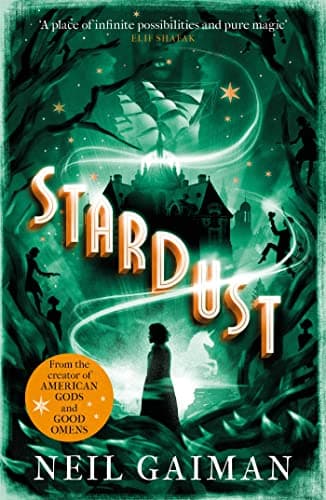
In the sleepy English village of Wall, life is defined by a massive stone barrier that separates the mundane world from the impossible landscapes of Faerie. For Tristran Thorn, the wall is merely a backdrop to his unrequited love for the beautiful Victoria Forester. To win her heart, he makes a reckless vow to retrieve a fallen star that they witnessed streaking across the night sky and landing deep within the forbidden territory beyond the gap.
Tristran’s journey begins as a quest for a token of affection, but it quickly evolves into a collision of disparate ambitions. As he crosses the threshold, he discovers that a fallen star is far more than a celestial stone, and he is not the only inhabitant of Faerie pursuing it. While Tristran seeks the star to secure his future in Wall, ancient powers and ambitious heirs hunt the same prize for far more dangerous ends, setting the stage for a race across a land where logic is secondary to the laws of myth.
The setting of the novel is split between the Victorian-era village of Wall and the sprawling, unpredictable realm of Faerie. In Wall, the world is governed by tradition, social hierarchy, and the physical boundary that keeps magic at bay, except for one day every nine years during the midsummer market. Once across the wall, however, the atmosphere shifts into a pre-industrial wilderness where geography is fluid and magic is transactional. The world-building emphasizes the "Otherness" of Faerie, where the flora and fauna operate under a distinct set of moral and physical rules that often catch the unprepared Tristran off-guard.
Tristran begins his journey with a simplistic, almost transactional view of love and heroism. His initial character arc focuses on the realization that his "prize"—the star—is a sentient being with her own agency and resentment. The early relationship between Tristran and the Star is one of mutual frustration; he views her as his ticket to a happy life with Victoria, while she views him as a kidnapper. This dynamic forces Tristran to move beyond his sheltered upbringing and begin the slow process of developing empathy and resilience in a world that does not care about his romantic aspirations.
While the story utilizes the structure of a traditional nineteenth-century fairytale, it consistently subverts expectations through a lens of realism and dark humor. The trope of the "Heroic Quest" is complicated by the fact that Tristran is largely incompetent at the start, relying on luck and magical artifacts rather than skill. Furthermore, the "Damsel in Distress" trope is challenged by the Star’s personality; she is not a passive object but a wounded, angry individual who actively resists Tristran’s attempts to "rescue" her. The narrative also introduces a secondary plot involving the Lords of Stormhold, which functions more like a political thriller, adding a layer of lethal, Machiavellian stakes to what would otherwise be a whimsical journey.
Add to your library to track progress and write reviews
Find Stardust Neil Gaiman in PDF, EPUB, ebook, audiobook, print, or library editions.
Neil Gaiman and Charles Vess' Stardust

44 books in catalog
Groundbreaking dark fantasy comic books and dark, whimsical prose fiction have reshaped speculative literature, most famously through the comic book series The Sandman. English author Neil Gaiman, born Neil Richard Gaiman on 10 November 1960, created this influential series before publishing widely acclaimed fantasy novels including Stardust, American Gods, Coraline, and The Graveyard Book.
Born Neil Richard Gaiman in Portchester, Hampshire, UK, he spent much of his childhood reading in public libraries, where he discovered the works of C.S. Lewis, J.R.R. Tolkien, Edgar Allan Poe, Ursula K. LeGuin, and G.K. Chesterton. He began his professional career in journalism before transitioning into comic book writing in the late 1980s, gaining prominence with Black Orchid in 1988 and launching The Sandman series for DC Comics' Vertigo imprint in 1989. Over the subsequent decades, he expanded into writing novels, short fiction, audio theatre, screenplays, and films, eventually taking up residence in the United States near Minneapolis.
His fiction has earned widespread critical recognition, receiving Hugo, Nebula, and Bram Stoker awards. In 2008, he published The Graveyard Book, becoming the first author to win both the American Newbery Medal and the British Carnegie Medal for the same work. In 2013, his novel The Ocean at the End of the Lane was voted Book of the Year in the British National Book Awards. His extensive bibliography and media adaptations continued to draw major critical attention through 2017 and beyond.
Gaiman's literary work is noted for combining imaginative fantasy with a darkly humorous tone, fusing modern settings with classical mythology, folklore, and fairy tale motifs. His stories frequently explore themes of memory, childhood innocence, ancient gods navigating contemporary society, and the fundamental power of stories. Across all age categories, his narratives balance gothic atmosphere with warm human empathy and sharp observational wit.