§Synopsis
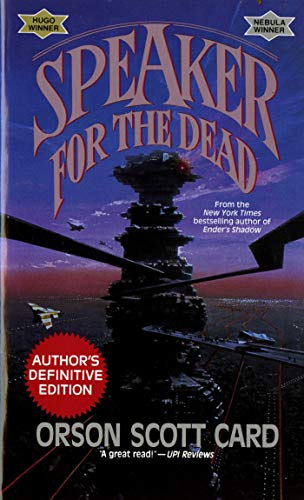
01Ender Wiggin, the young military genius, discovers that a second alien war is inevitable and that he must dismiss his fears to make peace with humanity's strange new brothers.
§Our take
Speaker for the Dead is a murder mystery with a moral spine, though its ambitions sometimes outrun the plot. On a distant colony, two researchers are dead, and Ender Wiggin arrives to investigate. His work as a Speaker means delivering an honest account of a whole life, faults included; the ritual gives the mystery its sternest test, asking whether truth can be told without turning judgment into punishment.
The deeper achievement is the alien ecology, which makes first contact an ecological puzzle rather than another battle. Ender has aged only decades while thousands of years have passed, turning his old war into mythology and putting guilt at the center of the investigation. The prose can be preachy, the exposition dense, and the conversations long. Even so, the question of how to understand people unlike yourself gives the book real staying power.
§Themes
- Honest eulogy
- A Speaker tells the truth about a whole life, including its wrongs, making grief an exercise in moral complexity.
- Alien ecology
- Lusitania's interlinked biology turns first contact into an ecological puzzle rather than a military contest.
- Guilt into myth
- Ender carries guilt from an earlier war that has become legend, so every judgment he makes carries extra weight.
- Time bends the colony
- Thousands of years pass among the colonists while Ender ages only decades, leaving history and memory badly out of step.
- Who narrates the alien?
- Berlatsky argues that the alien viewpoints come through Ender, keeping them from becoming true equals.
§How it was received
Kirkus found the alien biology and death mystery engaging but judged the plot burdened by adolescent angst and heavy religious and linguistic background, with demanding adults likely to be frustrated. The novel won the 1986 Nebula Award for Best Novel, presented in 1987. The later critical divide is sharp: a 2013 Salon essay argues that its gender politics and alien framing are sexist and colonial, while a college course review praises its compassion and redemption.
§Read it if
- You want a murder mystery in which alien contact is an ecological puzzle, not another battle
- You enjoy moral fiction that treats truth, grief and responsibility as difficult practical problems
- You want to see Ender older and out of step with a world that has moved on for thousands of years
§Skip it if
- You want the pace of Ender's Game. This book is slower, more philosophical and built around long conversations.
- You want alien cultures that speak for themselves. One critic thinks routing every alien perspective through Ender makes him too central.
§Before you start
- Reading experience
- Slower and more talkative than Ender's Game, with long conversations, dense exposition, and an investigation that unfolds through interviews rather than battles.
- Reading order
- Second novel in the Ender series by publication: after Ender's Game (1985), before Xenocide (1991) and Children of the Mind (1996). It begins the Speaker sub-sequence and marks a tonal break from the first book; Ender in Exile (2008) sits elsewhere in the chronology. Read Ender's Game first.
- Content notes
- Two xenologists are murdered, with torture and killing described; A husband physically abuses his wife; Adultery appears in the story; Unusual alien reproduction includes a very young pregnancy and children emerging violently, with no explicit sex scenes.
§Common questions
- Do I need to read Ender's Game first?
- Probably yes. One reviewer calls the plot complete on its own, but it assumes Ender's history; Ender's Game is the safer first book.
- What does a Speaker for the Dead do?
- Delivers an honest eulogy that tells the whole life, including the person's wrongs.
- Is Speaker for the Dead YA?
- There isn't a firm age bracket. Kirkus thought it best suited to young-adult readers, but warned that demanding adults could be frustrated.
§If you liked this
- Ender's Game by Orson Scott Card — The fast, school-and-war prequel makes the contrast sharp: Speaker slows down for a colony mystery built around ritual and alien life.
- The Handmaid's Tale by Margaret Atwood — It was one of the novels Speaker for the Dead beat for the 1986 Nebula, though the reading resemblance is thin: a very different kind of literary SF.
- Marooned in Realtime by Vernor Vinge — A 1987 Hugo co-finalist that shares the relativistic time and generational gaps, though it makes a very different bet.
Track this book
Add to your library to track progress and write reviews