SSansFiction
The libraryCollectionsJournalStatsFor authors
Sign inJoin now
Sansfiction,

A digital library for books. Made by readers, for readers.

v 2.0 · 2026
The library
  • Discover
  • Collections
  • Book tracker
  • Journal
  • Stats
For authors
  • SF Links
  • Analytics
  • How it works
  • FAQ
Elsewhere
  • X / @sansfiction
  • Privacy
  • Terms
  • Contact
© 2026 SansFiction · Digital · GlobalA quiet room for your reading life.
The libraryCollectionsJournalStatsFor authors
Sign inJoin now →
Navigation
Library
Bookshelf
Journal
Discover
Collections
Tierlists
Stats
Profile
Author Page
Link Builder
Account
Sign in
S
G
BooksadventureRoadside Picnic
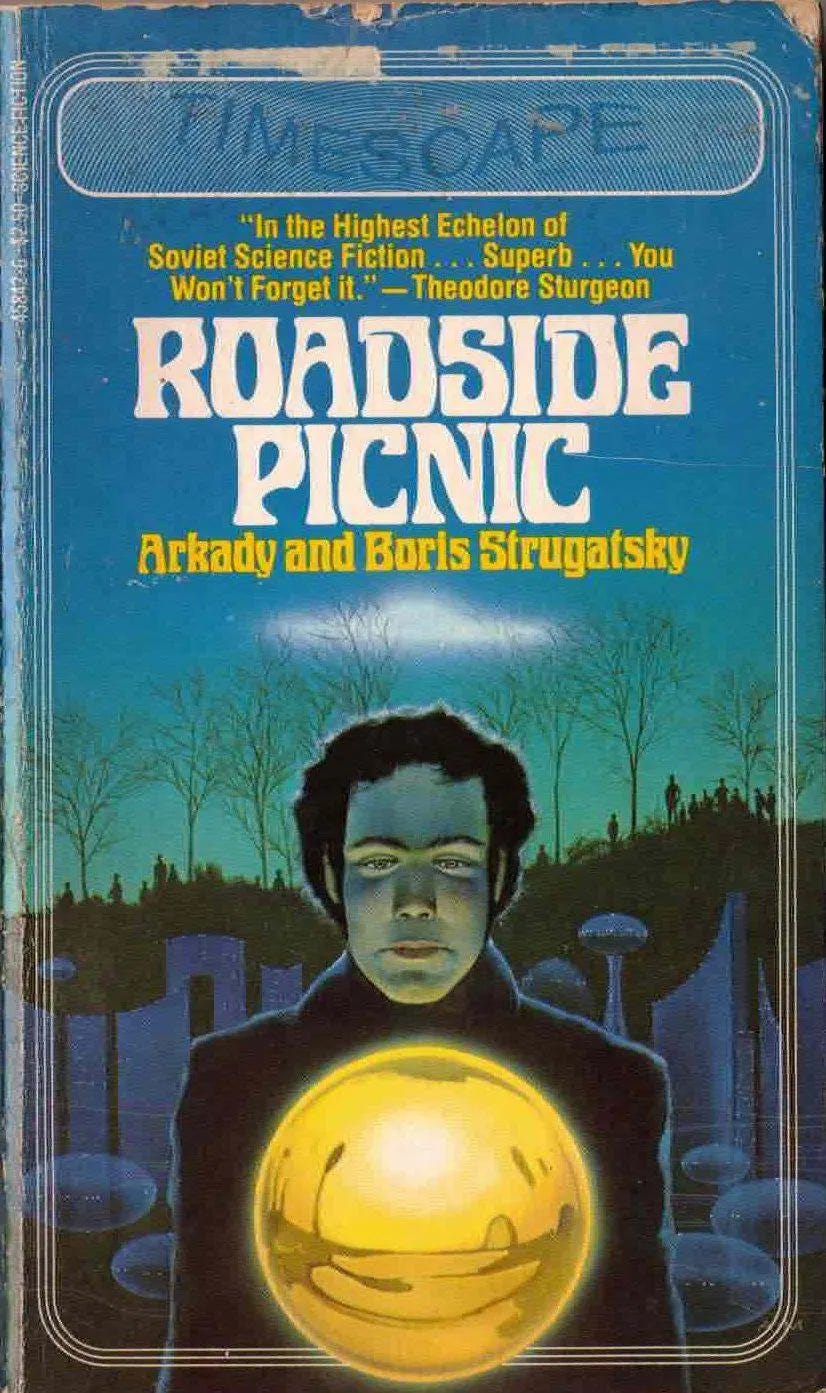
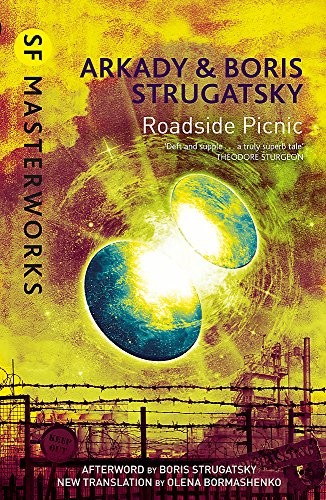
Cover of Roadside Picnic by Arkady Strugatsky

Roadside Picnic,

by Arkady Strugatsky, Boris Strugatsky, Olena Bormashenko, Ursula K. Le Guin

Ask AI
Rating4.0/ 5
Ratings374
Pages226
Reading Hours5h
Published1972
LanguageEnglish

§Synopsis

01

Comment by Hari Kunru in The Guardian:

Soviet-era Russian science fiction deserves a wider audience in English. The Strugatsky brothers collaborated on numerous novels and stories, the best known of which is this, partly because it was filmed by Andrei Tarkovsky as Stalker, in 1977. The novel takes place 10 years after a mysterious alien visitation, which seems to have no rational explanation. No one saw the visitors. Their presence caused disease and blindness in the areas where they landed. Now, in the six "Zones", the laws of physics (and, seemingly, of reality) are disturbed by anomalies, and littered with inexplicable, deadly wreckage. Only a few brave "stalkers" risk their lives to enter the zones to gather alien artefacts for sale. Some of these artefacts offer the promise of extraordinary powers. Unlike Tarkovsky's film, which concentrates on the hallucinatory, vacated landscape of the zones, the novels portray a society adapting to an inexplicable, terrifying event, an eruption of the unknown. Though written in 1971 and published in English in 1977, the novel was heavily bowdlerised by Soviet censors, and an authoritative text wasn't available in Russian until 2000. It's a book with an extraordinary atmosphere – and a demonstration of how science fiction, by using a single bold central metaphor, can open up the possibilities of the novel.

Original Title: Пикник на обочине

Track this book

Add to your library to track progress and write reviews
§Genres
adventure1aliens1classics1dystopian1fantasy1fiction1literary criticism1
§Moods
mysterious1reflective1scary1
§Tags
#clasici1#diverse characters1#dystopia1#fantezie1#fatphobia1#plot driven1

§About the Author

Arkady Strugatsky

1 books in catalog

Soviet science fiction gained some of its most enduring speculative narratives through the collaborative writing of a pair of brothers whose works explored complex philosophical and social dilemmas. Arkady Strugatsky, writing alongside his younger brother Boris, produced speculative fiction that questioned totalitarian authority, human nature, and the limits of knowledge, most famously in the 1972 novella Roadside Picnic.

Their fiction, written within the framework of state oversight, balanced engaging narrative premises with deep social allegory, inspiring international translations and cinematic adaptations such as Andrei Tarkovsky's 1979 film Stalker.

Career & Background

Arkady Natanovich Strugatsky was born in Batumi in 1925, and his family later moved to Leningrad. In January 1942, during the Siege of Leningrad, he and his father were evacuated from the city, but Arkady was the sole survivor in his train car after his father died upon reaching Vologda. Drafted into the Soviet army in 1943, Arkady trained at the artillery school in Aktyubinsk before attending the Military Institute of Foreign Languages in Moscow, graduating in 1949 as an interpreter of English and Japanese. He worked as a teacher and interpreter for the military until 1955, when he transitioned to work as an editor and writer. In 1958, he began his long-standing literary collaboration with his brother Boris, a partnership that lasted until Arkady's death on 12 October 1991. Arkady became a member of the Union of Soviet Writers in 1964 and translated Japanese short stories and novels into Russian, as well as co-translating English literature with his brother.

Writing Style & Themes

Operating under Soviet state censorship, the author and his brother drew upon traditions of satire and social commentary to create layered narrative worlds. Their stories regularly incorporated coded language and philosophical ambiguity to examine bureaucratic absurdity, scientific ethics, and human behavior. In works such as The Snail on the Slope, they questioned rigid ideological dogmas and absolute truths, reflecting on the difficulty of comprehending complex systems and the struggle of individuals within unyielding institutional structures.

Major Works

  • Roadside Picnic — First published in 1972, this seminal novella portrays stalkers who illegally enter hazardous alien visitation zones to retrieve inexplicable artifacts, directly inspiring Andrei Tarkovsky's film adaptation Stalker.
  • The Dead Mountaineer's Inn — A narrative combining locked-room detective fiction with sci-fi elements as an inspector investigates unusual guest encounters and a murder in an isolated mountain hotel.
  • The Snail on the Slope — A philosophical sci-fi novel split between two perspectives that satirizes state administration and explores the inscrutable nature of an alien forest.

§Editions

Cover of Roadside Picnic

Roadside Picnic

engKindle Edition226 pgs
Gollancz19729780575093133
§Genres
adventure1aliens1classics1dystopian1fantasy1fiction1literary criticism1
§Moods
mysterious1reflective1scary1
§Tags
#clasici1#diverse characters1#dystopia1#fantezie1#fatphobia1#plot driven1

Metadata

ISBN-139780575093133
ISBN-100575093137

Editions and availability

Find Roadside Picnic Arkady Strugatsky in PDF, EPUB, ebook, audiobook, print, or library editions.

Bookshop.orgGoogle Play BooksBarnes & NobleOpen Library

Featured In Lists

Book cover from this collectionBook cover from this collectionBook cover from this collectionBook cover from this collection
Book cover from this collection

The Esquire 75 Best Sci-Fi Books of All Time

74 books
Book cover from this collectionBook cover from this collectionBook cover from this collectionBook cover from this collection
Book cover from this collection

Sf Masterworks

71 books