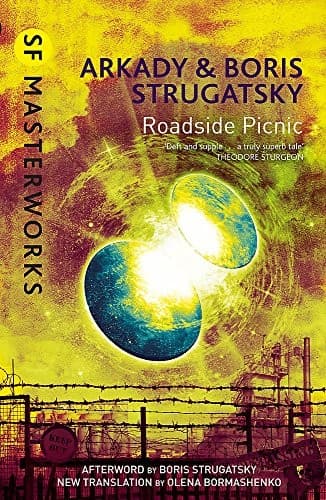
Comment by Hari Kunru in The Guardian:
Soviet-era Russian science fiction deserves a wider audience in English. The Strugatsky brothers collaborated on numerous novels and stories, the best known of which is this, partly because it was filmed by Andrei Tarkovsky as Stalker, in 1977. The novel takes place 10 years after a mysterious alien visitation, which seems to have no rational explanation. No one saw the visitors. Their presence caused disease and blindness in the areas where they landed. Now, in the six "Zones", the laws of physics (and, seemingly, of reality) are disturbed by anomalies, and littered with inexplicable, deadly wreckage. Only a few brave "stalkers" risk their lives to enter the zones to gather alien artefacts for sale. Some of these artefacts offer the promise of extraordinary powers. Unlike Tarkovsky's film, which concentrates on the hallucinatory, vacated landscape of the zones, the novels portray a society adapting to an inexplicable, terrifying event, an eruption of the unknown. Though written in 1971 and published in English in 1977, the novel was heavily bowdlerised by Soviet censors, and an authoritative text wasn't available in Russian until 2000. It's a book with an extraordinary atmosphere – and a demonstration of how science fiction, by using a single bold central metaphor, can open up the possibilities of the novel.
Original Title: Пикник на обочине
Add to your library to track progress and write reviews
Find Roadside Picnic Arkady Strugatsky in PDF, EPUB, ebook, audiobook, print, or library editions.
1 books in catalog
Soviet science fiction gained some of its most enduring speculative narratives through the collaborative writing of a pair of brothers whose works explored complex philosophical and social dilemmas. Arkady Strugatsky, writing alongside his younger brother Boris, produced speculative fiction that questioned totalitarian authority, human nature, and the limits of knowledge, most famously in the 1972 novella Roadside Picnic.
Their fiction, written within the framework of state oversight, balanced engaging narrative premises with deep social allegory, inspiring international translations and cinematic adaptations such as Andrei Tarkovsky's 1979 film Stalker.
Arkady Natanovich Strugatsky was born in Batumi in 1925, and his family later moved to Leningrad. In January 1942, during the Siege of Leningrad, he and his father were evacuated from the city, but Arkady was the sole survivor in his train car after his father died upon reaching Vologda. Drafted into the Soviet army in 1943, Arkady trained at the artillery school in Aktyubinsk before attending the Military Institute of Foreign Languages in Moscow, graduating in 1949 as an interpreter of English and Japanese. He worked as a teacher and interpreter for the military until 1955, when he transitioned to work as an editor and writer. In 1958, he began his long-standing literary collaboration with his brother Boris, a partnership that lasted until Arkady's death on 12 October 1991. Arkady became a member of the Union of Soviet Writers in 1964 and translated Japanese short stories and novels into Russian, as well as co-translating English literature with his brother.
Operating under Soviet state censorship, the author and his brother drew upon traditions of satire and social commentary to create layered narrative worlds. Their stories regularly incorporated coded language and philosophical ambiguity to examine bureaucratic absurdity, scientific ethics, and human behavior. In works such as The Snail on the Slope, they questioned rigid ideological dogmas and absolute truths, reflecting on the difficulty of comprehending complex systems and the struggle of individuals within unyielding institutional structures.