§Author· 1 book
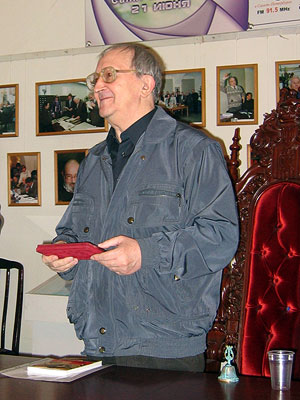
Boris Strugatsky
Also known as Boris Natanovich Strugatsky, Борис Натанович Стругацкий, Boris Stroegatski, S. Vititsky
Speculative fiction from the Soviet era gained international prominence through thought-provoking, allegorical narratives that challenged state orthodoxy while exploring human morality. Boris Strugatsky, writing alongside his brother Arkady Natanovich Strugatsky, co-created some of the most influential Russian science fiction of the twentieth century, including the acclaimed novel Roadside Picnic.
Career & Background
Born in Leningrad on 14 April 1933, Boris Strugatsky remained in the city with his mother during the World War II siege. He graduated from high school in 1950 and initially applied to the physics department at Leningrad State University before studying astronomy instead, graduating in 1955. Following his graduation, he worked as an astronomer and computer engineer at the Pulkovo Observatory, and in 1960 he participated in a geodetic and astronomical expedition in the Caucasus. He became a member of the Writers' Union of the USSR in 1964 and transitioned to working as a full-time writer in 1966.
Throughout most of his career, Strugatsky worked in close partnership with his brother Arkady, forming a collaborative writing duet that deeply influenced generations of Soviet and Russian readers. From 1972 onward, he served as the head of the Leningrad seminar for young speculative fiction writers, an institution that subsequently became known as the "Boris Strugatsky Seminar". He also established the "Bronze Snail" literary prize. An agnostic throughout his life, Strugatsky published two additional novels under a pseudonym after his brother's death, before passing away in Saint Petersburg on 19 November 2012.
Writing Style & Themes
The literary output of the Strugatsky brothers utilized science fiction as a vehicle to address philosophical questions and voice sly critiques of Soviet life. Their stories frequently feature complex dystopian or post-apocalyptic settings where characters face difficult ethical dilemmas, bureaucratized institutions, or unexplainable cosmic phenomena. Strugatsky's professional background in astronomy and computing lent a technical grounding to these allegorical landscapes, balancing imaginative concepts with humanistic concern.
Major Works
- Roadside Picnic — Co-authored with his brother Arkady, this celebrated novel depicts a post-visitation Zone filled with deadly extraterrestrial artifacts and serves as one of their most widely adapted and influential works.
§All Books
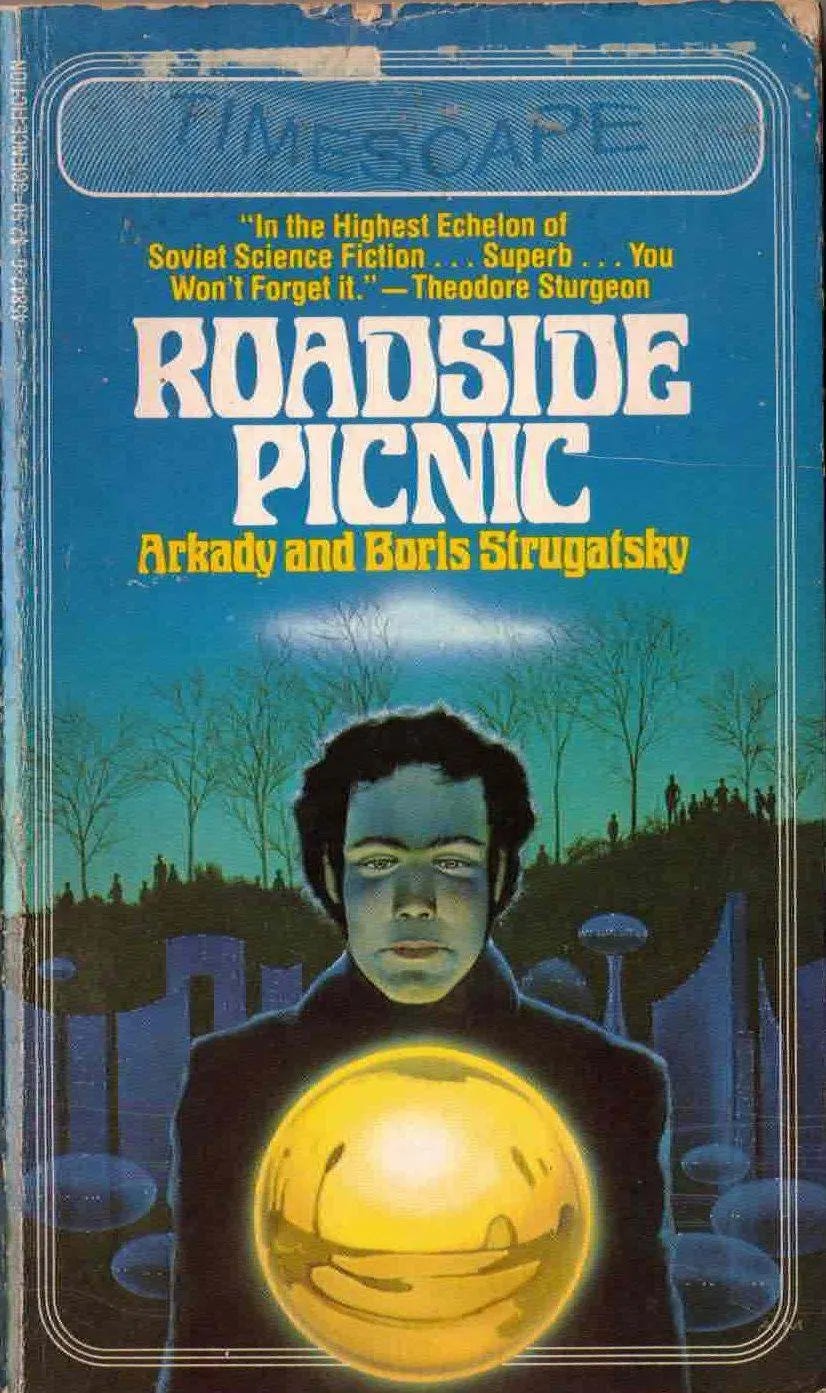
Roadside Picnic
Arkady Strugatsky, 1972
374 ratings
§ About Boris Strugatsky's books
- Books on SansFiction
- 1
- Published
- 1972
- Average rating
- 4.0 / 5 across 374 ratings
- Genres
- Adventure, Aliens, Classics, Dystopian
The book: Roadside Picnic (1972)
[Comment by Hari Kunru in The Guardian][1]: > Soviet-era Russian science fiction deserves a wider audience in English. The Strugatsky brothers collaborated on numerous novels and stories, the best known of which is this, partly because it was filmed by Andrei Tarkovsky as Stalker, in 1977.
Common questions about Boris Strugatsky
- Who is Boris Strugatsky?
- Born in Leningrad on 14 April 1933, Boris Strugatsky remained in the city with his mother during the World War II siege. He graduated from high school in 1950 and initially applied to the physics department at Leningrad State University before studying astronomy instead, graduating in 1955.
- What is Boris Strugatsky best known for?
- Boris Strugatsky is best known for Roadside Picnic, published in 1972 with 374 ratings and a 4.0 average. It is the most-rated of Boris Strugatsky's books on SansFiction.
- What genres does Boris Strugatsky write?
- Boris Strugatsky's books on SansFiction are tagged Adventure, Aliens, Classics and Dystopian.