SSansFiction
The libraryCollectionsJournalStatsFor authors
Sign inJoin now
Sansfiction,

A digital library for books. Made by readers, for readers.

v 2.0 · 2026
The library
  • Discover
  • Collections
  • Book tracker
  • Journal
  • Stats
For authors
  • SF Links
  • Analytics
  • How it works
  • FAQ
Elsewhere
  • X / @sansfiction
  • Privacy
  • Terms
  • Contact
© 2026 SansFiction · Digital · GlobalA quiet room for your reading life.
The libraryCollectionsJournalStatsFor authors
Sign inJoin now →
Navigation
Library
Bookshelf
Journal
Discover
Collections
Tierlists
Stats
Profile
Author Page
Link Builder
Account
Sign in
S
G
BooksbusinessOutliers: The Story of Success
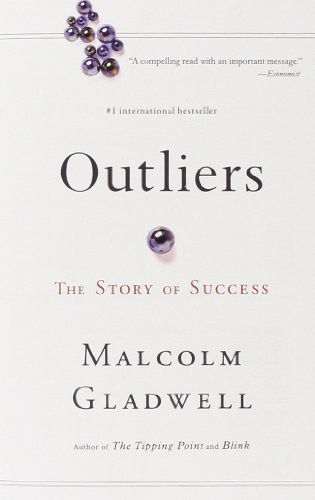
Cover of Outliers: The Story of Success by Malcolm Gladwell

Outliers: The Story of Success,

by Malcolm Gladwell

Ask AI
Rating4.0/ 5
Ratings738
Pages309
Reading Hours6h
Published2008
LanguageEnglish

§Synopsis

01

Identifies the qualities of successful people, maintaining that culture, family, and idiosyncratic factors can have a decisive impact on shaping high achievers,

§Our take

Gladwell's real subject isn't genius. It's the luck that arranges the board before anyone starts playing. That makes Outliers both liberating and faintly destabilizing: if birthdate, culture, coaching and timing carry so much weight, the mythology of pure merit looks threadbare. Kirkus called it a crowd-pleaser and praised the lively storytelling, while noting that the central idea may not be new and the examples can repeat the same point.

The 10,000-hour rule shows both the book's reach and its limits. Gladwell turns Anders Ericsson's Berlin violin study into a famous threshold, but Ericsson says the number was an average, not a magic cutoff, and that structured, feedback-driven practice is the point. The hockey story lands; the culture chapters are shakier, as selected examples become grand theories. Michiko Kakutani accepted the common-sense core but questioned the broad claims, while Stephen Kotkin compared the persuasiveness to a magic trick. Both objections land. Gladwell is better at making the argument feel true than proving how far it reaches.

§Themes

Merit gets a head start
Birthdate, family, culture and unusual access can give some people a decisive advantage before talent or effort becomes visible.
Practice without magic
The 10,000 hours came from a Berlin violin study whose top group averaged that mark by age 20; Ericsson stresses structured practice, not a magic number.
Culture writes the rules
The second half argues that inherited habits can shape conduct and performance, from cockpit deference to rice farming and mathematics.
Anecdote versus argument
The cases are vivid and persuasive, but critics question whether selected stories can support conclusions this broad.

§How it was received

Outliers reached No. 1 on the New York Times bestseller list and held the position for eleven consecutive weeks. Kirkus praised Gladwell's lively storytelling and called the book a crowd-pleaser, while noting that the central idea may not be new and that examples repeat the same point. Reviewers split over method: some value the readable reframing of success as circumstance, while critics say selected anecdotes become sweeping theories.

§Read it if

  • You want a quick, story-led argument for paying more attention to opportunity and less to natural talent
  • You enjoy case studies that turn birthdates, coaching, culture and practice into memorable scenes
  • You can handle an anecdote-driven argument and keep a little skepticism about its examples

§Skip it if

  • You want a systematic, data-led study rather than an argument built from selected cases
  • Broad claims about cultural inheritance make you uneasy, especially the airline-crash and rice-and-maths chapters

§Before you start

Reading experience
It reads quickly, with the hockey, airline-crash and Beatles chapters supplying momentum, though the culture sections require a more skeptical reader.
Reading order
Standalone. Gladwell's earlier books include The Tipping Point and Blink, so no reading order applies.
Content notes
Discusses the fatal 1997 Korean Air crash; Examines cultural stereotypes in sections that some readers find reductive.

§Common questions

Is Outliers part of a series?
No. It's a standalone book, and no reading order applies.
What is the 10,000-hour rule?
Gladwell presents roughly 10,000 hours of practice as a threshold for elite skill. Anders Ericsson says the figure was an average for the top violin students by age 20, not a magic cutoff; deliberate, feedback-driven practice is the real point.
Does practice alone explain success?
Not fully. A 2014 meta-analysis of 88 studies found practice explained about 12% of performance differences overall, though Ericsson disputed what counted as deliberate practice in those studies.

§If you liked this

  • Peak: Secrets from the New Science of Expertise by Anders Ericsson and Robert Pool — The researcher behind the Berlin violin study explains deliberate practice and his objections to treating 10,000 hours as a magic threshold.
  • Range: Why Generalists Triumph in a Specialized World by David Epstein — A counterweight to the belief that practice time alone guarantees success.
  • The Tipping Point by Malcolm Gladwell — An earlier Gladwell book in the same story-first popular social-science mode.
Sources
  • Wikipedia
  • Kirkus Reviews
  • Goodreads copy of Salon excerpt from Ericsson and Pool, Peak (2016)
  • Behavioral Scientist
  • Association for Psychological Science
  • The Boston Globe
  • Goodreads

Track this book

Add to your library to track progress and write reviews

§Genres
business1business & careers1general1motivation & self-improvement1nonfiction1psychology1psychology & mental health1
§Moods
medium-paced2reflective2hopeful1informative1inspiring1

§About the Author

Malcolm Gladwell
Malcolm Gladwell

2 books in catalog

Popular non-fiction investigating social science, psychology, and unexpected patterns in human behavior gained wide reader engagement through books like The Tipping Point: How Little Things Can Make a Big Difference. Malcolm Timothy Gladwell, an English-born Canadian journalist, author, and speaker, has spent decades examining how small changes, rapid decision-making, and hidden cultural structures shape daily life.

With a career bridging journalism and public commentary, Gladwell has brought complex sociological research into accessible mainstream discussions, examining everything from epidemic thresholds to the surprising mechanics of individual achievement.

Career & Background

Malcolm Timothy Gladwell was born on September 3, 1963, in Fareham, England, to a Jamaican psychotherapist mother and a white English mathematics professor father. In 1969, his family relocated to Elmira, Ontario, Canada. He later attended the University of Toronto, earning a Bachelor of Arts degree before entering journalism. Gladwell worked as a reporter for The Washington Post for ten years, covering business and science, before joining The New Yorker as a staff writer in 1996. He was appointed to the Order of Canada in 2011 and was recognized on the TIME 100 Most Influential People list and Foreign Policy's Top Global Thinkers.

In addition to his print journalism and books, Gladwell co-founded Pushkin Industries, an audio production company that produces podcasts and audiobooks. He hosts the popular podcast Revisionist History, which re-examines overlooked historical events, ideas, and figures. Gladwell continues to work as a staff writer for The New Yorker while publishing books, producing digital audio projects, and speaking publicly across the globe.

Writing Style & Themes

Gladwell's writing sits at the intersection of popular science, sociology, and narrative storytelling, frequently drawing on academic research to challenge intuitive assumptions about human behavior. His prose relies on engaging anecdotes, case studies, and clear conceptual frameworks that simplify complex psychological and sociological phenomena for general audiences.

Recurring themes across his work include the hidden influences that govern individual and group actions, the unexpected dynamics of social epidemics, the limitations of split-second intuition, and the systemic factors behind success and miscommunication. By contextualizing personal outcomes within broader environmental and historical circumstances, Gladwell encourages readers to re-evaluate conventional wisdom.

Major Works

  • The Tipping Point: How Little Things Can Make a Big Difference — Published in 2000, this landmark bestseller explores how small ideas, trends, and social behaviors cross a critical threshold to spread rapidly like contagions.
  • Outliers: The Story of Success — Published in 2008, this influential work examines the external factors, cultural backgrounds, family legacies, and preparation opportunities that contribute to high achievers.
  • Blink — This bestselling book investigates the power and pitfalls of rapid intuition, exploring how brain processes make snap judgments and when those instincts succeed or fail.
  • David and Goliath — This work explores the dynamics of underdogs and misfits, examining how perceived disadvantages can become unexpected strengths and how advantages can turn into liabilities.
  • Talking to Strangers — An examination of how people misinterpret and misunderstand individuals they do not know, analyzing high-profile cases of communication breakdown.
§Genres
business1business & careers1general1motivation & self-improvement1nonfiction1psychology1psychology & mental health1
§Moods
medium-paced2reflective2hopeful1informative1inspiring1

Metadata

ISBN-139780316017923
ISBN-100316017922

Editions and availability

Find Outliers: The Story of Success Malcolm Gladwell in PDF, EPUB, ebook, audiobook, print, or library editions.

Bookshop.orgGoogle Play BooksBarnes & NobleOpen Library

Featured In Lists

Book cover from this collectionBook cover from this collectionBook cover from this collectionBook cover from this collection
Book cover from this collection

Building A Better World

65 books