What's the most effective path to success in any domain? It's not what you think.
Plenty of experts argue that anyone who wants to develop a skill, play an instrument, or lead their field should start early, focus intensely, and rack up as many hours of deliberate practice as possible. If you dabble or delay, you'll never catch up to the people who got a head start. But a closer look at research on the world's top performers, from professional athletes to Nobel laureates, shows that early specialization is the exception, not the rule.
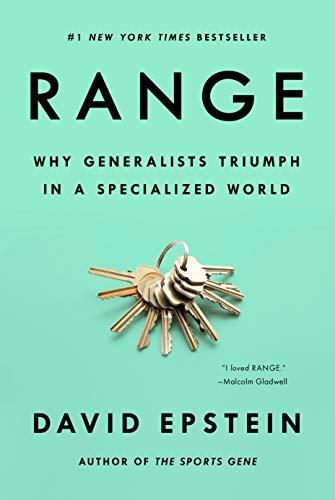
David Epstein examined the world's most successful athletes, artists, musicians, inventors, forecasters and scientists. He discovered that in most fields--especially those that are complex and unpredictable--generalists, not specialists, are primed to excel. Generalists often find their path late, and they juggle many interests rather than focusing on one. They're also more creative, more agile, and able to make connections their more specialized peers can't see.
Provocative, rigorous, and engrossing, Range makes a compelling case for actively cultivating inefficiency. Failing a test is the best way to learn. Frequent quitters end up with the most fulfilling careers. The most impactful inventors cross domains rather than deepening their knowledge in a single area. As experts silo themselves further while computers master more of the skills once reserved for highly focused humans, people who think broadly and embrace diverse experiences and perspectives will increasingly thrive.
What's the most effective path to success in any domain? It's not what you think.
Plenty of experts argue that anyone who wants to develop a skill, play an instrument, or lead their field should start early, focus intensely, and rack up as many hours of deliberate practice as possible. If you dabble or delay, you'll never catch up to the people who got a head start. But a closer look at research on the world's top performers, from professional athletes to Nobel laureates, shows that early specialization is the exception, not the rule.
David Epstein examined the world's most successful athletes, artists, musicians, inventors, forecasters and scientists. He discovered that in most fields--especially those that are complex and unpredictable--generalists, not specialists, are primed to excel. Generalists often find their path late, and they juggle many interests rather than focusing on one. They're also more creative, more agile, and able to make connections their more specialized peers can't see.
Provocative, rigorous, and engrossing, Range makes a compelling case for actively cultivating inefficiency. Failing a test is the best way to learn. Frequent quitters end up with the most fulfilling careers. The most impactful inventors cross domains rather than deepening their knowledge in a single area. As experts silo themselves further while computers master more of the skills once reserved for highly focused humans, people who think broadly and embrace diverse experiences and perspectives will increasingly thrive.
Add to your library to track progress and write reviews
Find Range: Why Generalists Triumph in a Specialized World David Epstein in PDF, EPUB, ebook, audiobook, print, or library editions.
1 books in catalog
Investigative journalism and science reporting intersect to reveal how human potential, athletic achievement, and modern skill acquisition are shaped by biology and breadth of experience. David Epstein has established himself as a prominent non-fiction author whose work challenges conventional assumptions about specialization, elite performance, and success.
Through deeply researched narratives and evidence-based analysis, Epstein examines how diverse experience and generalized learning often outperform narrow focus in complex environments, a theme central to his bestselling book Range: Why Generalists Triumph in a Specialized World.
David Epstein began his career in journalism after competing as a collegiate runner. He worked as a crime reporter before joining Sports Illustrated as a senior writer, where he specialized in investigative reporting and science issues in athletics. During his tenure at Sports Illustrated, Epstein co-authored a major 2009 investigative report with Selena Roberts revealing that New York Yankees third baseman Alex Rodriguez had tested positive for steroids in 2003.
He later joined ProPublica as an investigative reporter, covering complex topics across science, medicine, and sports, as well as federal law enforcement stories such as the Drug Enforcement Administration's pursuit of drug cartel figures. Epstein also hosted Slate's How To! podcast and delivered a widely viewed 2014 TED Talk on sports science. His investigative and science reporting earned him honors including the 2010 Society of Professional Journalists prize for science and technology writing.
Epstein's writing style bridges rigorous scientific research and compelling narrative reporting. Rather than relying on simplistic self-help formulas, he grounds his arguments in empirical studies, genetic research, and real-world case studies ranging from elite athletes to polymath scientists. He frequently explores how biological constraints, environmental conditions, and broad experimentation influence individual development and high-level performance.
A recurring theme across his books is the counterintuitive benefit of breadth over premature specialization. Epstein demonstrates how generalists who acquire diverse skill sets often develop superior problem-solving abilities and adaptability. His work also analyzes how structured constraints can foster creativity and innovation, encouraging readers to rethink established frameworks in education, sports, and professional careers.
1 books in catalog
Investigative journalism and science reporting intersect to reveal how human potential, athletic achievement, and modern skill acquisition are shaped by biology and breadth of experience. David Epstein has established himself as a prominent non-fiction author whose work challenges conventional assumptions about specialization, elite performance, and success.
Through deeply researched narratives and evidence-based analysis, Epstein examines how diverse experience and generalized learning often outperform narrow focus in complex environments, a theme central to his bestselling book Range: Why Generalists Triumph in a Specialized World.
David Epstein began his career in journalism after competing as a collegiate runner. He worked as a crime reporter before joining Sports Illustrated as a senior writer, where he specialized in investigative reporting and science issues in athletics. During his tenure at Sports Illustrated, Epstein co-authored a major 2009 investigative report with Selena Roberts revealing that New York Yankees third baseman Alex Rodriguez had tested positive for steroids in 2003.
He later joined ProPublica as an investigative reporter, covering complex topics across science, medicine, and sports, as well as federal law enforcement stories such as the Drug Enforcement Administration's pursuit of drug cartel figures. Epstein also hosted Slate's How To! podcast and delivered a widely viewed 2014 TED Talk on sports science. His investigative and science reporting earned him honors including the 2010 Society of Professional Journalists prize for science and technology writing.
Epstein's writing style bridges rigorous scientific research and compelling narrative reporting. Rather than relying on simplistic self-help formulas, he grounds his arguments in empirical studies, genetic research, and real-world case studies ranging from elite athletes to polymath scientists. He frequently explores how biological constraints, environmental conditions, and broad experimentation influence individual development and high-level performance.
A recurring theme across his books is the counterintuitive benefit of breadth over premature specialization. Epstein demonstrates how generalists who acquire diverse skill sets often develop superior problem-solving abilities and adaptability. His work also analyzes how structured constraints can foster creativity and innovation, encouraging readers to rethink established frameworks in education, sports, and professional careers.