§Synopsis
01Richard Mayhew is a man defined by his adherence to the unremarkable. A transplant to London with a sensible job, a demanding fiancée, and a collection of glass trolls, his life is governed by the predictable rhythms of the mundane. However, his reality fractures the moment he chooses a single act of kindness over social convention. By stopping to help an injured, blood-streaked girl on a sidewalk—a girl whom everyone else seems unable to even perceive—Richard inadvertently severs his tether to the world he knows. He becomes invisible to his colleagues, his landlord, and his own life, effectively "falling through the cracks" of London.
To reclaim his identity, Richard must descend into London Below, a subterranean mirror-city where the discarded and the forgotten have built a society within the shadows of the Underground. This is not a whimsical escape but a brutal transition into a realm governed by archaic laws, bartered favors, and ancient dangers. Richard is no longer a businessman; he is a displaced soul navigating a landscape where the names of tube stations—like Knightsbridge and Blackfriars—take on literal, often lethal, meanings. His survival depends on understanding a world that exists in the periphery of our vision, a place where the metaphorical "invisible" people of society have found a way to become tangible and terrifying.
The Architecture of the Cracks
The world-building of London Below operates on the principle of literalism and historical residue. It is a world composed of the things London Above has lost or forgotten: Roman ruins, medieval markets, and the discarded remnants of modernity. The atmosphere is thick with dampness and the scent of the Thames, structured around "The Gap"—the dangerous space between the platform and the train. In this setting, geography is fluid and dangerous; a simple walk through a park in the "Above" might be a trek through a monster-infested wasteland in the "Below." Trade is conducted not with currency, but with services, secrets, and physical objects of sentimental or historical weight.
Main Characters
- Richard Mayhew: A bewildered "London Above" office worker whose life is erased the moment he enters the subterranean world; he is a reluctant protagonist motivated purely by the desire to return to normalcy.
- Door: A young woman of noble lineage from London Below with the inherited ability to "open" things—from locked doors to conceptual barriers—who is currently fleeing the assassins who murdered her family.
- The Marquis de Carabas: A flamboyant, arrogant, and cunning "fixer" who trades in favors; he assists Door not out of altruism, but because of a complicated debt and the promise of future leverage.
- Mr. Croup and Mr. Vandemar: A pair of ancient, highly articulate, and sadistic mercenaries hired to capture Door; they represent an existential threat that transcends human limitations.
The Dissolution of the Ordinary
The narrative focuses heavily on the psychological erosion of Richard’s former self. Unlike typical fantasy heroes who embrace their new surroundings, Richard’s initial arc is defined by grief for his mundane life. His development is rooted in the "No Status Change" reality: he starts as a man who is ignored by the world and must find a way to become relevant in a society that operates on strength and cunning. His relationship with Door is one of mutual necessity; he provides a tether to a gentler morality, while she is his only hope for regaining his visible existence. Their dynamic highlights the contrast between Richard’s paralyzing fear and the high-stakes survivalism required in London Below.
Subverting the Urban Portal Fantasy
While the story utilizes the "portal fantasy" trope, it subverts the typical escapist allure of the genre. Instead of a magical kingdom, the "other world" is a gritty, dangerous reflection of urban decay and social exclusion. Gaiman deconstructs the idea of the "chosen one" by making Richard an accidental participant who is essentially a victim of his own empathy. The book also plays with the "hidden world" trope by suggesting that London Below isn't just a separate place, but a necessary shadow of the city above, populated by those who have been marginalized by society until they literally vanished from the sight of the "normal" population.
§Our take
Read Neverwhere for the place, not the plot. London Below is a society of the discarded, built from Roman ruins, medieval markets and the Underground itself, and Blackfriars and Knightsbridge stop being stops and become beings and places. If you know London, it's a treat. If you don't, it's a good tour.
The story is thinner than the world. The book began as a six-part BBC series, and the episodic shape shows. Richard is a passive hero by design, a man undone by one act of kindness, though some readers find him underdeveloped. The ending lands lightly. The villains, Mr Croup and Mr Vandemar, are the ones people remember: funny, sinister and a little too articulate. Even fans who want more from the plot tend to forgive it, because the storytelling moves so fast.
§Themes
- Falling through the cracks
- People ignored by society end up literally unseen, living in a city beneath the city.
- Kindness as a curse
- Richard loses his whole life because he stopped to help someone.
- Literal London
- Place names become real things, so the Underground map doubles as the book's geography.
- A fairy tale for grown-ups
- It has the wide-eyed logic of a children's story, then fills that world with menace for adults.
§How it was received
London Below does the heavy lifting: even readers who find the plot thin tend to stay for the scenery. The Mythopoeic Society praised its invention, and several reviewers found it fast and funny. The dissent is clear enough: the hero feels underpowered, the plot episodic, and the story thinner than its world. It has stayed in print for decades and outdid the BBC series abroad.
§Read it if
- You want a fantasy world you could walk into from a real city street
- You like menace and comedy in the same scene, with villains who steal the book
- You want a quick Gaiman that's lighter than American Gods and closer to Stardust
§Skip it if
- You need a driven, fully developed hero. Richard is passive, and readers say so.
- You read for plot first. Some readers call it basic, and even fans find the ending underwhelming.
§Before you start
- Reading experience
- Short and fast, with an episodic shape that some readers find propulsive and others find disjointed.
- Reading order
- Standalone. Gaiman's short story 'How the Marquis Got His Coat Back' revisits the world, but you don't need it. The BBC series tells a similar story differently.
- Content notes
- Violence and menace from the villains, with some gore; Mild profanity and moderate sexual description; Homelessness and poverty are central to the setting; rats and sewers feature.
§Common questions
- Is Neverwhere part of a series?
- No. It's a standalone novel. A related short story, 'How the Marquis Got His Coat Back', exists, but nothing else is required reading.
- Is the book the same as the BBC series?
- No. The novel grew out of the TV series but tells the story differently, with expanded material and changed details, such as moving the Floating Market to Harrods.
- Which edition should I read?
- Any of them. There's the original UK text, a US edition that adjusts London references for American readers, and the Author's Preferred Text with restored scenes. Some scenes differ between versions.
§If you liked this
- Stardust by Neil Gaiman — Gaiman in a more whimsical mood, which is the register Neverwhere sometimes shares.
- American Gods by Neil Gaiman — Darker and more provocative, and a good next step if Neverwhere feels light.
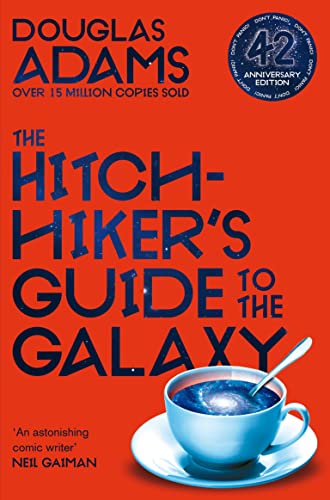
- The Hitchhiker's Guide to the Galaxy by Douglas Adams — One reviewer hears Adams's dry comic absurdity, along with a Dickensian London, in the dialogue and tone.
Track this book
Add to your library to track progress and write reviews