SSansFiction
The libraryCollectionsJournalStatsFor authors
Sign inJoin now
Sansfiction,

A digital library for books. Made by readers, for readers.

v 2.0 · 2026
The library
  • Discover
  • Collections
  • Book tracker
  • Journal
  • Stats
For authors
  • SF Links
  • Analytics
  • How it works
  • FAQ
Elsewhere
  • X / @sansfiction
  • Privacy
  • Terms
  • Contact
© 2026 SansFiction · Digital · GlobalA quiet room for your reading life.
The libraryCollectionsJournalStatsFor authors
Sign inJoin now →
Navigation
Library
Bookshelf
Journal
Discover
Collections
Tierlists
Stats
Profile
Author Page
Link Builder
Account
Sign in
S
G
BooksclassicsHouse of Leaves
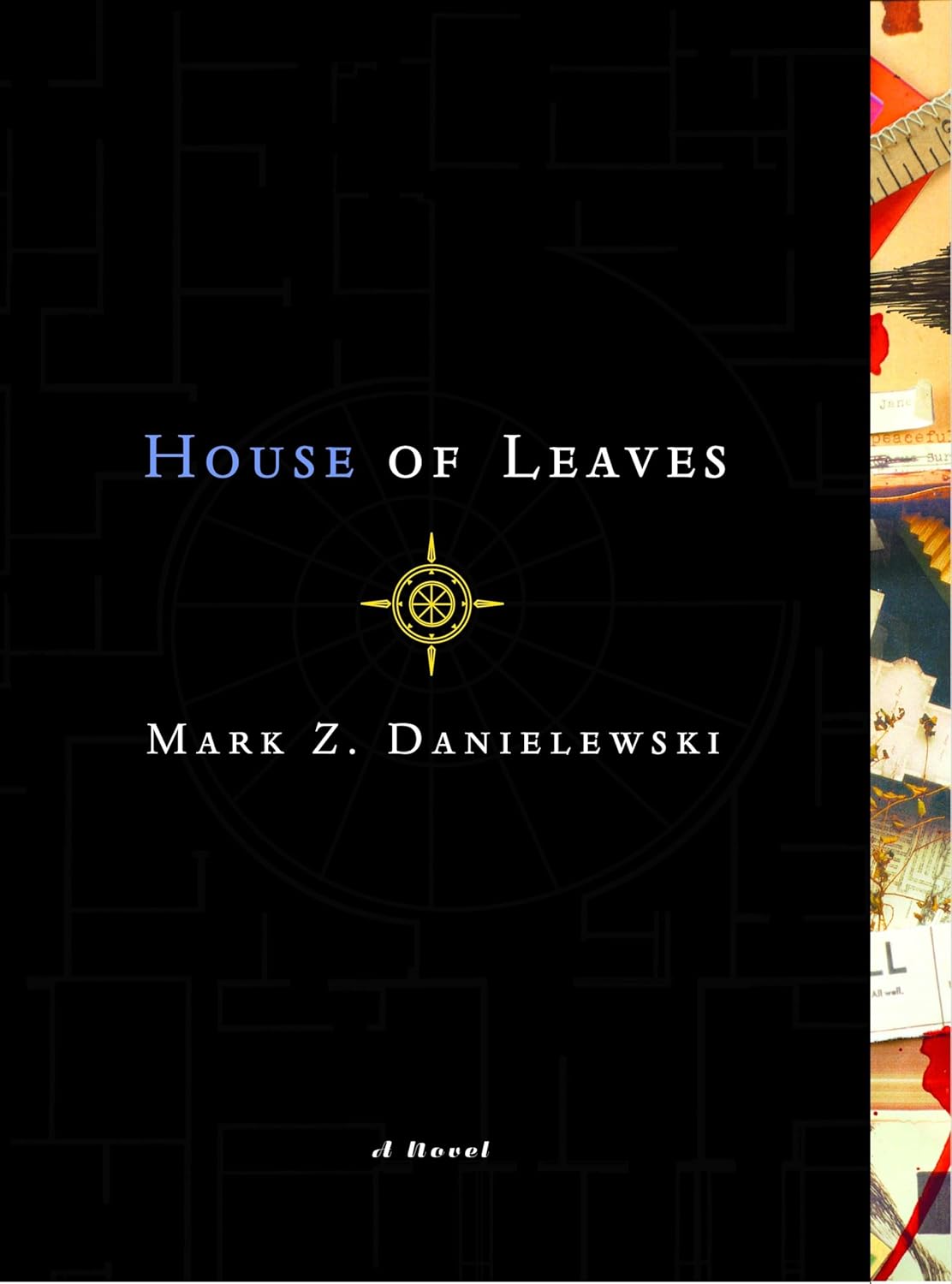
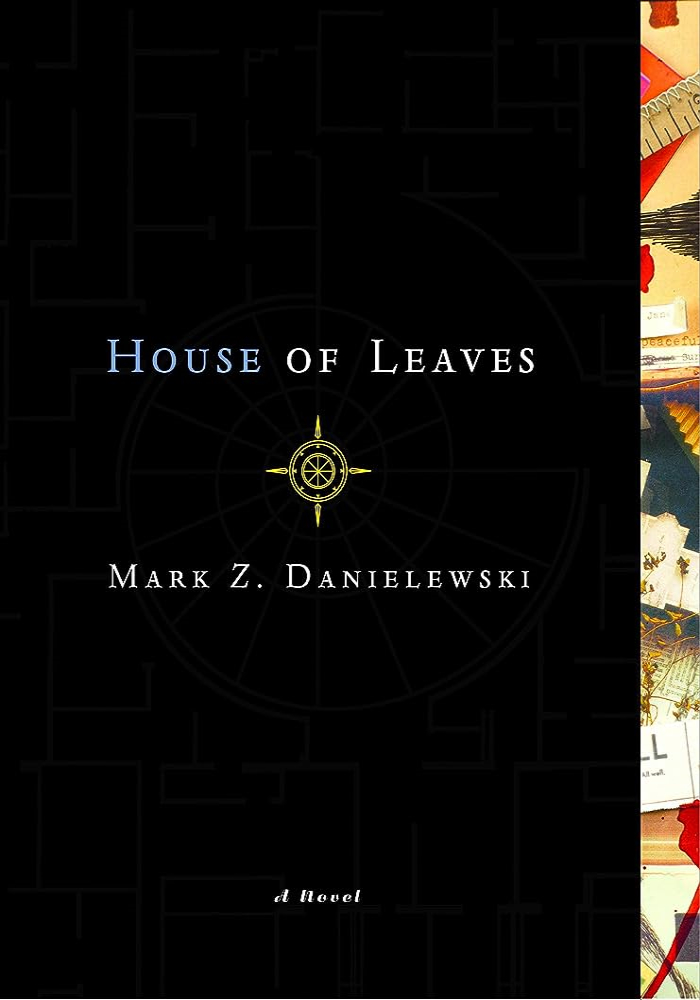
Cover of House of Leaves by Mark Z. Danielewski

House of Leaves,

by Mark Z. Danielewski

Ask AI
Rating4.1/ 5
Ratings648
Pages709
Reading Hours15h
Published2000
LanguageEnglish

§Synopsis

01

House of Leaves is an epistolary fiction and metafiction novel focusing on a fictional documentary film titled the Navidson Record, presented as a story within a story discussed in a handwritten monograph recovered by the primary narrator, Johnny Truant. The narrative makes heavy use of multiperspectivity as Truant's footnotes chronicle his efforts to transcribe the manuscript, which itself reveals the Navidson Record's supposed narrative through transcriptions and analysis depicting a story of a family who discovers a larger-on-the-inside labyrinth in their house.

§Our take

House of Leaves is less a conventional horror novel than a trapdoor built from footnotes, typefaces and unreliable documents. The physical book does the work of the house: text scatters, changes face and once tunnels backward through the page. At its best, that design turns reading into dread rather than merely describing it.

The weak point is Johnny Truant's commentary. Publishers Weekly found it weaker than the Navidson material, and readers still divide over whether it supplies emotional weight or dead weight. Edition matters: the Remastered Full-Color Edition shows the blue 'house,' red Minotaur and struck-through text, and adds vertical footnotes and two extra appendices without changing the story. Read it in print, slowly, because the typography is not trim.

§Themes

The page as labyrinth
Changing typefaces and scattered layouts make reading feel like navigating the impossible house.
Footnotes with teeth
A long note tunnels across pages and prints backward, making the sheet itself part of the story.
Scholarship as nightmare
Invented citations and mock-academic commentary expose the machinery of scholarship while deepening the dread.
Maze and Minotaur
The house's inner labyrinth gives the Minotaur myth a place in the book's visual language.
Love beneath the horror
Family grief and estrangement sit beneath the story of a home that keeps unfolding.

§How it was received

Kirkus was emphatic, calling the nested texts, footnotes and appendices a fresh approach to horror built around a house and treating the ambiguity as dread rather than flaw. Publishers Weekly admired the Navidson story as a tour de force but found the Johnny Truant half weaker and questioned Danielewski's character voices. The debut has since become a cult and academic fixture, with readers still divided over whether the typography is brilliant or pretentious and whether the ambiguity pays off.

§Read it if

  • You want horror in which the physical book carries the fear
  • You enjoy layered fiction, invented citations and footnotes that do real narrative work
  • You like slow, demanding fiction and don't need every mystery answered

§Skip it if

  • You need a linear plot, firm answers and a tidy payoff
  • Long annotation digressions and typographic stunts sound like clutter rather than craft

§Before you start

Reading experience
Expect a deliberately slow, demanding read, with dense footnote blocks, pages that may need rotating and one long note that runs backward across the sheet.
Reading order
Standalone. The novella-length Whalestoe Letters, taken from the novel, was also published separately, and Poe's Haunted is a companion album. Neither is a sequel.
Content notes
Sexual abuse and rape are depicted; Child abuse and neglect are depicted; Psychosis, panic attacks and hallucinations are depicted; Drug and alcohol abuse and sexual content appear.

§Common questions

Why does House of Leaves sometimes get dated 1999?
It was first published in 2000: a signed Pantheon hardcover on February 29, then the general hardback and paperback on March 7. Some catalog listings carry a stray 1999.
Which edition should I buy?
If you have a choice, the Remastered Full-Color Edition shows the blue 'house', the red Minotaur and the struck-through text, and adds vertical footnotes and two extra appendices; the story itself is unchanged. Readers disagree on whether colour is essential.
Do I have to read every footnote?
Not strictly, but read them if you want the full design. They carry shifts between narrative layers and contain some of the physical tricks.

§If you liked this

  • Infinite Jest by David Foster Wallace — Dense footnotes and mock-scholarly apparatus make it the natural formal comparison; Publishers Weekly also invoked David Foster Wallace when questioning the voices here.
  • Moby-Dick by Herman Melville — Stephen King and Joe Hill were reported to have argued over whether House of Leaves is horror's Moby-Dick.
Sources
  • Wikipedia
  • Wikipedia
  • Goodreads
  • Goodreads
  • Goodreads
  • Google Books
  • Open Library
  • Kirkus Reviews
  • Publishers Weekly
  • EBSCO Research Starters
  • Route 57 (University of Sheffield student journal)
  • Uncanny Magazine
  • Wikipedia

Track this book

Add to your library to track progress and write reviews

§Genres
classics1contemporary literature & fiction1documentary films1ergodic literature1fantasy1fiction1horror1
§Content Warnings
§Moods
adventurous1challenging1clever1dark1emotional1mysterious1reflective1
§Tags
#a mix driven1#character driven1#confinement1#diverse characters1

§About the Author

Mark Z. Danielewski
Mark Z. Danielewski

1 books in catalog

A labyrinthine horror and satirical novel centered on an impossible house whose interior dimensions exceed its exterior, House of Leaves re-engineered horror and fiction through complex typographical layouts and multi-layered narratives. American fiction author Mark Z. Danielewski, born in New York City on March 5, 1966, achieved wide recognition with this celebrated debut novel, which established his distinct approach to physical book design and structural experimentation.

Career & Background

Born in New York City in 1966, Mark Z. Danielewski is the son of filmmaker Tad Danielewski, whose discussions of modernism, Freud, Nietzsche, and Sartre influenced his early intellectual direction. Danielewski earned a Bachelor of Arts degree from Yale University in 1988 and a Master of Arts degree from the University of California, Los Angeles in 1993. Before establishing his literary career, he worked as a tutor, plumber, and restaurant employee. His sister, the singer Poe (Anne Decatur Danielewski), supported his early literary efforts by sending manuscripts to potential supporters. Danielewski now lives in Los Angeles.

Writing Style & Themes

Danielewski is widely known for his engagement with ergodic literature and signiconic narrative design, where typography, page layout, text orientation, and visual structure actively shape the reading experience. His works frequently examine unreliable narration, labyrinthine architectures, memory, and multi-layered texts. In addition to novel writing, his creative output spans multidisciplinary formats, including the Halloween theatrical performances of The Fifty Year Sword at REDCAT and his piece THROWN, a reflection on Matthew Barney's CREMASTER 2 exhibited at the Guggenheim Museum during its 2015 Storylines exhibition.

Major Works

  • House of Leaves — Published in 2000, this landmark debut novel tells the story of a family discovering that the inside of their house is larger than the outside, framed by multiple unreliable narrators and footnoted commentaries. The book won the New York Public Library's Young Lions Fiction Award and became a widely studied text in postmodern fiction.
  • Only Revolutions — Released in 2006, this novel features a dual-narrative format that can be read from either end, chronicling two endlessly youthful protagonists across American history. The work was nominated for the National Book Award.
  • The Fifty Year Sword — Originally presented as a multi-voice performance piece on Halloween three years in a row at REDCAT, this ghost story novella utilizes unique formatting and stitched text motifs in its physical print edition.
  • The Familiar — Published between 2015 and 2017 by Pantheon, this ambitious project was released across five 880-page volumes, weaving together diverse global perspective threads through distinctive visual and textual conventions.

§Other Editions

Showing 2 of 27 editions
Cover of House of Leaves

House of Leaves

eng709 pgs2nd
Pantheon20009780375703768
Amazon
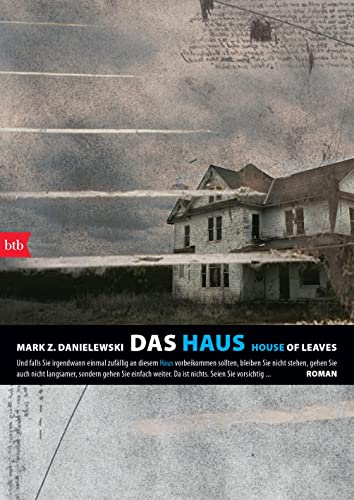
Cover of Das Haus

Das Haus

engPaperback
Klett Cotta20009783442739707
§Genres
classics1contemporary literature & fiction1documentary films1ergodic literature1fantasy1fiction1horror1
§Content Warnings
§Moods
adventurous1challenging1clever1dark1emotional1mysterious1reflective1
§Tags
#a mix driven1#character driven1#confinement1#diverse characters1

Metadata

ISBN-139781862301108
ISBN-101862301107
ASIN0375703764

Editions and availability

Find House of Leaves Mark Z. Danielewski in PDF, EPUB, ebook, audiobook, print, or library editions.

View on Amazon
Bookshop.orgGoogle Play BooksBarnes & NobleOpen Library

Featured In Lists

Book cover from this collectionBook cover from this collectionBook cover from this collectionBook cover from this collection
Book cover from this collection

Mother Horror's 101 Horror Books to Read Before You're Murdered

239 books
Book cover from this collectionBook cover from this collectionBook cover from this collectionBook cover from this collection
Book cover from this collection

TrueLit’s 100 Best Books of the Quarter Century

99 books
Book cover from this collectionBook cover from this collectionBook cover from this collectionBook cover from this collection
Book cover from this collection

Horror

168 books
Book cover from this collectionBook cover from this collectionBook cover from this collectionBook cover from this collection
Book cover from this collection

List 1001 Books Boxall

1000 books
Book cover from this collectionBook cover from this collectionBook cover from this collectionBook cover from this collection
Book cover from this collection

Mystery, Thriller & Suspense #booktalk

20 books•@sansfictionbot
Book cover from this collectionBook cover from this collectionBook cover from this collectionBook cover from this collection
Book cover from this collection

Literature and Fiction #booktalk

12 books•@sansfictionbot
Book cover from this collectionBook cover from this collectionBook cover from this collectionBook cover from this collection
Book cover from this collection

Letters Across Time: Stories Told in Letters

9 books