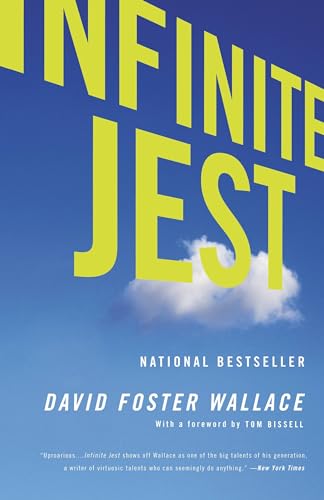
A landmark work in late twentieth-century fiction, Infinite Jest reconfigured narrative form through its encyclopedic scope, dense endnotes, and intricate exploration of addiction, entertainment, and human isolation. David Foster Wallace emerged through this ambitious writing as a prominent voice in contemporary literature, blending rigorous analytical depth with emotional complexity. His expansive literary output across novels, short fiction, and journalism probed the psychological pressures of modern culture and the search for genuine human connection amidst constant stimulation.
Beyond his best-known novel, Wallace produced acclaimed essay collections and short story compilations that scrutinized subjects ranging from professional tennis and state fairs to luxury cruise ships and the ethical dilemmas of food consumption. His work achieved critical acclaim while establishing a dedicated readership, demonstrating how formal experimentation and linguistic virtuosity could serve a deeply empathetic purpose.
Career & Background
Born in Ithaca, New York, Wallace grew up in central Illinois as the son of educators. During his youth, he excelled academically while competing as a high-ranked junior tennis player in the Midwest, an experience that later informed his analytical essays on athletics. He pursued higher education at Amherst College, earning dual degrees in English and philosophy. His senior undergraduate honors thesis in logic and philosophy was adapted into his debut novel, The Broom of the System, published in 1987. Wallace continued his education at the University of Arizona, completing a Master of Fine Arts degree in creative writing.
Over the next two decades, Wallace built an extensive career as both an author and an educator. He taught literature and creative writing at Emerson College, Illinois State University in Normal, and Pomona College in Claremont, California, earning praise for his intense engagement with students and commitment to teaching. His literary accomplishments were recognized with major honors, including a Whiting Writers' Award, a Lannan Literary Award, and a MacArthur Foundation Fellowship in 1997. Throughout his career, he published short stories, essays, and book reviews in prestigious journals and magazines.
Throughout his adult life, Wallace struggled with depression and addiction, undergoing multiple hospitalizations before dying by suicide in 2008 at the age of 46. In the years following his death, his influence continued to grow across academic and literary communities, though his legacy was also reexamined following posthumous revelations of abusive behavior, particularly during his relationship with writer Mary Karr. His unfinished final novel, The Pale King, was published posthumously in 2011 and was named a finalist for the Pulitzer Prize.
Writing Style & Themes
Wallace's writing style is characterized by linguistic virtuosity, inventive structure, and intense moral and existential inquiry. Moving intentionally beyond cynical postmodern irony, he sought to restore sincerity and emotional depth to contemporary fiction. His complex prose frequently incorporates self-referential endnotes, specialized technical terminology, and dense narrative layers to reflect the overwhelming velocity of modern consciousness and media consumption.
A central theme across Wallace's work is the search for meaning within routine existence and the struggle against self-absorption. He described the primary purpose of fiction as a way of making readers feel "less alone inside," viewing narrative art as a crucial tool for cultivating empathy. Whether analyzing the mechanics of a tennis match or charting the psychological weight of everyday boredom, his work balances cerebral precision with comic humor and compassionate observation.
Major Works
- Infinite Jest — Published in 1996, this monumental novel presents a dark, satirical vision of a near-future North America consumed by entertainment and commercialization. Featuring more than 300 detailed endnotes, Infinite Jest was named by Time magazine as one of the 100 best English-language novels published between 1923 and 2005.
- The Broom of the System — Wallace's 1987 debut novel, adapted from his Amherst College undergraduate honors thesis, introduced his distinctive combination of philosophical inquiry, linguistic playfulness, and tragicomic character study.
- Consider the Lobster and Other Essays — This 2005 collection showcases Wallace's non-fiction prowess, gathering wide-ranging essays on food ethics, political campaigns, language usage, and popular culture.
- The Pale King — Assembled from manuscript materials left behind after his death, this unfinished novel set inside an IRS regional office was published posthumously in 2011 and named a finalist for the Pulitzer Prize.
- This Is Water: Some Thoughts, Delivered on a Significant Occasion, about Living a Compassionate Life — Originally presented as a commencement address at Kenyon College in 2005, this short work articulates Wallace's philosophy on mindfulness, empathy, and overcoming daily self-centeredness.
- Oblivion: Stories — Published in 2004, this short fiction collection explores the anxieties of modern identity, consciousness, and communication through intricate and psychologically acute stories.