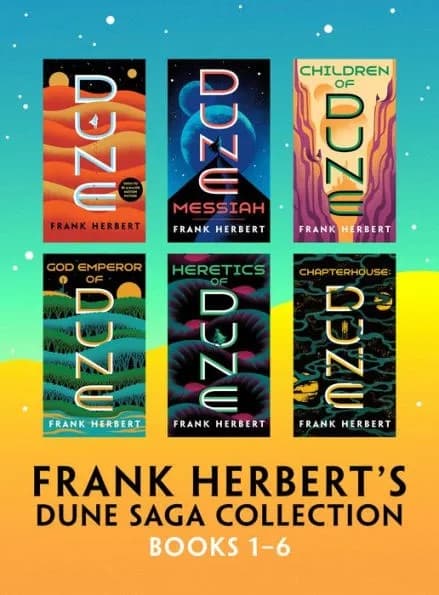
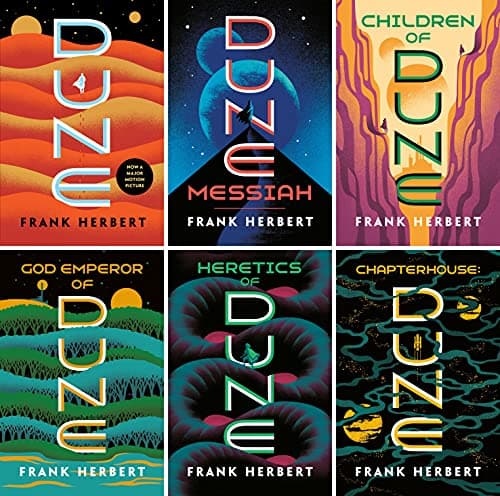
BooksclassicsFrank Herbert's Dune Saga 6-Book Boxed Set: Dune, Dune Messiah, Children of Dune, God Emperor of Dune, Heretics of Dune, and Chapterhouse: Dune

№ 1 · Dune
In the distant future of the Padishah Empire, humanity has spread across the stars, yet it remains shackled to a rigid feudal system where noble houses vie for influence under the shadow of an absolute Emperor. Central to this interstellar economy is the desert planet Arrakis, the only known source of the spice melange. This substance is not merely a luxury; it is a biological necessity for space travel, granting the Navigators of the Spacing Guild the prescience required to fold space. Without the spice, the machinery of galactic civilization would grind to an immediate halt, making Arrakis the most dangerous and coveted piece of territory in the universe.
The narrative begins as House Atreides is ordered by the Emperor to leave their lush homeworld of Caladan to take stewardship of Arrakis, replacing their ancestral enemies, the ruthless House Harkonnen. This move is recognized by Duke Leto Atreides as a "feud-mille," a trap designed to overextend his resources and provoke a fatal conflict. At the heart of this transition is Leto’s son, Paul, a young man who has been trained in the secret mental arts of the Bene Gesserit and the strategic calculations of the Mentats. As the Atreides family attempts to secure the "water-wealth" of the desert and build an alliance with the indigenous Fremen, they find themselves caught in a web of corporate sabotage, religious prophecy, and a multi-generational conspiracy that seeks to steer the very course of human evolution.
The world of Arrakis is defined by its brutal environmental constraints. Water is the primary currency, and every aspect of the culture—from the "stillsuits" that reclaim the body's moisture to the "sandtrout" that dictate the planet's lifecycle—is a response to the lack of it. Herbert builds a complex biological machine where the giant sandworms are not just monsters, but essential components of the spice production cycle. The atmosphere is one of constant physiological tension, where the environment itself is a character that punishes any lapse in discipline or foresight.
In a universe that has banned "thinking machines" following an ancient holy war against artificial intelligence, the saga explores the limits of human potential. Instead of computers, society relies on specialized humans: Mentats, who function as living calculators, and the Bene Gesserit, who have mastered their own biochemistry and the art of "The Voice" to influence others. This focus on "soft" technology creates a unique atmosphere where political maneuvers are conducted with the precision of a chess match, and the greatest weapons are not lasers, but psychology, conditioning, and the manipulation of long-held religious myths.
While the saga utilizes the "Chosen One" trope, it does so to examine the inherent dangers of charismatic leadership. The narrative explores how religious folklore can be manufactured and planted by organizations like the Missionaria Protectiva to provide a safety net for their members in future generations. Paul is not a simple hero; he is a product of genetic engineering and social programming who is deeply aware that his rise to power might trigger a momentum he cannot control. The series functions as a cautionary tale about the intersection of messianic fervor and state power, questioning the morality of those who utilize faith as a tool for political liberation.
The structure of the Dune saga mirrors historical power struggles over finite resources. The "Great Convention" of noble houses and the CHOAM Company represent an interstellar version of corporate feudalism, where the extraction of resources outweighs the lives of the populace. By stripping away digital technology, Herbert forces the reader to confront the raw mechanics of power, showing how a single commodity can dictate the survival of a species and how those who control the "flow" of that commodity can hold the entire universe hostage.
Add to your library to track progress and write reviews
Find Frank Herbert's Dune Saga 6-Book Boxed Set: Dune, Dune Messiah, Children of Dune, God Emperor of Dune, Heretics of Dune, and Chapterhouse: Dune Frank Herbert in PDF, EPUB, ebook, audiobook, print, or library editions.

22 books in catalog
The desert planet of Arrakis, with its giant sandworms, complex ecology, and political factions vying for control over the spice melange, remains one of the most thoroughly detailed world-building achievements in speculative fiction. American author Frank Herbert introduced this setting in his seminal 1965 novel Dune, creating an expansive universe that transformed epic science fiction by weaving together ecology, philosophy, religion, and political intrigue.
Born in Tacoma, Washington in 1920, Herbert spent his youth in the Pacific Northwest and worked on local newspapers as a teenager. He attended the University of Washington in Seattle and worked a wide variety of jobs throughout his early adult life, including time as a TV cameraman, radio commentator, oyster diver, jungle survival instructor, lay analyst, and creative writing teacher. He also worked as a reporter and later editor of a number of West Coast newspapers before becoming a full-time writer. Herbert began publishing science fiction in 1952 with his short story 'Looking for Something?' in Startling Stories. His research into the Oregon Dunes during the 1950s served as a primary catalyst for his ecological themes. He achieved widespread fame more than ten years later following the serial publication in Analog of 'Dune World' and 'The Prophet of Dune', which were amalgamated into the novel Dune in 1965.
Herbert's fiction is distinguished by its intricate world-building, ecological awareness, and deep examination of human potential and institutional vulnerability. Rather than relying solely on technological advancement, his narrative focus often centers on human adaptability, psychological conditioning, religious mythmaking, and the perilous consequences of messianic leadership. He frequently explored how harsh environments shape cultures, social structures, and survival strategies, a focus prominently displayed in novels such as Destination: Void and The Jesus Incident alongside his desert sagas.
Dune