§Synopsis
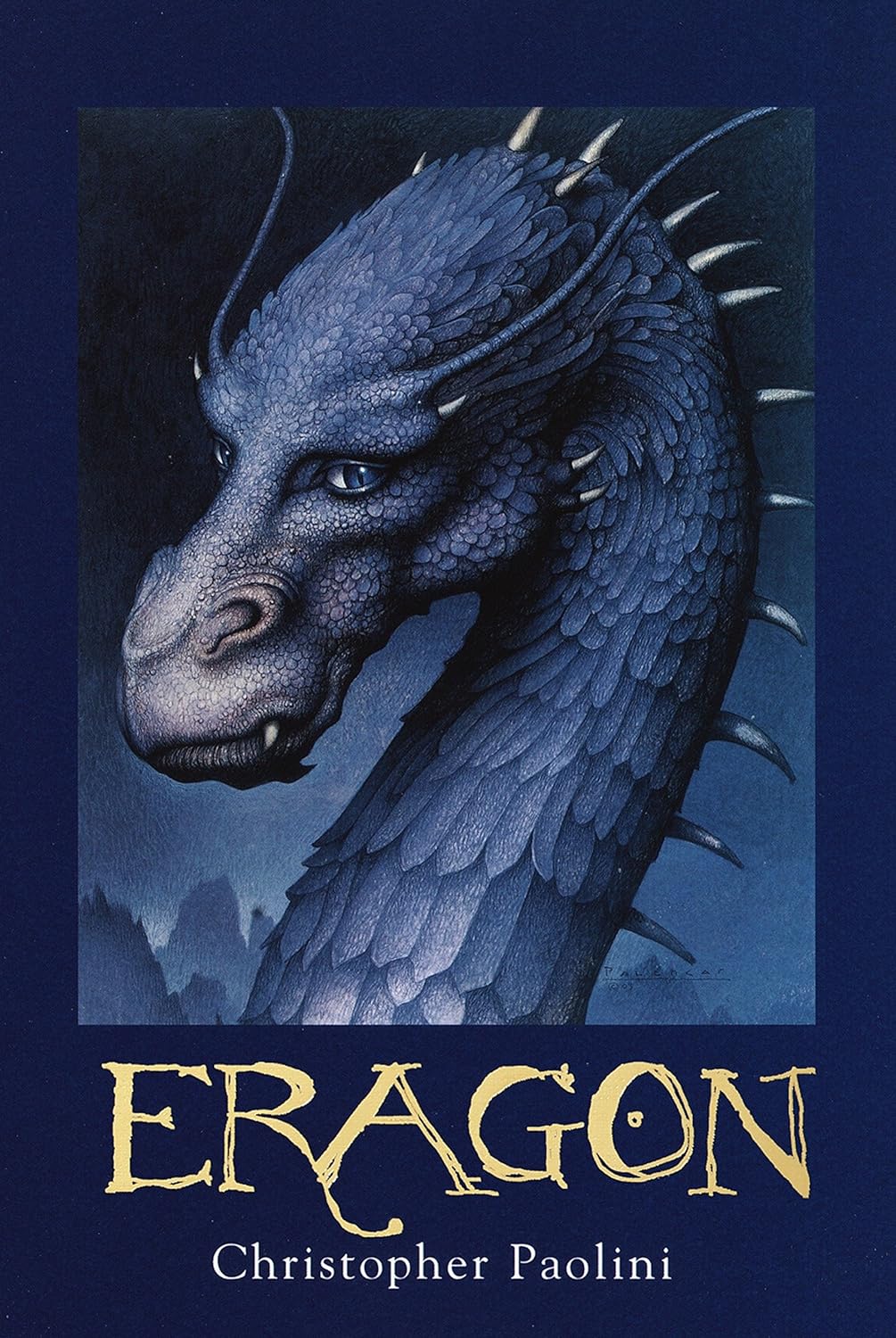
01When fifteen-year-old Eragon finds a polished blue stone in the forest, he thinks it is the lucky discovery of a poor farm boy. But when the stone brings a dragon hatchling, Eragon soon realizes he has stumbled upon a legacy nearly as old as the Empire itself.
Overnight his simple life is shattered, and, gifted with only an ancient sword, a loyal dragon, and sage advice from an old storyteller, Eragon is soon swept into a dangerous tapestry of magic, glory, and power. Now his choices could save—or destroy—the Empire.
§Our take
Eragon is most convincing as an invitation into fantasy and least convincing as an original piece of worldbuilding.
A blue stone, an ancient legacy and a farm boy swept into a war over the Empire make an irresistible premise, and Saphira is the reason to stay: her humor and the rider bond give the story warmth the plot often lacks. Much of the rest sits in the shadow of Tolkien and Star Wars, with elves, dwarves, a special sword and an empire to fight. Trade reviewers split down the same line. Kirkus and Publishers Weekly saw a promising epic; School Library Journal complained that magic solves too much, while The New York Times Book Review found clichés and real talent. Readers keep returning to one question: is it derivative, and does the dragon bond excuse the shortcuts? The unusual route to Knopf—self-published by Paolini's family, promoted at schools and libraries, then brought to the publisher by novelist Carl Hiaasen—makes the commercial success feel stranger.
§Themes
- Chosen by a stone
- A blue stone turns a farm boy into a Rider and pulls him into a struggle with the Empire.
- The dragon is the heart
- Saphira's humor and trust make the rider bond the book's warmest and most lasting pleasure.
- Borrowed blueprints
- Elves, dwarves, a special sword and an empire make the Tolkien and Star Wars comparison hard to ignore.
- Magic cuts every knot
- The magic system can solve a hard problem just as the danger starts to peak.
- A legend learns to lead
- Eragon grows through mentors who model self-control, perseverance and teamwork, though his quick mastery can feel unearned.
§How it was received
Early trade reviews were mostly positive but uneasy about familiarity: Kirkus called it a solid, sweeping epic with visible Tolkien influence, while Publishers Weekly welcomed a promising start. School Library Journal disliked convenient magic, and The New York Times Book Review was harsher on clichés and dialogue but still found real talent. Over time, the critical shorthand became “derivative but readable”; the novel became an immediate New York Times bestseller, and many readers still name Saphira and the gateway into fantasy as its lasting appeal.
§Read it if
- You want a clean gateway into high fantasy, with dragons, invented languages and a large map to explore
- You care more about Saphira's personality and the rider bond than originality or polished prose
- You like fast adventure once the quest starts and the trimmings of maps, glossaries and pronunciation keys
§Skip it if
- You need an original setting and nuanced characters. Tolkien and Star Wars are easy to see, and many readers who loved the book young now notice its clichés and flat supporting cast.
- Convenient magic, rapid skill gains and graphic violence make the story feel too neat or too harsh.
§Before you start
- Reading experience
- The opening can crawl before the quest picks up, while dense vocabulary, invented languages and graphic violence make this a demanding read for younger or first-time fantasy readers.
- Reading order
- Book 1 of The Inheritance Cycle. Follow it with Eldest (2005), Brisingr (2008) and Inheritance (2011); the planned trilogy became a four-book cycle. The Fork, the Witch, and the Worm (2018) contains later Eragon-universe stories, and Murtagh (2023) is a spin-off novel.
- Content notes
- Graphic fantasy violence and major character deaths, including beheading, tearing apart, torture, branding, poisoning, mountains of bodies and an infant impaled on a spear; The love interest is held captive or unconscious for much of the book; Some disabled characters are given pitiable portrayals; Minor substance use includes a character who regularly smokes a pipe and occasional beer or mead; One mild expletive appears; sexual content is limited to a crush, passing mentions of mistresses and a brief non-explicit bath scene.
§Common questions
- Is Eragon part of a series?
- Yes. It opens The Inheritance Cycle, followed by Eldest, Brisingr and Inheritance.
- Is Eragon just a Tolkien and Star Wars ripoff?
- Critics often see Tolkien and Star Wars in its plot and world, while Paolini names Tolkien, myth, Beowulf and other older sources as influences. Some readers call that homage; others call it a rehash.
- When was Eragon published?
- Paolini International, the family company, self-published the first copies in November 2001, according to the author; some listings date that edition to 2002. Alfred A. Knopf published the edited edition on 26 August 2003.
§If you liked this
- The Lord of the Rings by J. R. R. Tolkien — The obvious yardstick: Tolkien shaped Paolini's elves, dwarves, invented languages and quest structure, though Eragon reaches for Star Wars as well.
- Dragonflight (Dragonriders of Pern) by Anne McCaffrey — McCaffrey is another declared influence, and her telepathic rider-dragon bond gives Saphira and Eragon a clear precedent.
- A Wizard of Earthsea by Ursula K. Le Guin — Both put a young man through a fantasy education shaped by power, but Le Guin's prose is far more controlled and restrained.
Track this book
Add to your library to track progress and write reviews