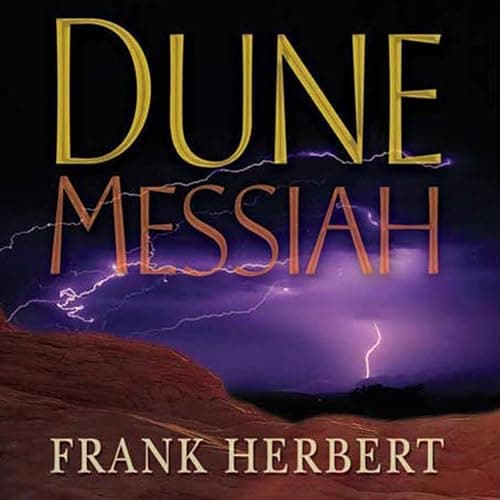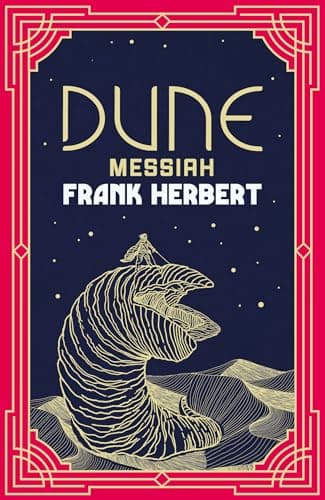
Twelve years have passed since Paul Atreides claimed the Golden Lion Throne, yet the victory that concluded the desert war on Arrakis has evolved into a burden of cosmic proportions. As the messianic figure known as Muad’Dib, Paul has become the reluctant figurehead of a galactic jihad that has claimed billions of lives in his name. He is no longer a simple revolutionary or a young duke seeking justice; he is a god-emperor trapped by the very religious fervor he ignited to survive, presiding over a sprawling empire that is beginning to buckle under the weight of its own bureaucracy and fanaticism.
While Paul’s prescience allows him to see the infinite threads of the future, this gift has become his ultimate cage. He is haunted by visions of a catastrophe he cannot yet avert, navigating a path where every choice seems to lead toward a predetermined tragedy. In the shadows of his court, an unholy alliance between the Spacing Guild, the Bene Gesserit, and the mysterious Tleilaxu begins to take shape. They do not seek to overthrow him with mere armies, but through a delicate web of biological engineering, political manipulation, and psychological warfare that strikes at the heart of Paul’s most intimate loyalties.
In this sequel, the focus shifts from the open sands of Arrakis to the claustrophobic corridors of power in the city of Arrakeen. The world-building explores the "Imperial Arrakis," where the once-ascetic Fremen have become an elite ruling class, and the planet itself has begun to undergo a forced ecological transformation. Herbert introduces the Tleilaxu, masters of genetic manipulation, whose "Face Dancers" and biological constructs challenge the definition of humanity. The atmosphere is one of gilded stagnation—a world where religion has become the law, and the infrastructure of the empire is built upon the worship of a man who desperately wishes to be human again.
The central arc of the narrative focuses on the psychological disintegration of a "Chosen One." Paul Atreides is no longer developing his powers; he is suffering from them. His development is defined by isolation; as a god, he has no peers, and his relationships with Chani and Alia are strained by the political necessities of the throne. The dynamic between Paul and the ghola Hayt serves as the emotional core of the first half, forcing Paul to confront the ghosts of his past while navigating a present where he cannot trust his own senses or his own visions.
Frank Herbert uses this installment to aggressively subvert the "Chosen One" and "Restoration of the King" tropes. While the first book followed the traditional trajectory of a hero reclaiming his birthright, the second book acts as a deconstruction of that success. It examines the "Great Man" theory of history, suggesting that individuals—no matter how powerful or prescient—are often swept away by the momentum of the social and religious movements they create. The book functions less like a space opera and more like a classical Greek tragedy, where the protagonist's primary conflict is not with an external villain, but with the inescapable nature of his own fate and the systems of power he helped build.
Add to your library to track progress and write reviews
Find Kāpas mesija Frank Herbert in PDF, EPUB, ebook, audiobook, print, or library editions.
Dune





22 books in catalog
The desert planet of Arrakis, with its giant sandworms, complex ecology, and political factions vying for control over the spice melange, remains one of the most thoroughly detailed world-building achievements in speculative fiction. American author Frank Herbert introduced this setting in his seminal 1965 novel Dune, creating an expansive universe that transformed epic science fiction by weaving together ecology, philosophy, religion, and political intrigue.
Born in Tacoma, Washington in 1920, Herbert spent his youth in the Pacific Northwest and worked on local newspapers as a teenager. He attended the University of Washington in Seattle and worked a wide variety of jobs throughout his early adult life, including time as a TV cameraman, radio commentator, oyster diver, jungle survival instructor, lay analyst, and creative writing teacher. He also worked as a reporter and later editor of a number of West Coast newspapers before becoming a full-time writer. Herbert began publishing science fiction in 1952 with his short story 'Looking for Something?' in Startling Stories. His research into the Oregon Dunes during the 1950s served as a primary catalyst for his ecological themes. He achieved widespread fame more than ten years later following the serial publication in Analog of 'Dune World' and 'The Prophet of Dune', which were amalgamated into the novel Dune in 1965.
Herbert's fiction is distinguished by its intricate world-building, ecological awareness, and deep examination of human potential and institutional vulnerability. Rather than relying solely on technological advancement, his narrative focus often centers on human adaptability, psychological conditioning, religious mythmaking, and the perilous consequences of messianic leadership. He frequently explored how harsh environments shape cultures, social structures, and survival strategies, a focus prominently displayed in novels such as Destination: Void and The Jesus Incident alongside his desert sagas.