§Synopsis
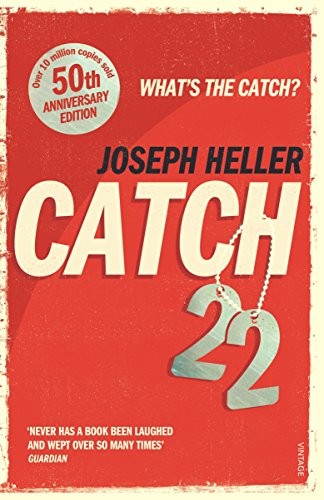
01Catch-22 is like no other novel. It has its own rationale, its own extraordinary character. It moves back and forth from hilarity to horror. It is outrageously funny and strangely affecting. It is totally original. Set in the closing months of World War II in an American bomber squadron off Italy, Catch-22 is the story of a bombardier named Yossarian, who is frantic and furious because thousands of people he hasn't even met keep trying to kill him. Catch-22 is a microcosm of the twentieth-century world as it might look to someone dangerously sane. It is a novel that lives and moves and grows with astonishing power and vitality -- a masterpiece of our time. - Back cover.
§Our take
Catch-22 is at its best when the joke is the trap: every attempt to escape the war proves why escape is forbidden. Heller's circular narration can feel like busywork on the first pages, especially with a large cast and abrupt chronology, but that looping is the book's central joke rather than mere perversity. Give it five chapters; many readers find the accumulated absurdity suddenly clicks.
The harder issue is what sits beneath the laughter. Early reviewers were split, and Orville Prescott called it a dazzling performance that many readers might endure rather than enjoy. A peer-reviewed essay argues that the book handles women and sexual violence inconsistently, with a hospital sequence played for laughs. Those complaints matter. Catch-22 is not merely a clever antiwar romp; it is a funny book with sharp edges, and some of those edges cut in uncomfortable places.
§Themes
- The Catch-22 trap
- A request to be excused proves Yossarian is sane, so the rule requires him to fly, while anyone eager to fly is declared insane.
- War as private enterprise
- Milo's profiteering syndicate and the scramble for rank turn the squadron's machinery toward money and advancement.
- Absurdity with bodies attached
- Gallows humor keeps death at arm's length until the grimness later breaks through the comic frame.
- The Cold War in uniform
- Loyalty oaths, corporate jargon and computer-age touches carry Heller's postwar present into the 1940s squadron.
- The limits of the joke
- The novel's treatment of women and sexual violence is uneven, and a hospital scene involving a nurse is played for comedy.
§How it was received
Reviews in 1961 were sharply divided: Kirkus called it comic, inventive and sometimes grim, while Orville Prescott said it was not a good novel by conventional measures but still a dazzling performance likely to anger as many readers as it pleased. Some critics found it repetitive and formless, a charge Heller disputed. The hardcover was not a bestseller, but the 1962 paperback and word of mouth among young readers made it a national success, and it later reached canonical status; it was a 1962 National Book Award finalist, not a winner.
§Read it if
- You like satire that rewards patience and a second reading
- You want the enemy to include rank, paperwork, profit and institutional self-interest
- You can handle dark comedy that eventually gives way to horror
§Skip it if
- You prefer a linear plot and a small cast. The opening shifts time and adds many characters, and some readers find the voice confusing.
- You expect the book to handle sexual violence consistently. It doesn't: a hospital scene involving a nurse is played for laughs, a choice challenged by a peer-reviewed essay.
§Before you start
- Reading experience
- The opening is the hard part: time shifts, the cast expands, and the circular style can feel repetitive, but many readers say the book clicks after the first few chapters or around halfway.
- Reading order
- Not in a series. Catch-22 is a standalone novel. Closing Time (1994) follows Yossarian and Sammy Singer in old age; it is optional, not required, and reviewers judged it much weaker beside the original.
- Content notes
- War violence and death, including some graphic scenes presented through dark humor; Sexual violence and the objectification of women; a hospital scene involving a nurse is played for comedy; Period slurs and a demeaning term for women.
§Common questions
- What does the title Catch-22 mean?
- It names the rule that traps Yossarian: asking to be excused from dangerous missions proves he is sane, so he must keep flying, while anyone willing to fly is called insane.
- Why is 1955 sometimes attached to Catch-22?
- The novel was first published in October 1961. Its opening excerpt appeared in 1955 as Catch-18; the title changed after Leon Uris's Mila 18 made the number awkward.
- Is Catch-22 part of a series?
- No. It is a standalone. Closing Time (1994) is an optional sequel, and reviewers judged it much weaker beside the original.
§If you liked this
- Slaughterhouse-Five by Kurt Vonnegut — The nearest companion: another non-linear, darkly comic World War II novel, though Vonnegut's version is more fragmented and dreamlike.
- The Good Soldier Svejk by Jaroslav Hasek — Heller cited Hasek as an influence; Svejk outwits army absurdity through passive resistance, while Yossarian schemes actively.
- Candide by Voltaire — Prescott compared Catch-22 to it for its mixture of satire and brutality.
- The Trial by Franz Kafka — Prescott also drew the comparison, and Kafka's helpless confrontation with an illogical system has the same trapping quality.
- Something Happened by Joseph Heller — Heller's quieter corporate-suburban follow-up; some recent critics rank it above Catch-22 for its subtlety.
Sources
- Wikipedia
- Kirkus Reviews
- Literary Hub
- LitCharts
- Encyclopedia.com (reference biography)
- Middle Tennessee State University, First Amendment Encyclopedia
- National Book Foundation
- European Journal of American Studies (scholarly article, Rogers)
- Goodreads discussion
- Goodreads discussion
- Common Sense Media
- Common Sense Media
- Audiobooks.com
Track this book
Add to your library to track progress and write reviews