
§Author· 1 book
Joseph Heller
Also known as Joe Heller
Satirical literature of the twentieth century was profoundly redefined by military and bureaucratic farce, most notably through the creation of a title phrase that became a permanent idiom for absurd, paradoxical logic. American satirical novelist, short story writer, and playwright Joseph Heller achieved lasting prominence with his 1961 debut novel, Catch-22, a scathing critique of war and institutional dysfunction based in part on his own World War II service.
Beyond his famous debut, Heller produced a substantial body of work including novels, stage plays, screenplays, and nonfiction that probed modern anxiety, ambition, and institutional absurdities. His writing garnered widespread acclaim and earned him nominations for the Nobel Prize in Literature in 1972 and 1975.
Career & Background
Born on May 1, 1923, in the Coney Island neighborhood of Brooklyn, New York, Heller was raised in a Jewish immigrant household. His father, a bakery delivery man, died when Heller was five years old, leaving his mother, his brother Lee, and his sister Sylvia to raise him. After serving during World War II, Heller pursued higher education and worked in advertising and teaching before publishing Catch-22 in 1961. The novel gained immense momentum during the 1960s, leading to a major 1970 feature film adaptation and cementing his reputation as a key voice in post-World War II American fiction.
Although more than a decade elapsed before his second novel appeared, Heller maintained a distinct writing pace. He followed his debut with Something Happened in 1974, a deep exploration of corporate angst, and continued publishing fiction and drama over the following decades. In addition to his novels, Heller wrote plays and non-fiction works until his death on December 12, 1999, in East Hampton, New York.
Writing Style & Themes
Heller's signature writing style combines irreverent humor, circular dialogue, and dark satire to illustrate human existence as fragmented and absurd. His narratives frequently target rigid institutional structures, military bureaucracy, and capitalist pressures, exposing how corporate and governmental systems trap individuals in nonsensical loops of authority.
Major Works
- Catch-22 — Published in 1961, this classic satirical novel draws on World War II experiences to depict the absurdities of military bureaucracy and wartime logic, coining a classic phrase for contradictory choices.
- Something Happened — Released in 1974, Heller's long-awaited second novel examines corporate disillusionment and domestic anxiety through the internal monologue of an American businessman.
- Good as Gold — Published in 1979, this satirical novel explores political corruption, family dynamics, and Jewish-American identity in Washington, D.C.
- God Knows — A 1984 novel featuring a humorous, first-person deathbed monologue by the biblical King David, blending ancient history with contemporary vernacular.
- Closing Time — Published in 1994, this novel serves as a sequel to Catch-22, revisiting characters like Yossarian in late-twentieth-century New York.
§All Books
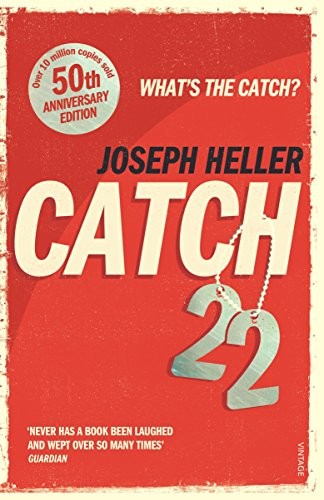
Catch-22
Joseph Heller, 1955
1,102 ratings
§ About Joseph Heller's books
- Books on SansFiction
- 1
- Published
- 1955
- Average rating
- 4.0 / 5 across 1,102 ratings
- Genres
- Classics, Comedy, Fiction, Historical Fiction
The book: Catch-22 (1955)
Catch-22 is like no other novel. It has its own rationale, its own extraordinary character. It moves back and forth from hilarity to horror. It is outrageously funny and strangely affecting. It is totally original.
Common questions about Joseph Heller
- Who is Joseph Heller?
- Born on May 1, 1923, in the Coney Island neighborhood of Brooklyn, New York, Heller was raised in a Jewish immigrant household. His father, a bakery delivery man, died when Heller was five years old, leaving his mother, his brother Lee, and his sister Sylvia to raise him. After serving during World War II, Heller pursued higher education and worked in advertising and teaching before publishing Catch-22 in 1961.
- What is Joseph Heller best known for?
- Joseph Heller is best known for Catch-22, published in 1955 with 1,102 ratings and a 4.0 average. It is the most-rated of Joseph Heller's books on SansFiction.
- What genres does Joseph Heller write?
- Joseph Heller's books on SansFiction are tagged Classics, Comedy, Fiction and Historical Fiction.
Explore: Classics · Comedy · Fiction · Historical Fiction