
Shadow Moon is a man defined by his movement, a drifter navigating the liminal spaces where the divine meets the mundane. After the world-shaking events of his past in America, he finds himself wandering the rugged, mist-soaked landscapes of the English Peak District. In this quieter, more claustrophobic setting, the grand scale of global mythology is replaced by the intimate, suffocating weight of local folklore. When a sudden storm forces Shadow to seek refuge in a village pub, he is drawn into the lives of the locals, discovering that even the smallest towns harbor ancient, hungry secrets.
The tension of the narrative centers on the legend of the Black Dog—a spectral apparition that, according to regional myth, serves as a grim harbinger of death. As Shadow accepts the hospitality of a local couple, he learns of a recent tragedy involving a young woman named Cassie, whose death seems inextricably linked to the sightings of this ghostly hound. The conflict is not merely one of survival against a supernatural entity, but a psychological exploration of how a community processes grief and whether the "Black Dog" is a literal monster or a manifestation of the collective depression and history embedded in the very soil of the village.
Gaiman shifts the world-building from the expansive highways of the United States to the dense, layered history of rural England. The setting functions as a character itself, defined by "holloways," ancient stone walls, and a sense that the past is never truly buried. The rules of this world are governed by traditional British folklore, where the supernatural is subtle, creeping in through the peripheral vision rather than announcing itself with thunder. It is a landscape where the boundary between a metaphor for mental illness and a corporeal ghost is intentionally thin, creating an atmosphere of quiet, mounting dread.
Following the events of "American Gods," Shadow Moon has evolved from a passive pawn into a more proactive, albeit still stoic, observer. His development in this story focuses on his heightened intuition; he no longer questions the existence of the impossible but instead seeks to understand its mechanics. His interaction with Oliver and Moira reflects a man searching for a moment of normalcy while remaining perpetually attuned to the "wrongness" beneath the surface. This dynamic highlights Shadow's isolation—he is a man who can enter a home but never truly belong to the world of the living or the dead.
The novella utilizes the "Stranger in Town" trope to peel back the layers of a closed community, a staple of British folk horror. However, Gaiman subverts the standard ghost story by weaving in the linguistic history of the "Black Dog" as a metaphor for depression—a term famously used by Winston Churchill. By blending the literal "Black Shuck" of English myth with the figurative weight of psychological struggle, the story challenges the reader to determine if the threat is an external predator or an internal collapse. It leans into the "Harbinger of Death" trope while questioning if the omen causes the tragedy or simply arrives to witness it.
Shadow Moon is a man defined by his movement, a drifter navigating the liminal spaces where the divine meets the mundane. After the world-shaking events of his past in America, he finds himself wandering the rugged, mist-soaked landscapes of the English Peak District. In this quieter, more claustrophobic setting, the grand scale of global mythology is replaced by the intimate, suffocating weight of local folklore. When a sudden storm forces Shadow to seek refuge in a village pub, he is drawn into the lives of the locals, discovering that even the smallest towns harbor ancient, hungry secrets.
The tension of the narrative centers on the legend of the Black Dog—a spectral apparition that, according to regional myth, serves as a grim harbinger of death. As Shadow accepts the hospitality of a local couple, he learns of a recent tragedy involving a young woman named Cassie, whose death seems inextricably linked to the sightings of this ghostly hound. The conflict is not merely one of survival against a supernatural entity, but a psychological exploration of how a community processes grief and whether the "Black Dog" is a literal monster or a manifestation of the collective depression and history embedded in the very soil of the village.
Gaiman shifts the world-building from the expansive highways of the United States to the dense, layered history of rural England. The setting functions as a character itself, defined by "holloways," ancient stone walls, and a sense that the past is never truly buried. The rules of this world are governed by traditional British folklore, where the supernatural is subtle, creeping in through the peripheral vision rather than announcing itself with thunder. It is a landscape where the boundary between a metaphor for mental illness and a corporeal ghost is intentionally thin, creating an atmosphere of quiet, mounting dread.
Following the events of "American Gods," Shadow Moon has evolved from a passive pawn into a more proactive, albeit still stoic, observer. His development in this story focuses on his heightened intuition; he no longer questions the existence of the impossible but instead seeks to understand its mechanics. His interaction with Oliver and Moira reflects a man searching for a moment of normalcy while remaining perpetually attuned to the "wrongness" beneath the surface. This dynamic highlights Shadow's isolation—he is a man who can enter a home but never truly belong to the world of the living or the dead.
The novella utilizes the "Stranger in Town" trope to peel back the layers of a closed community, a staple of British folk horror. However, Gaiman subverts the standard ghost story by weaving in the linguistic history of the "Black Dog" as a metaphor for depression—a term famously used by Winston Churchill. By blending the literal "Black Shuck" of English myth with the figurative weight of psychological struggle, the story challenges the reader to determine if the threat is an external predator or an internal collapse. It leans into the "Harbinger of Death" trope while questioning if the omen causes the tragedy or simply arrives to witness it.
Add to your library to track progress and write reviews
Find Black Dog Neil Gaiman in PDF, EPUB, ebook, audiobook, print, or library editions.
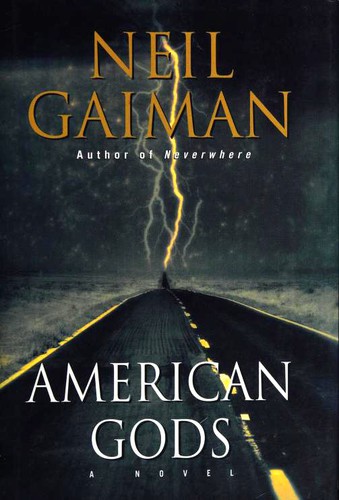
American Gods
American Gods

44 books in catalog
Groundbreaking dark fantasy comic books and dark, whimsical prose fiction have reshaped speculative literature, most famously through the comic book series The Sandman. English author Neil Gaiman, born Neil Richard Gaiman on 10 November 1960, created this influential series before publishing widely acclaimed fantasy novels including Stardust, American Gods, Coraline, and The Graveyard Book.
Born Neil Richard Gaiman in Portchester, Hampshire, UK, he spent much of his childhood reading in public libraries, where he discovered the works of C.S. Lewis, J.R.R. Tolkien, Edgar Allan Poe, Ursula K. LeGuin, and G.K. Chesterton. He began his professional career in journalism before transitioning into comic book writing in the late 1980s, gaining prominence with Black Orchid in 1988 and launching The Sandman series for DC Comics' Vertigo imprint in 1989. Over the subsequent decades, he expanded into writing novels, short fiction, audio theatre, screenplays, and films, eventually taking up residence in the United States near Minneapolis.
His fiction has earned widespread critical recognition, receiving Hugo, Nebula, and Bram Stoker awards. In 2008, he published The Graveyard Book, becoming the first author to win both the American Newbery Medal and the British Carnegie Medal for the same work. In 2013, his novel The Ocean at the End of the Lane was voted Book of the Year in the British National Book Awards. His extensive bibliography and media adaptations continued to draw major critical attention through 2017 and beyond.
Gaiman's literary work is noted for combining imaginative fantasy with a darkly humorous tone, fusing modern settings with classical mythology, folklore, and fairy tale motifs. His stories frequently explore themes of memory, childhood innocence, ancient gods navigating contemporary society, and the fundamental power of stories. Across all age categories, his narratives balance gothic atmosphere with warm human empathy and sharp observational wit.

44 books in catalog
Groundbreaking dark fantasy comic books and dark, whimsical prose fiction have reshaped speculative literature, most famously through the comic book series The Sandman. English author Neil Gaiman, born Neil Richard Gaiman on 10 November 1960, created this influential series before publishing widely acclaimed fantasy novels including Stardust, American Gods, Coraline, and The Graveyard Book.
Born Neil Richard Gaiman in Portchester, Hampshire, UK, he spent much of his childhood reading in public libraries, where he discovered the works of C.S. Lewis, J.R.R. Tolkien, Edgar Allan Poe, Ursula K. LeGuin, and G.K. Chesterton. He began his professional career in journalism before transitioning into comic book writing in the late 1980s, gaining prominence with Black Orchid in 1988 and launching The Sandman series for DC Comics' Vertigo imprint in 1989. Over the subsequent decades, he expanded into writing novels, short fiction, audio theatre, screenplays, and films, eventually taking up residence in the United States near Minneapolis.
His fiction has earned widespread critical recognition, receiving Hugo, Nebula, and Bram Stoker awards. In 2008, he published The Graveyard Book, becoming the first author to win both the American Newbery Medal and the British Carnegie Medal for the same work. In 2013, his novel The Ocean at the End of the Lane was voted Book of the Year in the British National Book Awards. His extensive bibliography and media adaptations continued to draw major critical attention through 2017 and beyond.
Gaiman's literary work is noted for combining imaginative fantasy with a darkly humorous tone, fusing modern settings with classical mythology, folklore, and fairy tale motifs. His stories frequently explore themes of memory, childhood innocence, ancient gods navigating contemporary society, and the fundamental power of stories. Across all age categories, his narratives balance gothic atmosphere with warm human empathy and sharp observational wit.