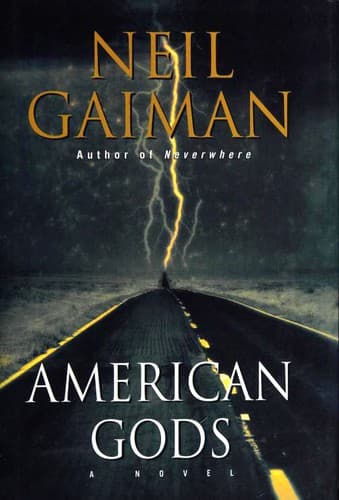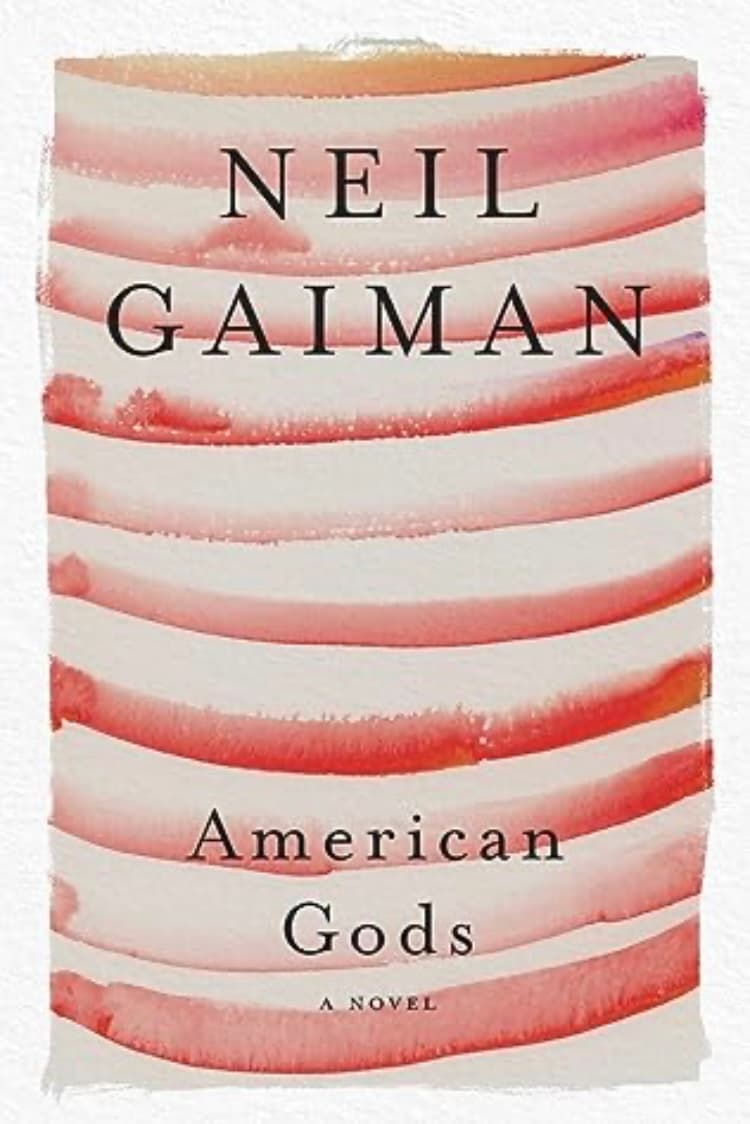
Shadow Moon enters the world after a three-year prison stint only to find the life he was returning to has vanished. His wife, Laura, is dead in a tragic accident, and the future he meticulously planned while behind bars has dissolved into a vacuum of grief and uncertainty. With no remaining ties to his former existence and a void where his purpose used to be, Shadow finds himself adrift in a Midwestern landscape that feels increasingly surreal, haunted by unsettling dreams and a growing sense that the reality he understands is merely a thin veil over something much older.
A chance encounter with a charismatic, enigmatically manipulative man calling himself Mr. Wednesday offers Shadow a way forward. Accepting a position as a bodyguard and driver, Shadow is pulled into a transcontinental road trip that serves as a recruitment drive for an impending conflict. As they traverse the backroads of America, Shadow discovers that the country is populated by forgotten figures from ancient folklore who were brought to the New World by centuries of immigrants. These entities, now displaced and fading, are struggling to survive in a modern landscape that has shifted its devotion toward new, tangible obsessions.
The world of this narrative operates on the mechanic that belief is a literal, generative force. When people moved to America, they brought their spirits, monsters, and deities with them, but these entities are only as powerful as the faith and sacrifice offered to them. The atmosphere is one of fading glory and roadside Americana, where "holy places" are not cathedrals, but tourist traps like the House on the Rock—locations where the energy of millions of visitors creates a thinning of the fabric between the mundane and the "backstage" of reality. This setting establishes a world where the supernatural is gritty, impoverished, and hiding in plain sight within the cracks of the working class.
Shadow begins the story in a state of emotional paralysis. His initial character arc is defined by a refusal to be surprised; having been hardened by prison, he adopts a "don't ask" policy toward the supernatural occurrences he witnesses. His relationship with Mr. Wednesday is one of transactional skepticism. However, as he is exposed to the "backstage" of America, Shadow is forced to move from a passive observer of his own life to an active participant in a reality he doesn't yet believe in. His development hinges on his ability to reconcile his grounded, literal mind with a world that operates on metaphor and myth.
The novel utilizes the classic trope of the American road trip but strips away the traditional themes of discovery and freedom. Instead, the journey across the United States is framed as a strategic mobilization. It subverts the "Urban Fantasy" genre by moving the focus away from hidden magical societies in big cities and placing it in the "flyover" states and forgotten towns. By doing so, it explores the trope of the "Old vs. New" conflict, not as a simple battle of good and evil, but as a struggle for relevance in a culture that discards its history in favor of the next technological advancement.
Publishers Weekly liked the small-town portraits and dry humor in 2001 but thought the plot drifted from episode to episode, and readers have kept the argument going: some find the middle slow and aimless, others treat the detours as the reason to be there. What almost everyone singles out is the premise, that gods shrink when belief goes elsewhere, which readers most often call the book's best idea. The "Coming to America" interludes, tracing how each wave of immigrants carried its religion across, are either the backbone, as LitCharts argues, or an interruption, depending on who you ask. Shadow Moon divides people too. Some find him passive or blank; others warm to his stillness against all the strangeness.
Add to your library to track progress and write reviews
Kirkus, reviewing before publication, greeted it warmly as a tour through world mythologies that's also a love story. Publishers Weekly was more reserved, praising the human moments and faulting the drifting plot. The book then took the 2002 Hugo for Best Novel, beating Perdido Street Station, and is also credited with the Nebula, Locus Fantasy and Bram Stoker awards.
Find American Gods Neil Gaiman in PDF, EPUB, ebook, audiobook, print, or library editions.

44 books in catalog
Groundbreaking dark fantasy comic books and dark, whimsical prose fiction have reshaped speculative literature, most famously through the comic book series The Sandman. English author Neil Gaiman, born Neil Richard Gaiman on 10 November 1960, created this influential series before publishing widely acclaimed fantasy novels including Stardust, American Gods, Coraline, and The Graveyard Book.
Born Neil Richard Gaiman in Portchester, Hampshire, UK, he spent much of his childhood reading in public libraries, where he discovered the works of C.S. Lewis, J.R.R. Tolkien, Edgar Allan Poe, Ursula K. LeGuin, and G.K. Chesterton. He began his professional career in journalism before transitioning into comic book writing in the late 1980s, gaining prominence with Black Orchid in 1988 and launching The Sandman series for DC Comics' Vertigo imprint in 1989. Over the subsequent decades, he expanded into writing novels, short fiction, audio theatre, screenplays, and films, eventually taking up residence in the United States near Minneapolis.
His fiction has earned widespread critical recognition, receiving Hugo, Nebula, and Bram Stoker awards. In 2008, he published The Graveyard Book, becoming the first author to win both the American Newbery Medal and the British Carnegie Medal for the same work. In 2013, his novel The Ocean at the End of the Lane was voted Book of the Year in the British National Book Awards. His extensive bibliography and media adaptations continued to draw major critical attention through 2017 and beyond.
Gaiman's literary work is noted for combining imaginative fantasy with a darkly humorous tone, fusing modern settings with classical mythology, folklore, and fairy tale motifs. His stories frequently explore themes of memory, childhood innocence, ancient gods navigating contemporary society, and the fundamental power of stories. Across all age categories, his narratives balance gothic atmosphere with warm human empathy and sharp observational wit.
American Gods