№ 1 · Alice's Adventures in Wonderland
Alice's Adventures in Wonderland,
§Synopsis
01Alice's Adventures in Wonderland (commonly Alice in Wonderland) is an 1865 English children's novel by Lewis Carroll. A young girl named Alice falls through a rabbit hole into a fantasy world of anthropomorphic creatures. It is seen as an example of the literary nonsense genre.
One of the best-known works of Victorian literature, its narrative, structure, characters and imagery have had huge influence on popular culture and literature, especially in the fantasy genre.
§Our take
Wonderland is less a conventional story than a dream ruled by absurd etiquette, which is why it can enchant children and unsettle grown-ups at once. F. J. Harvey Darton called the nonsense the point rather than a moral lesson. Common Sense Media sees children's fantasy and adult satire in the same book. That double life explains its durability better than any single hidden code.
The book's rough edges are part of the bargain. Its twelve episodic chapters can feel shapeless, and the Victorian language, parody poems and wordplay can block younger readers. Read it aloud, ideally with Tenniel's classic engravings. An annotated edition can explain the jokes, but Gardner's notes trade some of the dream's flow for context. For readers who want momentum or a clear moral quest, this is the wrong Wonderland; for anyone willing to surrender to the nonsense, it remains gloriously stubborn.
§Themes
- Nonsense with rules
- Absurd instructions are followed with dead seriousness, so a strange internal logic survives even when ordinary sense does not.
- Identity in free fall
- Alice's abrupt changes in size turn childhood, adulthood and the difference between them into practical problems.
- Rules make power
- The croquet game and the trial show a social order where rules shift whenever the people in charge say so.
- Appetite turns dangerous
- Alice grows and shrinks by consuming things, while threats of being eaten or beheaded keep appetite comic and menacing.
- Learning out of joint
- Carroll bends familiar moral poems, Latin drill and schoolroom phrases into comic nonsense.
§How it was received
Early reviews were broadly warm; one called the book wildly fantastic and impossible, while Walter Besant predicted it would last as long as the language. F. J. Harvey Darton later argued that it marked the end of the preachy, moralising tradition in children's writing because the nonsense was the point, not a lesson. A Penguin essay notes the divide between story-lovers and meaning-hunters, while Common Sense Media continues to treat it as both children's fantasy and adult satire.
§Read it if
- You like a dreamlike adventure where jokes, poems and strange rules matter more than a conventional plot
- You want a book that children can enter as fantasy while adults hear the satire
- You enjoy reading aloud, especially with Tenniel's engravings or an annotated edition
§Skip it if
- You need a strong forward plot. The chapters are episodic and the logic refuses to settle.
- Dense Victorian diction, parody poems and wordplay are likely to wear you out
§Before you start
- Reading experience
- The twelve short, episodic chapters are easy to read in sittings, but the Victorian diction, parody poems and wordplay can be tougher than the book's length and reputation as a children's story suggest; it works best read aloud.
- Reading order
- First of two Alice novels. Through the Looking-Glass, and What Alice Found There (1871) is the sequel and can be read independently. The Nursery 'Alice' (1890) is a separate toddler-friendly retelling.
- Content notes
- The Queen of Hearts repeatedly demands beheadings, though none are shown on the page; The Duchess's cook throws crockery; The Caterpillar smokes a hookah, a very light substance reference; Some readers find the rude characters, disorientation and dream logic unsettling or anxiety-inducing.
§Common questions
- Which illustrated edition should I read?
- Tenniel's engravings are the classic choice. Gardner's annotations add Victorian context; Rackham, Oxenbury, Zwerger and Riddell each give the book a different mood.
- Is Alice's Adventures in Wonderland only for children?
- No. It is a children's novel by origin, but adult readers have long found social satire in its nonsense.
- Do I need to read Through the Looking-Glass?
- No. It is the sequel to Alice's Adventures in Wonderland, but it can be read independently.
§If you liked this
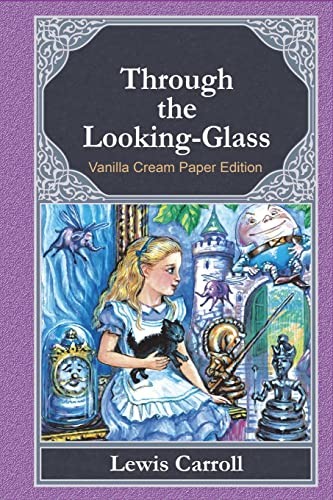
- Through the Looking-Glass by Lewis Carroll — The direct sequel trades Wonderland's cards and croquet for chessboard logic and mirror reversals, and includes 'Jabberwocky'.
- The Hunting of the Snark by Lewis Carroll — Carroll's later long nonsense poem offers more wordplay and less narrative than Alice.
- The Phantom Tollbooth by Norton Juster — A modern book of wordplay, absurdity and logic jokes, a good next read for readers who enjoy Alice's puns.
- A Book of Nonsense by Edward Lear — Edward Lear is Carroll's great Victorian companion for readers who care most about verse and comic rhyme.
- The Wonderful Wizard of Oz by L. Frank Baum — Baum gives a strange land and odd rulers a quest and moral shape, exactly what Alice deliberately lacks.
Track this book
Add to your library to track progress and write reviews