SSansFiction
The libraryCollectionsJournalStatsFor authors
Sign inJoin now
Sansfiction,

A digital library for books. Made by readers, for readers.

v 2.0 · 2026
The library
  • Discover
  • Collections
  • Book tracker
  • Journal
  • Stats
For authors
  • SF Links
  • Analytics
  • How it works
  • FAQ
Elsewhere
  • X / @sansfiction
  • Privacy
  • Terms
  • Contact
© 2026 SansFiction · Digital · GlobalA quiet room for your reading life.
The libraryCollectionsJournalStatsFor authors
Sign inJoin now →
Navigation
Library
Bookshelf
Journal
Discover
Collections
Tierlists
Stats
Profile
Author Page
Link Builder
Account
Sign in
S
G
BooksadventureДюна. Мессия Дюны. Дети Дюны
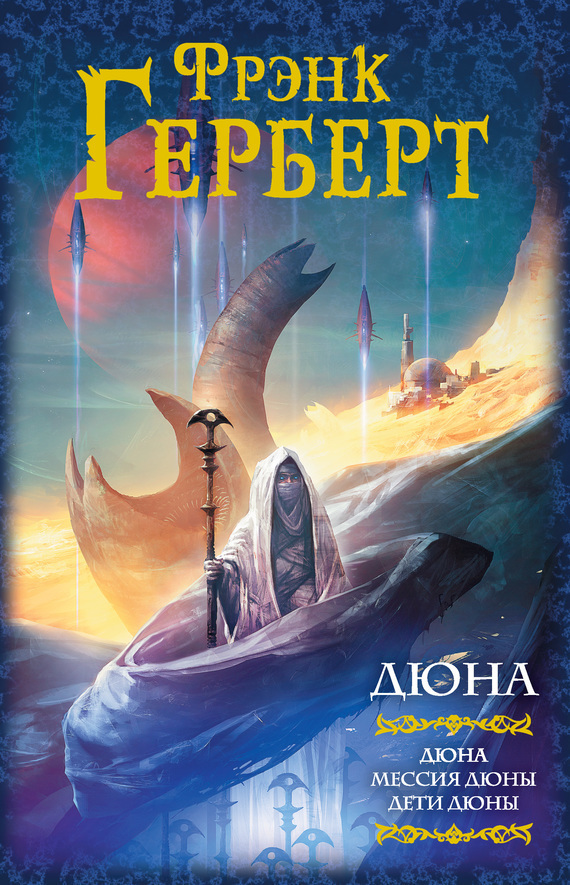
Cover of Дюна. Мессия Дюны. Дети Дюны by Frank Herbert
№ 1 · Dune

Дюна. Мессия Дюны. Дети Дюны,

by Frank Herbert, Павел Вязников, Юрий Соколов, Александр Анваер

Ask AI
Rating3.5/ 5
Ratings2
Pages1227
Reading Hours26h
Published1979
Language—

§Synopsis

01

Frank Herbert’s initial trilogy—comprising Dune, Dune Messiah, and Children of Dune—is less a celebration of a galactic hero and more a cautionary examination of the dangers inherent in following charismatic leaders. What begins as a classic struggle for survival on the harsh desert planet of Arrakis quickly evolves into a complex meditation on the intersection of religion, ecology, and absolute power. The narrative spans generations, shifting from the tactical maneuvers of House Atreides to the unintended consequences of a holy war that reshapes the known universe.

At its core, the saga explores the crushing weight of prescience—the ability to see the future—and how such knowledge can trap an individual in a predestined path. Arrakis itself acts as a crucible, where the scarcity of water and the abundance of the life-extending spice melange force humanity into a brutal sociopolitical structure. As the Atreides family rises to prominence, they must navigate a landscape of ancient prophecies, biological engineering, and the slow, agonizing transformation of a planet’s environment.

The Ecopolitical Machinery of Arrakis

The world-building of the "Dune" trilogy is defined by its meticulous attention to systems. Arrakis is a closed ecological loop where the life cycle of the giant sandworms is inextricably linked to the production of melange, a substance that grants longevity and allows for interstellar travel. Society is structured as a neo-feudal system where Great Houses compete for the Emperor's favor, overseen by the Spacing Guild’s monopoly on transport and the Bene Gesserit’s long-term genetic manipulation. The atmosphere is one of high-stakes paranoia, where every gesture and word carries weight, and survival depends on mastering the "water discipline"—the total conservation of moisture in a world that never rains.

Main Characters

  • Paul Atreides: The scion of a noble house caught between his duty as a leader and the terrifying visions of a messianic future he cannot control.
  • Lady Jessica: A sister of the Bene Gesserit order who chooses maternal love over her sect’s genetic mandates, initiating a chain of events that breaks an age-old prophecy.
  • Alia Atreides: Paul’s sister, born with the full consciousness and ancestral memories of a Reverend Mother, struggling to navigate a world that views her as an "Abomination."
  • Baron Vladimir Harkonnen: The calculating and hedonistic rival of the Atreides, whose mastery of political chess and industrial exploitation drives the initial conflict.
  • Leto II Atreides: One of Paul's twin children, he possesses the terrifying gift of ancestral memory and must decide how to handle the decaying legacy of his father’s empire.

The Deconstruction of the "Chosen One"

While the first volume utilizes the tropes of the "Hero’s Journey," the trilogy as a whole serves to subvert them. Paul Atreides does not simply gain power to defeat a villain; he is a protagonist who becomes a prisoner of his own myth. His development is marked by a tragic struggle against "terrible purpose"—the realization that his victory may unleash a religious frenzy across the stars. This thematic inversion is a cornerstone of Herbert’s work: he presents a savior only to reveal the horrific cost of salvation and the loss of individual agency that occurs when a man becomes a god.

Feudalism in the Far Future

Herbert utilizes several major science fiction tropes but reimagines them through a sociological lens. The "Galactic Empire" is not a high-tech utopia but a stagnant, regressive society where computers are banned, and human "Mentats" perform complex calculations. This setting allows the narrative to focus on human potential and social engineering rather than technological advancement. The "Dune" trilogy establishes the blueprint for the "Eco-SF" subgenre, showing how environmental scarcity dictates the evolution of culture, religion, and warfare. By the time the story reaches Children of Dune, the focus shifts from the survival of a house to the survival of the human species, as the characters face the ecological consequences of changing the desert landscape they once fought to conquer.

Track this book

Add to your library to track progress and write reviews

§Genres
adventure1classics1dystopian1fantasy1literary collections1science fiction1space1

§About the Author

Frank Herbert
Frank Herbert

22 books in catalog

The desert planet of Arrakis, with its giant sandworms, complex ecology, and political factions vying for control over the spice melange, remains one of the most thoroughly detailed world-building achievements in speculative fiction. American author Frank Herbert introduced this setting in his seminal 1965 novel Dune, creating an expansive universe that transformed epic science fiction by weaving together ecology, philosophy, religion, and political intrigue.

Career & Background

Born in Tacoma, Washington in 1920, Herbert spent his youth in the Pacific Northwest and worked on local newspapers as a teenager. He attended the University of Washington in Seattle and worked a wide variety of jobs throughout his early adult life, including time as a TV cameraman, radio commentator, oyster diver, jungle survival instructor, lay analyst, and creative writing teacher. He also worked as a reporter and later editor of a number of West Coast newspapers before becoming a full-time writer. Herbert began publishing science fiction in 1952 with his short story 'Looking for Something?' in Startling Stories. His research into the Oregon Dunes during the 1950s served as a primary catalyst for his ecological themes. He achieved widespread fame more than ten years later following the serial publication in Analog of 'Dune World' and 'The Prophet of Dune', which were amalgamated into the novel Dune in 1965.

Writing Style & Themes

Herbert's fiction is distinguished by its intricate world-building, ecological awareness, and deep examination of human potential and institutional vulnerability. Rather than relying solely on technological advancement, his narrative focus often centers on human adaptability, psychological conditioning, religious mythmaking, and the perilous consequences of messianic leadership. He frequently explored how harsh environments shape cultures, social structures, and survival strategies, a focus prominently displayed in novels such as Destination: Void and The Jesus Incident alongside his desert sagas.

Major Works

  • Dune — Published in 1965 after being serialized in Analog as 'Dune World' and 'The Prophet of Dune', this novel explores Paul Atreides's journey on the desert planet Arrakis amid feudal galactic politics and ecological struggle.
  • Dune Messiah — The second novel in the series continues the narrative of Paul Atreides, examining the tragic consequences of imperial power and religious fervor.
  • Children of Dune — The third installment focuses on Paul's twin children, Leto II and Ghanima, as they navigate the shifting ecological and political landscape of Arrakis.
  • Destination: Void — A standalone science fiction novel exploring artificial intelligence, human consciousness, and survival aboard a crewed starship.
  • The Jesus Incident — Co-authored with Bill Ransom, this novel expands upon the themes of artificial intelligence, worship, and ecological adaptation on an alien ocean world.

§Featured Series

Dune

Cover of Dune by Frank Herbert

Dune

Frank Herbert, 1965
Cover of Dune Messiah by Frank Herbert

Dune Messiah

Frank Herbert, 1965
Cover of Children of Dune by Frank Herbert

Children of Dune

Frank Herbert, 1975
Cover of God Emperor of Dune by Frank Herbert

God Emperor of Dune

Frank Herbert, 1981
Cover of Heretics of Dune by Frank Herbert

Heretics of Dune

Frank Herbert, 1984
Cover of Chapterhouse: Dune by Frank Herbert

Chapterhouse: Dune

Frank Herbert, 1985
Cover of Hunters of Dune by Brian Herbert, Kevin J. Anderson

Hunters of Dune

Brian Herbert, 2006
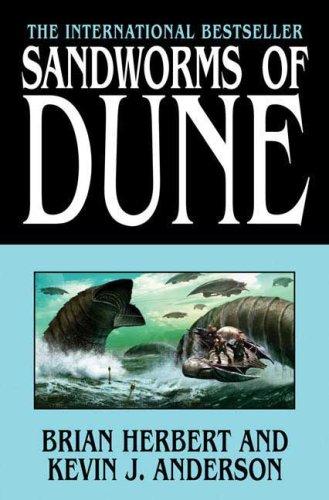
Cover of Sandworms of Dune by Brian Herbert, Kevin J. Anderson

Sandworms of Dune

Brian Herbert, 2007

§Also part of

Dune Universe (Chronological)Dune Universe (Publication Order)

§Other Editions

Cover of Дюна. Мессия Дюны. Дети Дюны

Дюна. Мессия Дюны. Дети Дюны

Hardcover
АСТ, Neoclassic19799785171042530
§Genres
adventure1classics1dystopian1fantasy1literary collections1science fiction1space1

Metadata

ISBN-139785170677252
ISBN-105170677251

Editions and availability

Find Дюна. Мессия Дюны. Дети Дюны Frank Herbert in PDF, EPUB, ebook, audiobook, print, or library editions.

Bookshop.orgGoogle Play BooksBarnes & NobleOpen Library