
§Author· 10 books
Thomas Pynchon
Also known as Thomas Ruggles Pynchon Jr., Thomas Ruggles Pynchon, Jr.
Dense historical landscapes, secret postal networks, V-2 rocket trajectories, and sprawling conspiracies form the foundation of postmodern fiction's most complex narratives.
Thomas Pynchon established a distinct presence in post-World War II American literature through encyclopedic novels such as Gravity's Rainbow and The Crying of Lot 49, blending mathematical concepts, historical research, and absurd humor.
Career & Background
Born Thomas Ruggles Pynchon Jr. on May 8, 1937, in Glen Cove, New York, he spent his childhood in nearby East Norwich and Oyster Bay against the backdrop of World War II and the early Cold War. He initially attended Cornell University to study engineering physics before serving two years in the United States Navy. Returning to Cornell, he earned a bachelor's degree in English in 1959, combining scientific and literary training in a way that shaped his rigorous approach to complex systems.
Pynchon published short fiction in the late 1950s before launching his novelistic career with V. in 1963. Throughout decades of writing, he maintained extreme personal privacy, declining public appearances and media interviews while living outside the public spotlight. His private correspondence from 1963 to 1982 with literary agent Candida Donadio offers documented glimpses into his creative discipline, personal anxieties, and the meticulous archival research required to build his multi-layered fiction.
Writing Style & Themes
Pynchon's prose is characterized by its paranoid atmosphere, vast structural scope, and dense interweaving of high-level mathematics, physics, history, and popular culture. Rather than focusing solely on individual psychological drama, his books explore how individuals are caught inside sprawling institutional networks, corporate monopolies, technological momentum, and state authority that operate beyond personal control.
A defining hallmark of his fiction is the juxtaposition of deep erudition with lowbrow comedy, slapstick, and musical numbers. His narratives frequently feature sprawling casts, underground countercultures, and unresolved mysteries where truth is fragmented and motives remain intentionally elusive.
Major Works
- V. — Published in 1963, Pynchon's debut novel traces navy veteran Benny Profane and searcher Herbert Stencil across interconnected historical vignettes as Stencil pursues an elusive, shifting entity known only as V.
- The Crying of Lot 49 — Published in 1966, this novel centers on Oedipa Maas as she uncovers evidence of a centuries-old covert postal distribution system named W.A.S.T.E. operating across Southern California.
- Gravity's Rainbow — Published in 1973, this landmark novel investigates the development, trajectory, and psychological fallout of the German V-2 rocket program during World War II, interweaving physics, occultism, and military bureaucracy.
- Vineland — Published in 1990, this story explores the retreat of 1960s radical counterculture and its confrontation with government surveillance and media influence in 1980s Northern California.
- Mason & Dixon — Published in 1997, this historical novel reimagines the eighteenth-century boundary survey conducted by Charles Mason and Jeremiah Dixon using period-appropriate prose, astronomy, and colonial politics.
- Against the Day — Published in 2006, this epic narrative spans from the 1893 Chicago World's Fair to World War I, weaving together anarchists, airship crews, early science fiction tropes, and corporate espionage.
- Inherent Vice — Published in 2009, this detective novel features private investigator Larry 'Doc' Sportello navigating 1970 Southern California counterculture, real estate schemes, and drug conspiracies.
- Bleeding Edge — Published in 2013, this investigative novel takes place in New York City during the 2001 dot-com bust and leading up to September 11, examining cyber-forensics and corporate malfeasance.
§All Books
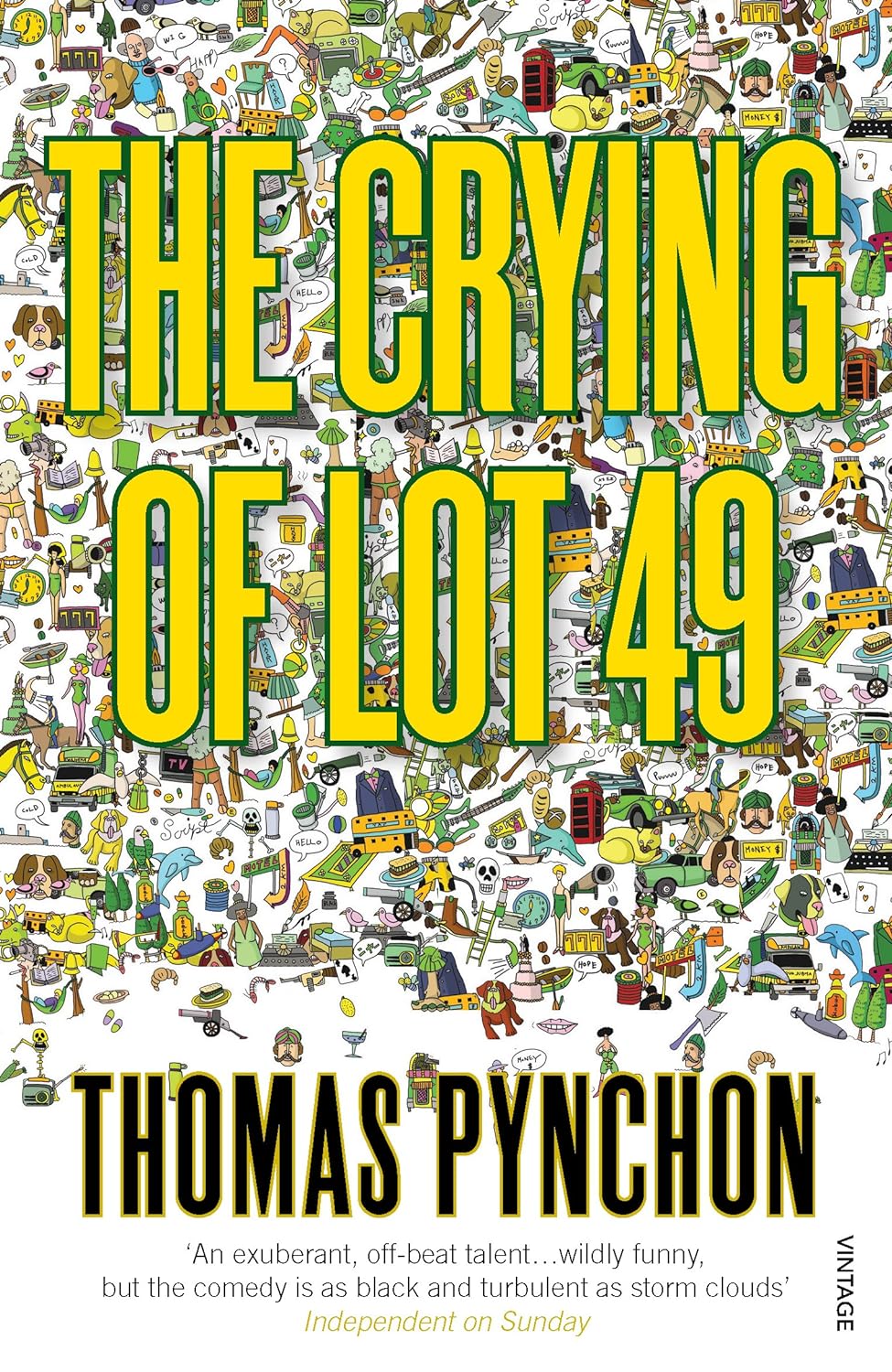
The Crying of Lot 49
Thomas Pynchon, 1965
276 ratings

Gravity's Rainbow
Thomas Pynchon, 1973
126 ratings

Inherent Vice
Thomas Pynchon, 2009
106 ratings

V.
Thomas Pynchon, 1963
63 ratings

Vineland
Thomas Pynchon, 1990
54 ratings

Bleeding Edge
Thomas Pynchon, 2013
43 ratings

Mason & Dixon
Thomas Pynchon, 1997
32 ratings

Against the Day
Thomas Pynchon, 2006
24 ratings

Shadow Ticket
Thomas Pynchon, 2025
9 ratings

Stone Junction: An Alchemical Pot-Boiler
Jim Dodge, 1990
8 ratings
§ About Thomas Pynchon's books
- Books on SansFiction
- 10
- Published
- 1963–2025
- Average rating
- 3.9 / 5 across 741 ratings
- Genres
- Science Fiction, General, History, Adventure
Start here: The Crying of Lot 49 (1965)
When her ex-lover, wealthy real-estate tycoon Pierce Inverarity, dies and designates her the coexecutor of his estate, California housewife Oedipa Maas is thrust into a paranoid mystery of metaphors, symbols, and the United States Postal Service.
Common questions about Thomas Pynchon
- Who is Thomas Pynchon?
- Born Thomas Ruggles Pynchon Jr. on May 8, 1937, in Glen Cove, New York, he spent his childhood in nearby East Norwich and Oyster Bay against the backdrop of World War II and the early Cold War. He initially attended Cornell University to study engineering physics before serving two years in the United States Navy.
- What is Thomas Pynchon best known for?
- Thomas Pynchon is best known for The Crying of Lot 49, published in 1965 with 276 ratings and a 3.8 average. It is the most-rated of Thomas Pynchon's books on SansFiction.
- How many books has Thomas Pynchon written?
- SansFiction lists 10 books by Thomas Pynchon, published between 1963 and 2025. The most popular are The Crying of Lot 49, Gravity's Rainbow, Inherent Vice, V. and Vineland.
- Which Thomas Pynchon book should I read first?
- The Crying of Lot 49 is the usual place to start: it is Thomas Pynchon's most-rated book here, with a 3.8 average.
- What genres does Thomas Pynchon write?
- Thomas Pynchon's books on SansFiction are tagged Science Fiction, General, History and Adventure.
Explore: Science Fiction · General · History · Adventure