Erik Larson
Historical narrative nonfiction that transforms archival research into suspenseful chronicles has redefined how readers engage with real-world history. Through books like The Devil in the White City, journalist and historian Erik Larson combines detailed archival documentation with narrative pacing to recount pivotal moments, from Gilded Age innovation and crime to pivotal moments of political crisis.
Career & Background
Born in Brooklyn on January 3, 1954, and raised in Freeport, Long Island, Larson earned a bachelor's degree from the University of Pennsylvania in 1976 and a master's degree from the Columbia University Graduate School of Journalism in 1978. He began his career in journalism as a feature writer for The Wall Street Journal and a senior writer for Time. His magazine articles have appeared in publications including The New Yorker, The Atlantic Monthly, and Harper's. Beyond his journalism, Larson has shared his craft as an instructor at San Francisco State University and the Johns Hopkins Writing Seminars.
Larson transitioned into writing narrative nonfiction books with Isaac's Storm in 1999, an international bestseller examining the 1900 Galveston hurricane. Seven of his books have become New York Times bestsellers, with four reaching the number-one position. Larson lives in Seattle with his wife, physician Christine Gleason, with whom he has three daughters.
Writing Style & Themes
Larson's approach relies on primary source research, drawing from historic diaries, personal letters, official records, and archival newspaper accounts. Influenced by creative nonfiction and classic true-crime reporting, he often structures his narratives around dual or parallel storylines—contrasting major technological or political developments against personal tragedies or hidden crimes. His works frequently explore themes of human hubris, institutional blind spots, and the complex atmospheric tensions preceding major historical catastrophes.
Major Works
- The Devil in the White City — This 2003 book contrasts the building of the 1893 Chicago World's Fair by architect Daniel Burnham with the sinister crimes of serial killer Dr. H. H. Holmes. A finalist for the National Book Award, it won the 2004 Edgar Award for Best Fact Crime and spent years on bestseller lists.
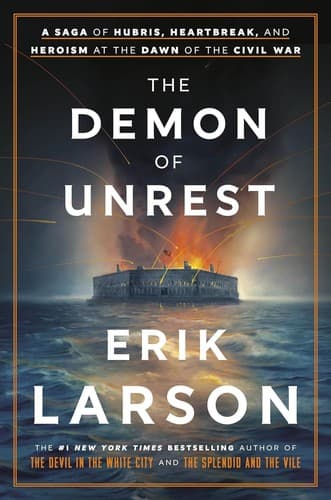
- The Demon of Unrest: A Saga of Hubris, Heartbreak, and Heroism at the Dawn of the Civil War — This narrative details the dramatic five-month window between Abraham Lincoln's election and the outbreak of the American Civil War at Fort Sumter, reaching the top spot on the New York Times bestseller list shortly after publication.
- In the Garden of Beasts: Love, Terror, and an American Family in Hitler's Berlin — Focusing on William E. Dodd, the first American ambassador to Nazi Germany, and his family during the rise of Hitler's regime, this book was acquired for publication in 20 countries and optioned by Tom Hanks for a feature film.
- Isaac's Storm — An international bestseller recounting the devastating 1900 hurricane that struck Galveston, Texas, and weather forecaster Isaac Cline's miscalculation of the impending storm.
- Dead Wake: The Last Crossing of the Lusitania — Published in 2015, this account captures the tragic 1915 sinking of the ocean liner Lusitania from the perspectives of passengers, military decision-makers, and the crew of the German U-boat.
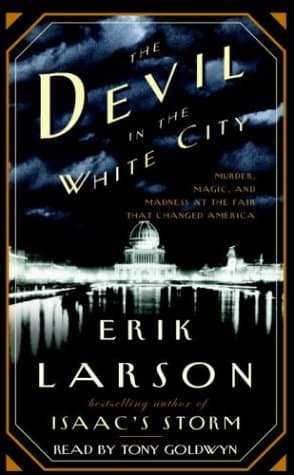
The Devil in the White City