BookshistoryThe Demon of Unrest: A Saga of Hubris, Heartbreak, and Heroism at the Dawn of the Civil War
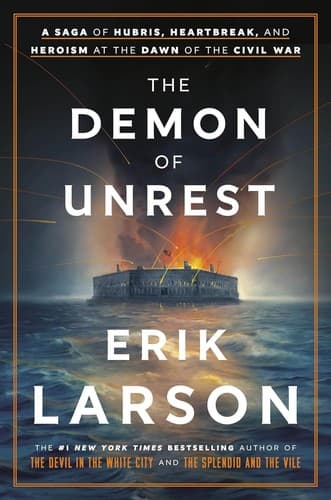
The Demon of Unrest: A Saga of Hubris, Heartbreak, and Heroism at the Dawn of the Civil War,
by Erik Larson
by Erik Larson
On November 6, 1860, Abraham Lincoln became the fluky victor in a tight race for president. The country was bitterly at odds; Southern extremists were moving ever closer to destroying the Union, with one state after another seceding and Lincoln powerless to stop them. Slavery fueled the conflict, but somehow the passions of North and South came to focus on a lonely federal fortress in Charleston Harbor: Fort Sumter.
Master storyteller Erik Larson offers a gripping account of the chaotic months between Lincoln’s election and the Confederacy’s shelling of Sumter—a period marked by tragic errors and miscommunications, enflamed egos and craven ambitions, personal tragedies and betrayals. Lincoln himself wrote that the trials of these five months were “so great that, could I have anticipated them, I would not have believed it possible to survive them.”
At the heart of this suspense-filled narrative are Major Robert Anderson, Sumter’s commander and a former slave owner sympathetic to the South but loyal to the Union; Edmund Ruffin, a vain and bloodthirsty radical who stirs secessionist ardor at every opportunity; and Mary Boykin Chesnut, wife of a prominent planter, conflicted over both marriage and slavery and seeing parallels between them. In the middle of it all is the overwhelmed Lincoln, battling with his duplicitous secretary of state, William Seward, as he tries desperately to avert a war that he fears is inevitable—one that will eventually kill 750,000 Americans.
Drawing on diaries, secret communiques, slave ledgers, and plantation records, Larson gives us a political horror story that captures the forces that led America to the brink—a dark reminder that we often don’t see a cataclysm coming until it’s too late.
Add to your library to track progress and write reviews
Find The Demon of Unrest: A Saga of Hubris, Heartbreak, and Heroism at the Dawn of the Civil War Erik Larson in PDF, EPUB, ebook, audiobook, print, or library editions.

2 books in catalog
Historical narrative nonfiction that transforms archival research into suspenseful chronicles has redefined how readers engage with real-world history. Through books like The Devil in the White City, journalist and historian Erik Larson combines detailed archival documentation with narrative pacing to recount pivotal moments, from Gilded Age innovation and crime to pivotal moments of political crisis.
Born in Brooklyn on January 3, 1954, and raised in Freeport, Long Island, Larson earned a bachelor's degree from the University of Pennsylvania in 1976 and a master's degree from the Columbia University Graduate School of Journalism in 1978. He began his career in journalism as a feature writer for The Wall Street Journal and a senior writer for Time. His magazine articles have appeared in publications including The New Yorker, The Atlantic Monthly, and Harper's. Beyond his journalism, Larson has shared his craft as an instructor at San Francisco State University and the Johns Hopkins Writing Seminars.
Larson transitioned into writing narrative nonfiction books with Isaac's Storm in 1999, an international bestseller examining the 1900 Galveston hurricane. Seven of his books have become New York Times bestsellers, with four reaching the number-one position. Larson lives in Seattle with his wife, physician Christine Gleason, with whom he has three daughters.
Larson's approach relies on primary source research, drawing from historic diaries, personal letters, official records, and archival newspaper accounts. Influenced by creative nonfiction and classic true-crime reporting, he often structures his narratives around dual or parallel storylines—contrasting major technological or political developments against personal tragedies or hidden crimes. His works frequently explore themes of human hubris, institutional blind spots, and the complex atmospheric tensions preceding major historical catastrophes.