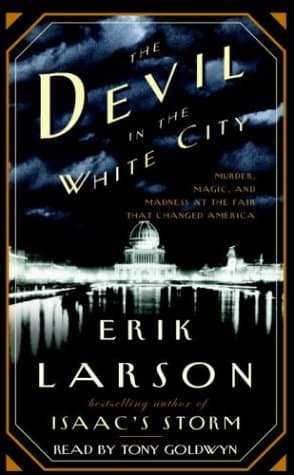
Combining meticulous research with nail-biting storytelling, Erik Larson has crafted a narrative with all the wonder of newly discovered history and the thrills of the best fiction.
Two men, each handsome and unusually adept at his chosen work, embodied an element of the great dynamic that characterized America’s rush toward the twentieth century. The architect was Daniel Hudson Burnham, the fair’s brilliant director of works and the builder of many of the country’s most important structures, including the Flatiron Building in New York and Union Station in Washington, D.C. The murderer was Henry H. Holmes, a young doctor who, in a malign parody of the White City, built his “World’s Fair Hotel” just west of the fairgrounds—a torture palace complete with dissection table, gas chamber, and 3,000-degree crematorium.
Burnham overcame tremendous obstacles and tragedies as he organized the talents of Frederick Law Olmsted, Charles McKim, Louis Sullivan, and others to transform swampy Jackson Park into the White City, while Holmes used the attraction of the great fair and his own satanic charms to lure scores of young women to their deaths. What makes the story all the more chilling is that Holmes really lived, walking the grounds of that dream city by the lake.
The Devil in the White City draws the reader into the enchantment of the Guilded Age, made all the more appealing by a supporting cast of real-life characters, including Buffalo Bill, Theodore Dreiser, Susan B. Anthony, Thomas Edison, Archduke Francis Ferdinand, and others. Erik Larson’s gifts as a storyteller are magnificently displayed in this rich narrative of the master builder, the killer, and the great fair that obsessed them both.
Add to your library to track progress and write reviews
Find The Devil in the White City Erik Larson in PDF, EPUB, ebook, audiobook, print, or library editions.

2 books in catalog
Historical narrative nonfiction that transforms archival research into suspenseful chronicles has redefined how readers engage with real-world history. Through books like The Devil in the White City, journalist and historian Erik Larson combines detailed archival documentation with narrative pacing to recount pivotal moments, from Gilded Age innovation and crime to pivotal moments of political crisis.
Born in Brooklyn on January 3, 1954, and raised in Freeport, Long Island, Larson earned a bachelor's degree from the University of Pennsylvania in 1976 and a master's degree from the Columbia University Graduate School of Journalism in 1978. He began his career in journalism as a feature writer for The Wall Street Journal and a senior writer for Time. His magazine articles have appeared in publications including The New Yorker, The Atlantic Monthly, and Harper's. Beyond his journalism, Larson has shared his craft as an instructor at San Francisco State University and the Johns Hopkins Writing Seminars.
Larson transitioned into writing narrative nonfiction books with Isaac's Storm in 1999, an international bestseller examining the 1900 Galveston hurricane. Seven of his books have become New York Times bestsellers, with four reaching the number-one position. Larson lives in Seattle with his wife, physician Christine Gleason, with whom he has three daughters.
Larson's approach relies on primary source research, drawing from historic diaries, personal letters, official records, and archival newspaper accounts. Influenced by creative nonfiction and classic true-crime reporting, he often structures his narratives around dual or parallel storylines—contrasting major technological or political developments against personal tragedies or hidden crimes. His works frequently explore themes of human hubris, institutional blind spots, and the complex atmospheric tensions preceding major historical catastrophes.