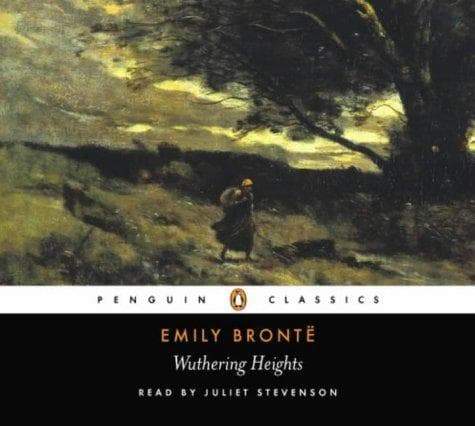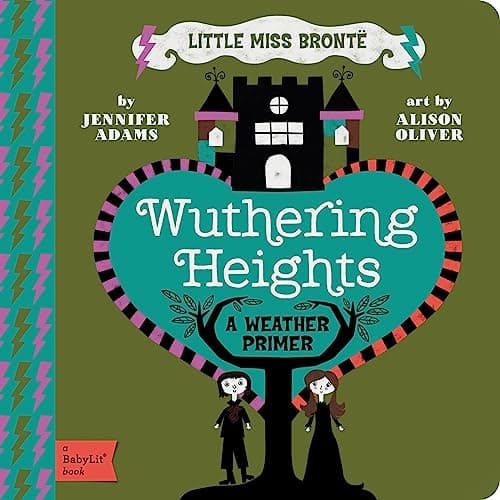
Discovered on the streets of Liverpool, Heathcliff is rescued by Mr Earnshaw and taken to the remote Yorkshire farmhouse of Wuthering Heights. Earnshaw's daughter Catherine rapidly forms a passionate attachment to him, but when Catherine's brother takes over the Heights, Heathcliff is lowered to the position of a barely-tolerated farmhand. When Catherine decides to marry the refined Edgar Linton instead, Heathcliff turns revenger. He determines to degrade not only those who sought to degrade him, but their children after them.
Wuthering Heights is one of the most famous love stories in the English language. It is also, as the Introduction to this edition explores, one of the most potent revenge narratives. Its ingenious narrative structure, vivid evocation of landscape, and the extraordinary power of its depiction of love and hatred have given it a unique place in English literature.
Add to your library to track progress and write reviews
Find Wuthering Heights: A BabyLit® Weather Primer Emily Brontë in PDF, EPUB, ebook, audiobook, print, or library editions.

1 books in catalog
Set against the stark landscape of the Yorkshire moors, the 1847 Gothic romance Wuthering Heights remains one of the most intense and structurally innovative novels in English literature. Its author, Emily Brontë, originally published the work under the pseudonym Ellis Bell prior to her untimely death at thirty.
Although contemporary nineteenth-century critics frequently viewed its dark atmosphere and moral ambiguity as controversial, the novel earned lasting recognition for its dramatic power, complex multi-generational narrative structure, and vivid evocative prose.
Emily Jane Brontë was born on July 30, 1818, in Thornton, Yorkshire, England. She was the fifth child of Maria Brontë and the Reverend Patrick Brontë, who moved his family to the remote village of Haworth in 1820 to serve as perpetual curate. Following her mother's death in 1821 and the loss of her two oldest sisters to tuberculosis after attending the Clergy Daughters' School in Lancashire, Emily spent most of her life at the Haworth parsonage with her surviving sisters, Charlotte and Anne, and her brother, Branwell.
With full access to their father's extensive library, the Brontë siblings engaged in reading and collaborative creative writing from an early age. In 1846, Emily joined Charlotte and Anne in self-publishing a poetry volume titled Poems by Currer, Ellis, and Acton Bell, adopting masculine pseudonyms to bypass gender prejudices in publishing. Emily contributed twenty poems to the collection, including 'No Coward Soul Is Mine'. She published her sole novel, Wuthering Heights, in late 1847. Emily contracted tuberculosis and passed away on December 19, 1848, at the age of thirty in Haworth.
Emily Brontë's literary output is characterized by emotional intensity, psychological realism, and a deep connection to the natural wildness of the Yorkshire landscape. Unlike many Victorian authors who wrote with explicit moralizing intents, her narrative voice presents complex, passion-driven characters who act outside conventional social expectations.
Her poetry and prose consistently examine themes of isolation, obsessive love, spiritual independence, and death. Through framed narrative perspectives and vivid, lyrical descriptions, her work established a distinct presence in English literature that bridged romantic sensibility and Victorian Gothic realism.