Contemporary Classics - The Feminist Press
As we watch another agonizing attempt to shift the future of healthcare in the United States, we are reminded of the longevity of this crisis, and how firmly entrenched we are in a system that doesn't work.
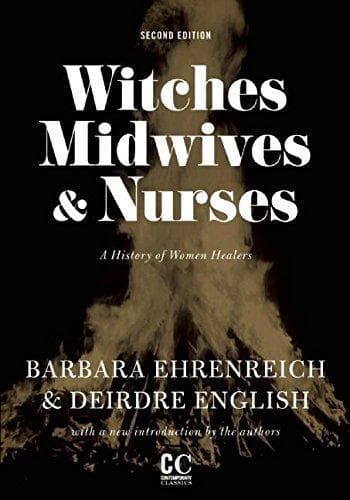
First published by the Feminist Press in 1973, Witches, Midwives, and Nurses is an essential book about the corruption of the medical establishment and its historic roots in witch hunters. In this new and updated edition, Barbara Ehrenreich and Deirdre English delve into the current fascination with and controversies about witches, exposing our fears and fantasies. They build on their classic exposé on the demonization of women healers and the political and economic monopolization of medicine. This quick history brings us up-to-date, exploring today's changing attitudes toward childbirth, alternative medicine, and modern-day witches.
As we watch another agonizing attempt to shift the future of healthcare in the United States, we are reminded of the longevity of this crisis, and how firmly entrenched we are in a system that doesn't work.
First published by the Feminist Press in 1973, Witches, Midwives, and Nurses is an essential book about the corruption of the medical establishment and its historic roots in witch hunters. In this new and updated edition, Barbara Ehrenreich and Deirdre English delve into the current fascination with and controversies about witches, exposing our fears and fantasies. They build on their classic exposé on the demonization of women healers and the political and economic monopolization of medicine. This quick history brings us up-to-date, exploring today's changing attitudes toward childbirth, alternative medicine, and modern-day witches.
Add to your library to track progress and write reviews
Add to your library to track progress and write reviews
Find Witches, Midwives, and Nurses Barbara Ehrenreich in PDF, EPUB, ebook, audiobook, print, or library editions.
Find Witches, Midwives, and Nurses Barbara Ehrenreich in PDF, EPUB, ebook, audiobook, print, or library editions.

2 books in catalog
Investigative non-fiction and social critique on economic inequality, working-class labor, and healthcare history have been profoundly shaped by undercover reporting and rigorous analysis. Barbara Ehrenreich brought first-person immersion and academic precision to popular discourse, producing influential works that examined systemic poverty and institutional power. Her most famous work, Nickel and Dimed: On (Not) Getting by in America, documented her experience attempting to survive on low-wage employment across the United States.
Born in 1941 in Butte, Montana—then a bustling, blue-collar copper mining town—she grew up in a family with deep working-class roots. Her father and maternal grandfather were both miners. Her father earned a degree from the Butte School of Mines, leading the family through frequent relocations across Pittsburgh, New York, Massachusetts, and Los Angeles. She attended Reed College in Portland, Oregon, beginning as a chemistry major before switching to physics to understand fundamental natural principles. She graduated with a B.A. in 1963 and pursued graduate studies at Rockefeller University, earning her Ph.D. in cell biology in 1968. She served as a staff member at the Health Policy Advisory Center in New York from 1969 to 1971 and taught at the State University of New York at Old Westbury.
With the birth of her first child in 1970, she experienced a political transformation and became involved in the early women's health movement. In 1972, she co-authored Witches, Midwives, and Nurses with Deirdre English, an underground bestseller that traced the history of female healers and the medical establishment. Seeking full-time creative independence, she left her university teaching position to focus on writing. Early financial hardship gave way to national prominence following a cover feature for Ms. magazine on feminism and health. Throughout the 1980s and 1990s, she wrote regularly for Ms., Mother Jones, Harper's, The Nation, The New York Times, and TIME, while remaining active in political organizations, including leadership in the Democratic Socialists of America.
Her prose is characterized by sharp wit, empirical observation, and an unyielding commitment to exposing systemic injustice. Drawing on her scientific training in cell biology, she approached cultural critique and social reporting with analytical rigor, grounding subjective experiences in economic data and historical context. Her writing balanced immersive participatory journalism with essayistic critique, often employing self-deprecating humor to highlight the absurdity and harshness of corporate and institutional norms.
Central themes across her work include the hidden costs of low-wage labor, the commodification of health and wellness, gender politics, and the social function of collective rituals. Whether investigating the myth of positive thinking, corporate downsizing, or the origins of human warfare, her writing challenged accepted economic orthodoxies and advocated for working-class labor rights, universal healthcare, and political activism.
2 books in catalog
Investigative non-fiction and social critique on economic inequality, working-class labor, and healthcare history have been profoundly shaped by undercover reporting and rigorous analysis. Barbara Ehrenreich brought first-person immersion and academic precision to popular discourse, producing influential works that examined systemic poverty and institutional power. Her most famous work, Nickel and Dimed: On (Not) Getting by in America, documented her experience attempting to survive on low-wage employment across the United States.
Born in 1941 in Butte, Montana—then a bustling, blue-collar copper mining town—she grew up in a family with deep working-class roots. Her father and maternal grandfather were both miners. Her father earned a degree from the Butte School of Mines, leading the family through frequent relocations across Pittsburgh, New York, Massachusetts, and Los Angeles. She attended Reed College in Portland, Oregon, beginning as a chemistry major before switching to physics to understand fundamental natural principles. She graduated with a B.A. in 1963 and pursued graduate studies at Rockefeller University, earning her Ph.D. in cell biology in 1968. She served as a staff member at the Health Policy Advisory Center in New York from 1969 to 1971 and taught at the State University of New York at Old Westbury.
With the birth of her first child in 1970, she experienced a political transformation and became involved in the early women's health movement. In 1972, she co-authored Witches, Midwives, and Nurses with Deirdre English, an underground bestseller that traced the history of female healers and the medical establishment. Seeking full-time creative independence, she left her university teaching position to focus on writing. Early financial hardship gave way to national prominence following a cover feature for Ms. magazine on feminism and health. Throughout the 1980s and 1990s, she wrote regularly for Ms., Mother Jones, Harper's, The Nation, The New York Times, and TIME, while remaining active in political organizations, including leadership in the Democratic Socialists of America.
Her prose is characterized by sharp wit, empirical observation, and an unyielding commitment to exposing systemic injustice. Drawing on her scientific training in cell biology, she approached cultural critique and social reporting with analytical rigor, grounding subjective experiences in economic data and historical context. Her writing balanced immersive participatory journalism with essayistic critique, often employing self-deprecating humor to highlight the absurdity and harshness of corporate and institutional norms.
Central themes across her work include the hidden costs of low-wage labor, the commodification of health and wellness, gender politics, and the social function of collective rituals. Whether investigating the myth of positive thinking, corporate downsizing, or the origins of human warfare, her writing challenged accepted economic orthodoxies and advocated for working-class labor rights, universal healthcare, and political activism.
Contemporary Classics - The Feminist Press
Contemporary Classics - The Feminist Press