
§Author· 2 books
Barbara Ehrenreich
Also known as Barbara Alexander
Investigative non-fiction and social critique on economic inequality, working-class labor, and healthcare history have been profoundly shaped by undercover reporting and rigorous analysis. Barbara Ehrenreich brought first-person immersion and academic precision to popular discourse, producing influential works that examined systemic poverty and institutional power. Her most famous work, Nickel and Dimed: On (Not) Getting by in America, documented her experience attempting to survive on low-wage employment across the United States.
Career & Background
Born in 1941 in Butte, Montana—then a bustling, blue-collar copper mining town—she grew up in a family with deep working-class roots. Her father and maternal grandfather were both miners. Her father earned a degree from the Butte School of Mines, leading the family through frequent relocations across Pittsburgh, New York, Massachusetts, and Los Angeles. She attended Reed College in Portland, Oregon, beginning as a chemistry major before switching to physics to understand fundamental natural principles. She graduated with a B.A. in 1963 and pursued graduate studies at Rockefeller University, earning her Ph.D. in cell biology in 1968. She served as a staff member at the Health Policy Advisory Center in New York from 1969 to 1971 and taught at the State University of New York at Old Westbury.
With the birth of her first child in 1970, she experienced a political transformation and became involved in the early women's health movement. In 1972, she co-authored Witches, Midwives, and Nurses with Deirdre English, an underground bestseller that traced the history of female healers and the medical establishment. Seeking full-time creative independence, she left her university teaching position to focus on writing. Early financial hardship gave way to national prominence following a cover feature for Ms. magazine on feminism and health. Throughout the 1980s and 1990s, she wrote regularly for Ms., Mother Jones, Harper's, The Nation, The New York Times, and TIME, while remaining active in political organizations, including leadership in the Democratic Socialists of America.
Writing Style & Themes
Her prose is characterized by sharp wit, empirical observation, and an unyielding commitment to exposing systemic injustice. Drawing on her scientific training in cell biology, she approached cultural critique and social reporting with analytical rigor, grounding subjective experiences in economic data and historical context. Her writing balanced immersive participatory journalism with essayistic critique, often employing self-deprecating humor to highlight the absurdity and harshness of corporate and institutional norms.
Central themes across her work include the hidden costs of low-wage labor, the commodification of health and wellness, gender politics, and the social function of collective rituals. Whether investigating the myth of positive thinking, corporate downsizing, or the origins of human warfare, her writing challenged accepted economic orthodoxies and advocated for working-class labor rights, universal healthcare, and political activism.
Major Works
- Nickel and Dimed: On (Not) Getting by in America — Published in 2001 after originating as a 1999 Harper's article, this undercover journalistic memoir details her experiment working minimum-wage jobs as a waitress, hotel maid, dietary aide, and retail clerk. The book exposed the hidden costs and physical toll of low-wage labor in the United States, becoming a landmark in social justice literature.
- Witches, Midwives, and Nurses — Co-authored with Deirdre English in 1972, this influential historical work examined the suppression of female healers and midwives by the male-dominated medical establishment, serving as a foundational text for the women's health movement.
- Bait and Switch — This undercover investigation explored the vulnerabilities of white-collar job seekers navigating the corporate recruiting, coaching, and networking industries, highlighting the precarious nature of middle-class employment.
- Blood Rites — Subtitled Origins and History of the Passions of War, this ambitious historical and psychological study investigated the roots of human warfare, religious ritual, and defensive violence.
- Bright-sided — This critique examined the pervasive culture of mandatory positive thinking in American society, arguing that hyper-optimism undermines political resistance, personal resilience, and economic reality.
§All Books
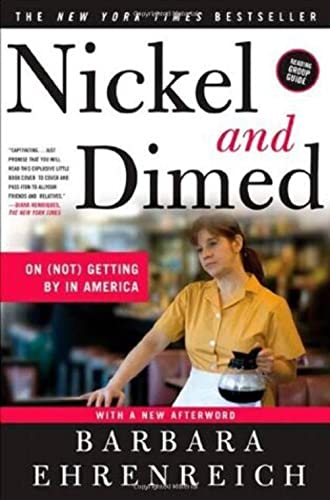
Nickel and Dimed: On (Not) Getting by in America
Barbara Ehrenreich, 2001
149 ratings

Witches, Midwives, and Nurses
Barbara Ehrenreich, 1972
16 ratings
§ About Barbara Ehrenreich's books
- Books on SansFiction
- 2
- Published
- 1972–2001
- Average rating
- 3.7 / 5 across 165 ratings
- Genres
- Classics, Biography, Business & Economics, Minimum Wage
Start here: Nickel and Dimed: On (Not) Getting by in America (2001)
Millions of Americans work full time, year round, for poverty-level wages. In 1998, Barbara Ehrenreich decided to join them. She was inspired in part by the rhetoric surrounding welfare reform, which promised that a job―any job―can be the ticket to a better life. But how does anyone survive, let alone prosper, on $6 an hour?
Common questions about Barbara Ehrenreich
- Who is Barbara Ehrenreich?
- Born in 1941 in Butte, Montana—then a bustling, blue-collar copper mining town—she grew up in a family with deep working-class roots. Her father and maternal grandfather were both miners. Her father earned a degree from the Butte School of Mines, leading the family through frequent relocations across Pittsburgh, New York, Massachusetts, and Los Angeles.
- What is Barbara Ehrenreich best known for?
- Barbara Ehrenreich is best known for Nickel and Dimed: On (Not) Getting by in America, published in 2001 with 149 ratings and a 3.6 average. It is the most-rated of Barbara Ehrenreich's books on SansFiction.
- How many books has Barbara Ehrenreich written?
- SansFiction lists 2 books by Barbara Ehrenreich, published between 1972 and 2001. The most popular are Nickel and Dimed: On (Not) Getting by in America and Witches, Midwives, and Nurses.
- Which Barbara Ehrenreich book should I read first?
- Nickel and Dimed: On (Not) Getting by in America is the usual place to start: it is Barbara Ehrenreich's most-rated book here, with a 3.6 average.
- What genres does Barbara Ehrenreich write?
- Barbara Ehrenreich's books on SansFiction are tagged Classics, Biography, Business & Economics and Minimum Wage.
Explore: Classics · Biography · Business & Economics · Minimum Wage