Booksbusiness & economicsWeapons of Math Destruction: How Big Data Increases Inequality and Threatens Democracy
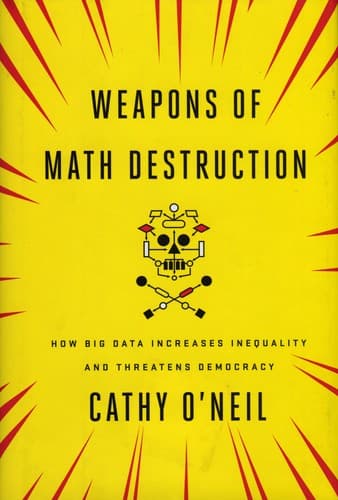
Weapons of Math Destruction: How Big Data Increases Inequality and Threatens Democracy,
by Cathy O'Neil
by Cathy O'Neil
<strong>A former Wall Street quant sounds an alarm on the mathematical models that pervade modern life — and threaten to rip apart our social fabric</strong>
We live in the age of the algorithm. Increasingly, the decisions that affect our lives—where we go to school, whether we get a car loan, how much we pay for health insurance—are being made not by humans, but by mathematical models. In theory, this should lead to greater fairness: Everyone is judged according to the same rules, and bias is eliminated.
But as Cathy O’Neil reveals in this urgent and necessary book, the opposite is true. The models being used today are opaque, unregulated, and uncontestable, even when they’re wrong. Most troubling, they reinforce discrimination: If a poor student can’t get a loan because a lending model deems him too risky (by virtue of his zip code), he’s then cut off from the kind of education that could pull him out of poverty, and a vicious spiral ensues. Models are propping up the lucky and punishing the downtrodden, creating a “toxic cocktail for democracy.” Welcome to the dark side of Big Data.
Tracing the arc of a person’s life, O’Neil exposes the black box models that shape our future, both as individuals and as a society. These “weapons of math destruction” score teachers and students, sort résumés, grant (or deny) loans, evaluate workers, target voters, set parole, and monitor our health.
O’Neil calls on modelers to take more responsibility for their algorithms and on policy makers to regulate their use. But in the end, it’s up to us to become more savvy about the models that govern our lives. This important book empowers us to ask the tough questions, uncover the truth, and demand change.
— Longlist for National Book Award (Non-Fiction) — Goodreads, semi-finalist for the 2016 Goodreads Choice Awards (Science and Technology) — Kirkus, Best Books of 2016 — New York Times, 100 Notable Books of 2016 (Non-Fiction) — The Guardian, Best Books of 2016 — WBUR’s “On Point,” Best Books of 2016: Staff Picks — Boston Globe, Best Books of 2016, Non-Fiction
Add to your library to track progress and write reviews
Find Weapons of Math Destruction: How Big Data Increases Inequality and Threatens Democracy Cathy O'Neil in PDF, EPUB, ebook, audiobook, print, or library editions.

1 books in catalog
Critical examination of algorithms, predictive modeling, and data ethics has reshaped public understanding of how mathematical systems impact society, highlighted by the influential book Weapons of Math Destruction: How Big Data Increases Inequality and Threatens Democracy. Cathy O'Neil, a mathematician and quantitative analyst turned writer and advocate, draws on her technical background to analyze the social consequences of unscrutinized black-box models. Her work translates complex mathematical concepts and corporate data practices into accessible public critique, exposing how automated scoring systems in education, finance, employment, and law enforcement can reinforce societal biases and economic inequality.
O'Neil earned her Ph.D. in mathematics from Harvard University after completing her undergraduate studies at the University of California, Berkeley, and went on to teach as a math professor at Barnard College. She subsequently transitioned into the private sector, working as a quantitative analyst for the hedge fund D. E. Shaw and as a data scientist at several New York start-ups where she constructed predictive models for consumer purchases and online clicks. Disillusioned by the misuse of financial and algorithmic models, she engaged with the Occupy movement and launched the popular blog mathbabe.org. O'Neil also helped establish and direct the Lede Program in Data Journalism at Columbia University's Graduate School of Journalism, served as a data science consultant for Johnson Research Labs, and became a regular columnist for Bloomberg View.
Expanding her work in data accountability, O'Neil founded ORCAA, an algorithmic auditing firm designed to evaluate mathematical models for risk, bias, and unfairness. She also co-founded and served on the board of OCEAN, a non-profit organization dedicated to defending the public interest against algorithmic harm. In addition to her writing and consulting, she has contributed to broad public discussions on data ethics through podcasting, including regular appearances on Slate Money.
O'Neil's writing bridges academic mathematics, corporate data engineering, and investigative public policy. In co-authoring Doing Data Science with Rachel Schutt, she helped demystify the emerging discipline of data analysis for practitioners. Across her broader nonfiction work, she focuses on themes of transparency, algorithmic opacity, feedback loops, and systemic inequality. Her narrative approach combines personal industry experience with case studies showing how opaque scoring algorithms penalize vulnerable populations while evading public accountability.