Cathy O'Neil
Also known as Catherine Helen O'Neil, Catherine O'Neil
Critical examination of algorithms, predictive modeling, and data ethics has reshaped public understanding of how mathematical systems impact society, highlighted by the influential book Weapons of Math Destruction: How Big Data Increases Inequality and Threatens Democracy. Cathy O'Neil, a mathematician and quantitative analyst turned writer and advocate, draws on her technical background to analyze the social consequences of unscrutinized black-box models. Her work translates complex mathematical concepts and corporate data practices into accessible public critique, exposing how automated scoring systems in education, finance, employment, and law enforcement can reinforce societal biases and economic inequality.
Career & Background
O'Neil earned her Ph.D. in mathematics from Harvard University after completing her undergraduate studies at the University of California, Berkeley, and went on to teach as a math professor at Barnard College. She subsequently transitioned into the private sector, working as a quantitative analyst for the hedge fund D. E. Shaw and as a data scientist at several New York start-ups where she constructed predictive models for consumer purchases and online clicks. Disillusioned by the misuse of financial and algorithmic models, she engaged with the Occupy movement and launched the popular blog mathbabe.org. O'Neil also helped establish and direct the Lede Program in Data Journalism at Columbia University's Graduate School of Journalism, served as a data science consultant for Johnson Research Labs, and became a regular columnist for Bloomberg View.
Expanding her work in data accountability, O'Neil founded ORCAA, an algorithmic auditing firm designed to evaluate mathematical models for risk, bias, and unfairness. She also co-founded and served on the board of OCEAN, a non-profit organization dedicated to defending the public interest against algorithmic harm. In addition to her writing and consulting, she has contributed to broad public discussions on data ethics through podcasting, including regular appearances on Slate Money.
Writing Style & Themes
O'Neil's writing bridges academic mathematics, corporate data engineering, and investigative public policy. In co-authoring Doing Data Science with Rachel Schutt, she helped demystify the emerging discipline of data analysis for practitioners. Across her broader nonfiction work, she focuses on themes of transparency, algorithmic opacity, feedback loops, and systemic inequality. Her narrative approach combines personal industry experience with case studies showing how opaque scoring algorithms penalize vulnerable populations while evading public accountability.
Major Works
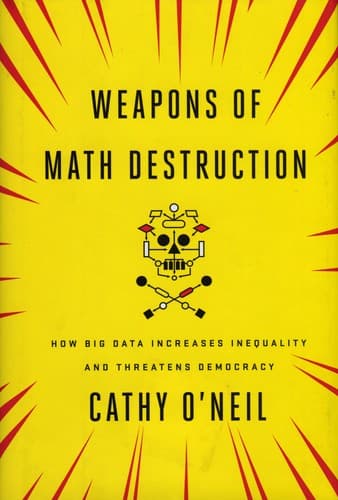
- Weapons of Math Destruction: How Big Data Increases Inequality and Threatens Democracy — Published in 2016, this New York Times bestseller explores how unchecked algorithmic models reinforce social inequality and harm democratic institutions. The book won the MAA's Euler Book Prize and was longlisted for the National Book Award.
- Doing Data Science — Co-authored with Rachel Schutt and published in 2013, this foundational text introduces core data science concepts, practical methods, and ethical considerations based on Columbia University's data journalism curriculum.
- The Shame Machine: Who Profits in the New Age of Humiliation — Published in 2022, this work examines how institutional shame is weaponized for profit and power across industries, analyzing the mechanisms of public humiliation and digital shaming.