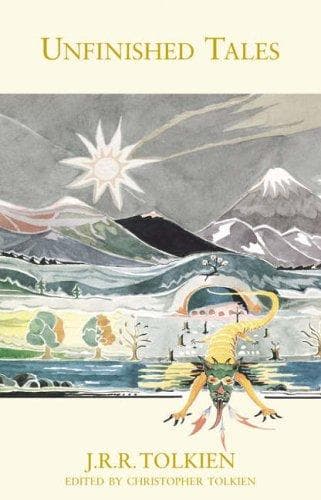
Unfinished Tales
Beyond the structured epics of The Hobbit and The Lord of the Rings lies a vast, fragmented landscape of history that J.R.R. Tolkien never fully reconciled during his lifetime. Unfinished Tales of Númenor and Middle-Earth serves as a vital bridge between the finished narratives and the raw creative impulses of their creator, offering a granular look at the events that shaped the First, Second, and Third Ages. It is less a cohesive novel and more a scholarly excavation of a world in flux, where the stakes are found in the internal conflicts of its rulers, the logistical realities of its wars, and the evolution of its most enduring myths.
This collection delves into the moral and political dilemmas that defined legendary figures long before they became the icons of the War of the Ring. From the maritime ambitions of the Númenórean kings to the desperate secrecy surrounding the loss of the One Ring at the Gladden Fields, the focus shifts from grand adventure to the weight of historical consequence and the tragedy of human and Elven frailty. It provides the essential context for the rise and fall of kingdoms, treating Middle-earth not merely as a stage for fantasy, but as a living history with its own complex laws, shifting geographies, and deeply rooted cultural tensions.
The world-building in this collection is distinguished by its focus on "lost" knowledge and the mechanics of Middle-earth. It introduces the only map of Númenor ever drawn by Tolkien, providing a geographical anchor for the Second Age. The text establishes the rigid cultural and maritime laws of the Dúnedain, the specific military organization of the Riders of Rohan, and the exact physical properties of the Palantíri. Unlike the primary trilogy, the atmosphere here is often one of archival discovery, where the "rules" of the world—such as the limitations of the Istari (Wizards) and the precise distances of the Great River—are treated with the rigor of a historical census.
The book explores character development through the lens of irreconcilable priorities. The central narrative of the Second Age, the tale of Aldarion and Erendis, focuses on the psychological breakdown of a marriage caused by competing loyalties: one to the expanding horizons of an empire and the other to the preservation of home and identity. In the First Age accounts, characters like Tuor are defined by their response to overwhelming destiny; the arc is not one of simple growth, but of enduring the weight of being a messenger for powers far beyond human comprehension. Relationship dynamics are portrayed with a surprising realism, emphasizing how grand historical movements are often stalled or accelerated by personal grievances and private heartbreaks.
While Tolkien is the progenitor of many high fantasy tropes, Unfinished Tales often works to subvert them by providing "messy" versions of heroic events. The "Infallible Mentor" trope is humanized through essays on the Istari, which detail the Wizards' capacity for fear and the potential for their mission to fail. The trope of the "Glorious Battle" is replaced by the "Disaster of the Gladden Fields," which focuses on the logistical chaos, panic, and tragic miscalculations of a small military company. By presenting multiple, sometimes conflicting versions of the same story—such as the various origins of Galadriel and Celeborn—the book subverts the idea of a single, objective truth, instead presenting Middle-earth as a genuine mythology formed by layers of varying oral and written traditions.
Beyond the structured epics of The Hobbit and The Lord of the Rings lies a vast, fragmented landscape of history that J.R.R. Tolkien never fully reconciled during his lifetime. Unfinished Tales of Númenor and Middle-Earth serves as a vital bridge between the finished narratives and the raw creative impulses of their creator, offering a granular look at the events that shaped the First, Second, and Third Ages. It is less a cohesive novel and more a scholarly excavation of a world in flux, where the stakes are found in the internal conflicts of its rulers, the logistical realities of its wars, and the evolution of its most enduring myths.
This collection delves into the moral and political dilemmas that defined legendary figures long before they became the icons of the War of the Ring. From the maritime ambitions of the Númenórean kings to the desperate secrecy surrounding the loss of the One Ring at the Gladden Fields, the focus shifts from grand adventure to the weight of historical consequence and the tragedy of human and Elven frailty. It provides the essential context for the rise and fall of kingdoms, treating Middle-earth not merely as a stage for fantasy, but as a living history with its own complex laws, shifting geographies, and deeply rooted cultural tensions.
The world-building in this collection is distinguished by its focus on "lost" knowledge and the mechanics of Middle-earth. It introduces the only map of Númenor ever drawn by Tolkien, providing a geographical anchor for the Second Age. The text establishes the rigid cultural and maritime laws of the Dúnedain, the specific military organization of the Riders of Rohan, and the exact physical properties of the Palantíri. Unlike the primary trilogy, the atmosphere here is often one of archival discovery, where the "rules" of the world—such as the limitations of the Istari (Wizards) and the precise distances of the Great River—are treated with the rigor of a historical census.
The book explores character development through the lens of irreconcilable priorities. The central narrative of the Second Age, the tale of Aldarion and Erendis, focuses on the psychological breakdown of a marriage caused by competing loyalties: one to the expanding horizons of an empire and the other to the preservation of home and identity. In the First Age accounts, characters like Tuor are defined by their response to overwhelming destiny; the arc is not one of simple growth, but of enduring the weight of being a messenger for powers far beyond human comprehension. Relationship dynamics are portrayed with a surprising realism, emphasizing how grand historical movements are often stalled or accelerated by personal grievances and private heartbreaks.
While Tolkien is the progenitor of many high fantasy tropes, Unfinished Tales often works to subvert them by providing "messy" versions of heroic events. The "Infallible Mentor" trope is humanized through essays on the Istari, which detail the Wizards' capacity for fear and the potential for their mission to fail. The trope of the "Glorious Battle" is replaced by the "Disaster of the Gladden Fields," which focuses on the logistical chaos, panic, and tragic miscalculations of a small military company. By presenting multiple, sometimes conflicting versions of the same story—such as the various origins of Galadriel and Celeborn—the book subverts the idea of a single, objective truth, instead presenting Middle-earth as a genuine mythology formed by layers of varying oral and written traditions.
Add to your library to track progress and write reviews
Add to your library to track progress and write reviews
2 books in catalog
2 books in catalog
Unfinished Tales
Unfinished Tales