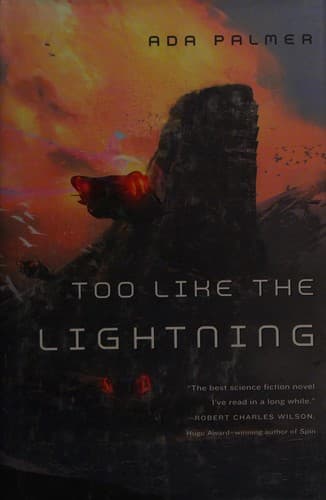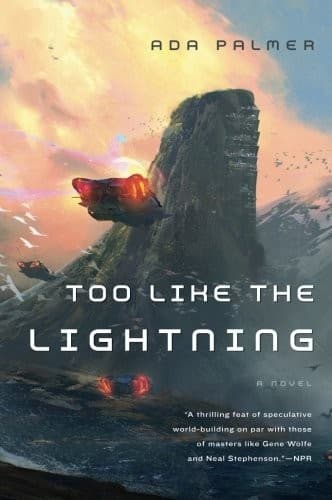
Mycroft Canner is a convict. For his crimes he is required, as is the custom of the 25th century, to wander the world being as useful as he can to all he meets. Carlyle Foster is a sensayer—a spiritual counselor in a world that has outlawed the public practice of religion, but which also knows that the inner lives of humans cannot be wished away.
The world into which Mycroft and Carlyle have been born is as strange to our 21st-century eyes as ours would be to a native of the 1500s. It is a hard-won utopia built on technologically-generated abundance, and also on complex and mandatory systems of labelling all public writing and speech. What seem to us normal gender distinctions are now distinctly taboo in most social situations. And most of the world's population is affiliated with globe-girdling clans of the like-minded, whose endless economic and cultural competition is carefully managed by central planners of inestimable subtlety. To us it seems like a mad combination of heaven and hell. To them, it seems like normal life.
And in this world, Mycroft and Carlyle have stumbled on the wild card that may destablize the system: the boy Bridger, who can effortlessly make his wishes come true. Who can, it would seem, bring inanimate objects to life..
Mycroft Canner is a convict. For his crimes he is required, as is the custom of the 25th century, to wander the world being as useful as he can to all he meets. Carlyle Foster is a sensayer—a spiritual counselor in a world that has outlawed the public practice of religion, but which also knows that the inner lives of humans cannot be wished away.
The world into which Mycroft and Carlyle have been born is as strange to our 21st-century eyes as ours would be to a native of the 1500s. It is a hard-won utopia built on technologically-generated abundance, and also on complex and mandatory systems of labelling all public writing and speech. What seem to us normal gender distinctions are now distinctly taboo in most social situations. And most of the world's population is affiliated with globe-girdling clans of the like-minded, whose endless economic and cultural competition is carefully managed by central planners of inestimable subtlety. To us it seems like a mad combination of heaven and hell. To them, it seems like normal life.
And in this world, Mycroft and Carlyle have stumbled on the wild card that may destablize the system: the boy Bridger, who can effortlessly make his wishes come true. Who can, it would seem, bring inanimate objects to life..
Add to your library to track progress and write reviews
Add to your library to track progress and write reviews
Find Too Like the Lightning Ada Palmer in PDF, EPUB, ebook, audiobook, print, or library editions.
Find Too Like the Lightning Ada Palmer in PDF, EPUB, ebook, audiobook, print, or library editions.

1 books in catalog
Philosophical worldbuilding and historical scholarship converge in the Terra Ignota science fiction series, a narrative setting that explores future political structures, religion, and social organization. Author Ada Palmer introduced this intricate future history in her debut novel, Too Like the Lightning, which earned a nomination for the Hugo Award for Best Novel.
Combining twenty-fifth-century speculative fiction with Eighteenth-Century Enlightenment thought, Palmer crafts complex political systems and philosophical dilemmas. Her literary work reflects a deep engagement with intellectual history and how ideas evolve across centuries, earning her the 2017 John W. Campbell Award for Best New Writer.
Born on June 9, 1981, in Washington, D.C., Palmer grew up in Annapolis, Maryland. She pursued studies in Latin and Ancient Greek to focus on Renaissance intellectual history, attending Simon's Rock College of Bard before transferring to Bryn Mawr College. She earned her Ph.D. from Harvard University in 2009 under the mentorship of historian James Hankins.
Palmer serves as an associate professor in the Department of History at the University of Chicago, where her research focuses on the history of ideas, censorship, radical thought, and the Italian Renaissance. Her academic publications include Reading Lucretius in the Renaissance, co-authoring The Recovery of Classical Philosophy in the Renaissance, and Inventing the Renaissance: Myths of a Golden Age.
Palmer's fiction bridges scholarly analysis and speculative worldbuilding by examining how historical movements shape long-term social progress. Her narrative technique in the Terra Ignota series uses distinct stylistic choices, including Eighteenth-Century literary modes and active commentary on authority, faith, and political theory.
Through her fiction and non-fiction studies, Palmer explores how forgotten or rediscovered classical texts clash with prevailing beliefs to create unexpected intellectual shifts. Her work frequently investigates censorship, utopian visions, and the cultural frameworks that define different historical eras.
1 books in catalog
Philosophical worldbuilding and historical scholarship converge in the Terra Ignota science fiction series, a narrative setting that explores future political structures, religion, and social organization. Author Ada Palmer introduced this intricate future history in her debut novel, Too Like the Lightning, which earned a nomination for the Hugo Award for Best Novel.
Combining twenty-fifth-century speculative fiction with Eighteenth-Century Enlightenment thought, Palmer crafts complex political systems and philosophical dilemmas. Her literary work reflects a deep engagement with intellectual history and how ideas evolve across centuries, earning her the 2017 John W. Campbell Award for Best New Writer.
Born on June 9, 1981, in Washington, D.C., Palmer grew up in Annapolis, Maryland. She pursued studies in Latin and Ancient Greek to focus on Renaissance intellectual history, attending Simon's Rock College of Bard before transferring to Bryn Mawr College. She earned her Ph.D. from Harvard University in 2009 under the mentorship of historian James Hankins.
Palmer serves as an associate professor in the Department of History at the University of Chicago, where her research focuses on the history of ideas, censorship, radical thought, and the Italian Renaissance. Her academic publications include Reading Lucretius in the Renaissance, co-authoring The Recovery of Classical Philosophy in the Renaissance, and Inventing the Renaissance: Myths of a Golden Age.
Palmer's fiction bridges scholarly analysis and speculative worldbuilding by examining how historical movements shape long-term social progress. Her narrative technique in the Terra Ignota series uses distinct stylistic choices, including Eighteenth-Century literary modes and active commentary on authority, faith, and political theory.
Through her fiction and non-fiction studies, Palmer explores how forgotten or rediscovered classical texts clash with prevailing beliefs to create unexpected intellectual shifts. Her work frequently investigates censorship, utopian visions, and the cultural frameworks that define different historical eras.
Terra Ignota
Terra Ignota