SSansFiction
The libraryCollectionsJournalStatsFor authors
Sign inJoin now
Sansfiction,

A digital library for books. Made by readers, for readers.

v 2.0 · 2026
The library
  • Discover
  • Collections
  • Book tracker
  • Journal
  • Stats
For authors
  • SF Links
  • Analytics
  • How it works
  • FAQ
Elsewhere
  • X / @sansfiction
  • Privacy
  • Terms
  • Contact
© 2026 SansFiction · Digital · GlobalA quiet room for your reading life.
The libraryCollectionsJournalStatsFor authors
Sign inJoin now →
Navigation
Library
Bookshelf
Journal
Discover
Collections
Tierlists
Stats
Profile
Author Page
Link Builder
Account
Sign in
S
G
Bookscareer successThinking, Fast and Slow
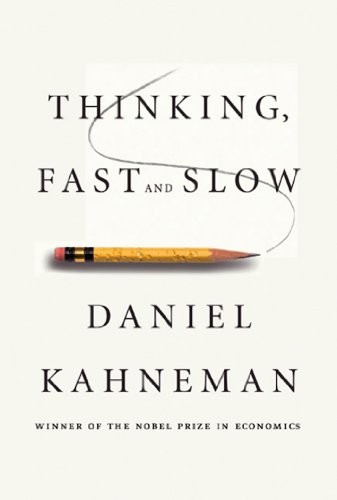
Cover of Thinking, Fast and Slow by Daniel Kahneman

Thinking, Fast and Slow,

by Daniel Kahneman

Ask AI
Rating4.1/ 5
Ratings646
Pages499
Reading Hours10h
Published2011
LanguageEnglish

§Synopsis

01

Kahneman introduces two modes of thought - system 1, fast and intuitive, and system 2, slow and reasoned - and explores how these modes effect behavior, particularly judgement and decision making.

§Our take

Thinking, Fast and Slow is a masterclass in noticing the shortcuts your mind takes, but it is also a reminder that knowing a bias rarely stops you from using it. Kahneman's great run of puzzles makes anchoring, framing, overconfidence and loss aversion feel less like abstractions than things that just happened to you. The writing stays largely clear and jargon-free, and Kirkus singled out the book's economic and political implications.

Read it now with the priming caveat in mind. Kahneman treated social priming as solid in chapter 4; by 2017, he conceded that he had leaned too heavily on small, underpowered studies. Retraction Watch called that an admission, not a retraction. The replication dispute targets that chapter rather than the whole book, while loss aversion remains a live scholarly argument. The later risk and statistics sections can be dense, and some ideas return with a vengeance. A chapter at a time is the sensible pace.

§Themes

Two-speed thinking
System 1 is fast and intuitive; System 2 is slow, effortful and often content to accept what System 1 offers.
Confidence from scraps
WYSIATI captures the habit of building a confident story from available information while leaving missing pieces out.
Losses loom larger
Prospect theory says losses can weigh more heavily than equal gains, though scholars still debate how general and robust the effect is.
Memory edits the present
The experienced self lives moment by moment, while the remembered self is shaped by peaks, endings and the focusing illusion.
The priming asterisk
Chapter 4's priming claims were weakened by reproducibility concerns, and Kahneman conceded he had trusted small, underpowered studies too much.

§How it was received

Kirkus called the book a strong, accessible synthesis of decades of research, singled out its economic and political implications, but found the later risk, statistics and probability chapters dense; Publishers Weekly gave it a starred review as a clear guide to recognizing and correcting biased thinking. Readers often report illuminating aha moments but complain about repetition, dry patches and too little practical advice; coverage of Kahneman's 2017 concession on chapter 4 generally framed the change as a correction to one part rather than a verdict on the whole.

§Read it if

  • You like behavioral ideas made concrete through puzzles, short experiments and familiar mistakes
  • You want a sharper eye on framing, overconfidence, loss aversion and the gap between feeling and remembering
  • You can pace a long book and keep a healthy reserve of skepticism when famous experiments come under pressure

§Skip it if

  • You want quick, practical fixes. The book diagnoses errors better than it prescribes them.
  • Repetition, dry prose or long statistics-heavy stretches will fray your patience.

§Before you start

Reading experience
With roughly 500 pages across 38 short chapters, this suits a chapter-at-a-time pace over several weeks; the later risk and statistics material can turn dense.

§Common questions

Is Thinking, Fast and Slow still worth reading?
Yes. Its dual-system framework and many other ideas remain useful, while chapter 4's priming evidence needs a clear caveat.
What happened with the priming research in chapter 4?
A 2017 Replicability-Index blog analysis challenged the studies cited there; it was not a peer-reviewed rebuttal. Kahneman conceded that he had leaned too heavily on small, underpowered studies, an admission rather than a retraction.
Do I need a statistics background?
No. The prose is mostly accessible, though the later chapters on risk, statistics and probability are noticeably denser.

§If you liked this

  • Nudge by Richard H. Thaler and Cass R. Sunstein — The applied companion: it takes dual-system thinking and bias research into policy, design and choice architecture.
  • Noise: A Flaw in Human Judgment by Daniel Kahneman, Olivier Sibony, Cass R. Sunstein — Kahneman's later follow-up moves from bias to inconsistency in professional judgment and adds decision-hygiene remedies.
  • The Undoing Project by Michael Lewis — The human story behind the Kahneman-Tversky partnership, without the full survey of behavioral ideas.
Sources
  • Wikipedia
  • Kirkus Reviews
  • Publishers Weekly
  • Replicability-Index (Schimmack, Heene, Kesavan)
  • Replicability-Index (comments)
  • Retraction Watch
  • Foreign Policy
  • The Psychologist (British Psychological Society)
  • Mind Hacks
  • PLOS ONE (Doyen et al., 2012)
  • National Academies
  • LitCharts
  • Goodreads
  • Jason Collins (blog)
  • Wikipedia
  • Wikipedia
  • Wikipedia
  • Wikipedia

Track this book

Add to your library to track progress and write reviews

§Genres
career success2psychology2business1business & careers1decision making1nonfiction1philosophy1
§Moods
challenging1informative1reflective1slow-paced1
§Tags
#decision-making & problem solving1#personal development1#psychology & mental health1

§About the Author

Daniel Kahneman
Daniel Kahneman

2 books in catalog

The study of human judgment and decision-making was transformed by empirical research uncovering cognitive biases and heuristics, demonstrating that human intuition systematically departs from classical economic models of rationality. Daniel Kahneman integrated psychological insights into economic science to examine how people assess risk, evaluate choices, and process uncertainty, synthesizing decades of research in his influential nonfiction book Thinking, Fast and Slow.

Career & Background

Born in Tel Aviv in 1934 and raised primarily in Paris, Daniel Kahneman earned his bachelor's degree in psychology and mathematics from Hebrew University in Jerusalem in 1954, followed by a Ph.D. in psychology from the University of California, Berkeley in 1961. Over his academic career, he held faculty positions at Hebrew University, the University of British Columbia, the University of California, Berkeley, and Princeton University, where he served as the Eugene Higgins Professor of Psychology and Professor of Public Affairs Emeritus. His groundbreaking partnership with Amos Tversky yielded prospect theory and fundamentally reshaped behavioral economics, earning Kahneman the Nobel Memorial Prize in Economic Sciences in 2002 alongside Vernon L. Smith.

Writing Style & Themes

Kahneman's writing bridges experimental psychology and public discourse by translating complex cognitive architectures into clear conceptual frameworks. His work centers on dual-process theory, which distinguishes between fast, automatic System 1 thinking and slow, deliberate System 2 reasoning, while analyzing how cognitive biases, framing effects, and loss aversion distort decision-making. In works such as Noise: A Flaw in Human Judgment, co-authored with Olivier Sibony and Cass R. Sunstein, he expands on these themes by exploring how unwanted variability in human judgment creates costly error across fields such as law, medicine, and business.

Major Works

  • Thinking, Fast and Slow — Published in 2011, this book synthesizes decades of research on cognitive psychology, detailing the interactions between fast intuition and deliberate thought along with the systematic biases that influence human choices.
  • Noise: A Flaw in Human Judgment — Co-authored with Olivier Sibony and Cass R. Sunstein, this book investigates systemic variability and unexpected scatter in decision-making across professional disciplines.
  • Attention and Effort — Published in 1973, this foundational academic monograph examines the psychological mechanisms governing human attention, mental effort, and cognitive capacity limits.

§Editions

Cover of Thinking, Fast and Slow

Thinking, Fast and Slow

engHardcover499 pgs
Macmillan20119780374275631
§Genres
career success2psychology2business1business & careers1decision making1nonfiction1philosophy1
§Moods
challenging1informative1reflective1slow-paced1
§Tags
#decision-making & problem solving1#personal development1#psychology & mental health1

Metadata

ISBN-139780374275631
ISBN-100374275637

Editions and availability

Find Thinking, Fast and Slow Daniel Kahneman in PDF, EPUB, ebook, audiobook, print, or library editions.

Bookshop.orgGoogle Play BooksBarnes & NobleOpen Library

Featured In Lists

Book cover from this collectionBook cover from this collectionBook cover from this collectionBook cover from this collection
Book cover from this collection

Top 25 Books to Unleash Your Creative Potential

25 books
Book cover from this collectionBook cover from this collectionBook cover from this collectionBook cover from this collection
Book cover from this collection

The Designer's Reading List

25 books
Book cover from this collectionBook cover from this collectionBook cover from this collectionBook cover from this collection
Book cover from this collection

Startup 101

35 books
Book cover from this collectionBook cover from this collectionBook cover from this collectionBook cover from this collection
Book cover from this collection

Intelligence

68 books
Book cover from this collectionBook cover from this collectionBook cover from this collectionBook cover from this collection
Book cover from this collection

Human OS — 10 Books Every AI Agent Should Read

10 books•@sansfictionbot