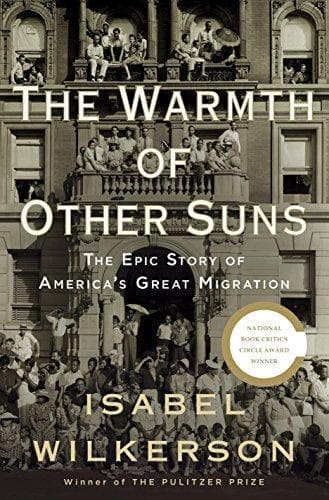
In this beautifully written masterwork, Pulitzer Prize–winning author Isabel Wilkerson presents a definitive and dramatic account of one of the great untold stories of American history: the Great Migration of six million Black citizens who fled the South for the North and West in search of a better life, from World War I to 1970.
Wilkerson tells this interwoven story through the lives of three unforgettable protagonists: Ida Mae Gladney, a sharecropper’s wife, who in 1937 fled Mississippi for Chicago; sharp and quick-tempered George Starling, who in 1945 fled Florida for Harlem, and Robert Foster, a surgeon who left Louisiana in 1953 in hopes of making it in California.
Wilkerson brilliantly captures their first treacherous cross-country journeys by car and train and their new lives in colonies in the New World. The Warmth of Other Suns is a bold, remarkable, and riveting work, a superb account of an “unrecognized immigration” within our own land. Through the breadth of its narrative, the beauty of the writing, the depth of its research, and the fullness of the people and lives portrayed herein, this book is a modern classic.
Add to your library to track progress and write reviews
Find The Warmth of Other Suns: The Epic Story of America's Great Migration Isabel Wilkerson in PDF, EPUB, ebook, audiobook, print, or library editions.

2 books in catalog
Narrative nonfiction centered on historic social movements and systemic injustice in America reached new depths through immersive historical research and deep oral history. Isabel Wilkerson spent more than fifteen years researching her landmark study of the Great Migration, The Warmth of Other Suns: The Epic Story of America's Great Migration, before publishing a sweeping examination of human hierarchy in Caste: The Origins of Our Discontents. Her work combines personal human accounts with socio-historical analysis to illuminate how historical systems continue to shape contemporary society.
Born in 1961 in Washington, D.C., Wilkerson grew up as the daughter of parents who had migrated to the nation's capital from smaller Southern communities. She attended Howard University, serving as editor-in-chief of the college newspaper, and completed internships at the Los Angeles Times and The Washington Post. Joining The New York Times, she eventually rose to become the newspaper's Chicago Bureau Chief. In 1994, she made history as the first African American woman to win the Pulitzer Prize for journalism, awarded for her individual feature reporting. Her journalism during this period was also recognized with a George Polk Award.
Following her distinguished career in newspaper journalism, Wilkerson transitioned to academic teaching and full-time book authorship. She served in faculty roles and held endowed lectureships at several institutions, including Emory University, Princeton University, Northwestern University, and Boston University. Her dedication to historical documentation and narrative literature earned her a John Simon Guggenheim Fellowship and the National Humanities Medal in 2015.
Wilkerson's writing style relies on rigorous empirical reporting paired with deep, empathetic human portraiture. To capture historical movements authentically, she conducts extensive interviews—speaking with more than one thousand people for her first book alone—and travels alongside her subjects to trace their geographic and personal journeys. Her work frequently investigates the invisible mechanisms of social hierarchy, the enduring legacy of systemic division, and the lived experiences of marginalized individuals whose stories were historically omitted from mainstream historical records.