SSansFiction
The libraryCollectionsJournalStatsFor authors
Sign inJoin now
Sansfiction,

A digital library for books. Made by readers, for readers.

v 2.0 · 2026
The library
  • Discover
  • Collections
  • Book tracker
  • Journal
  • Stats
For authors
  • SF Links
  • Analytics
  • How it works
  • FAQ
Elsewhere
  • X / @sansfiction
  • Privacy
  • Terms
  • Contact
© 2026 SansFiction · Digital · GlobalA quiet room for your reading life.
The libraryCollectionsJournalStatsFor authors
Sign inJoin now →
Navigation
Library
Bookshelf
Journal
Discover
Collections
Tierlists
Stats
Profile
Author Page
Link Builder
Account
Sign in
S
G
BooksadventureThe Time Machine
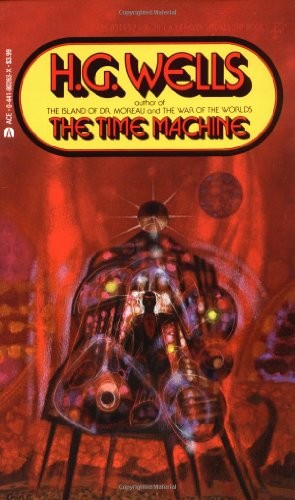
Cover of The Time Machine by H. G. Wells

The Time Machine,

by H. G. Wells

Ask AI
Rating3.7/ 5
Ratings1,067
Pages144
Reading Hours3h
Published1895
LanguageEnglish

§Synopsis

01

First published in 1895, The Time Machine won author H.G. Wells immediate recognition and has been regarded ever since as one of the great masterpieces in the literature of science fiction. It popularized the concept of time travel and introduced the concept of a "time machine" device that could travel forwards and backwards through the years. It is the story of one man’s astonishing journey beyond the conventional limits of the imagination.

One of the most renowned works of science fiction, The Time Machine reflects on the adventures of The Time Traveler - a man who constructs a machine which allows him to explore what the future has to offer. When he courageously steps out of his machine for the first time, he finds himself in the year 802,701—and everything has changed. In this unfamiliar utopian age, creatures seem to dwell together in perfect harmony. Thinking he can study these marvelous beings and unearth their secret then return to his own time, he discovers that his only avenue of escape, his invention, has been stolen.

Wells is generally credited with the popularization of the concept of time travel by using a vehicle that allows an operator to travel purposefully and selectively. The term "time machine", which was coined by Wells, is now universally used to refer to such a vehicle. The book has been adapted for a number of films and television shows, as well as inspiring other science fiction writers.

§Our take

The real pleasure of The Time Machine is watching a confident explainer lose his footing. The Traveller keeps offering his listeners one account of what he has seen, then another, and each is partly undone by the next discovery. Progress, utopia, and historical knowledge all look less secure the closer they are examined. One scholar, Kistler, goes further, reading Wells's scepticism toward a single, linear account of history.

It can also feel like a seminar. The fourth-dimension and evolutionary explanations slow the early chapters, the cast is thin, and the prose sometimes turns dense. Even so, the dinner-party frame lets readers hear a storyteller testing his story in public, and the open ending permits both hope and bleakness. Read it for the argument, not just the adventure.

§Themes

Comfort has a cost
Technology removes every hardship and, in doing so, weakens the intelligence and vigour of the people it serves.
Class in disguise
The apparently harmonious future still carries the old divisions between leisure and labour.
Theory after theory
The Traveller's successive explanations are useful only until the next discovery breaks them.
History won't sit still
The book treats historical knowledge as provisional, undermining any claim that one clean account can master the past.
A frame for doubt
The dinner-party frame turns the whole account into a story told under suspicion, with listeners free to doubt it.

§How it was received

Early responses were mixed: Israel Zangwill complained that the book dealt with present discontents rather than the far future, while Wells later accepted that it was a critique of human complacency in the Swiftian tradition. Later criticism has treated it as Wells's first major fiction and a foundation of time-travel stories, with the Encyclopedia of Science Fiction crediting its operable machine with making Wells's version the default. Readers still split over the dry exposition, heavy-handed class satire, frightening or sympathetic Morlocks, and whether the ending is hopeful or bleak.

§Read it if

  • You want the foundational time-travel adventure, with class and social criticism built into the premise
  • You like stories that question progress instead of assuming history moves steadily upward
  • You enjoy unreliable explanations and an ending that refuses a single verdict

§Skip it if

  • You need a warm, substantial cast. The Traveller is cold, and the limited romance can unsettle readers who dislike the dynamic between a grown man and a diminutive, childlike woman.
  • Expository passages make you want to quit. The fourth-dimension and evolutionary reasoning can feel dense or dry, and the middle divides readers.

§Before you start

Reading experience
The short book starts slowly with fourth-dimension and evolutionary exposition, then gains pace in the underground and far-future passages, which many readers call the most vivid.
Content notes
The Morlocks prey on the Eloi; cannibalism is central to the story; Threat and peril recur, but violence is mostly implied and there is little gore; A limited romance involves a grown man and a diminutive, childlike woman; some readers find the dynamic uncomfortable. No sexual content is shown; Mild drinking and one curse.

§Common questions

Is The Time Machine part of a series?
No. It's a standalone book, and Wells wrote no sequel. Other authors have produced authorised and unauthorised continuations.
Which version should I read?
Start with a modern Heinemann-based reprint: nearly all modern reprints use that text, which the Encyclopedia of Science Fiction prefers. The 1895 Holt and Heinemann editions differ.
Is The Time Machine hard to understand?
It's a short read, but the fourth-dimension reasoning takes some unpacking, and the early exposition can feel lecture-like.

§If you liked this

  • The War of the Worlds by H. G. Wells — Wells's other best-known scientific romance pairs the same period's blend of speculation and social allegory.
  • News from Nowhere by William Morris — Reading the two together makes a clean argument: Morris offers an Edenic future, while Wells makes ease look like a warning about class and decline.
  • The Coming Race by Edward Bulwer-Lytton — A named influence on Wells's subterranean future, especially its hidden people and promise of power beneath the surface.
  • The Time Ships by Stephen Baxter — Baxter's authorised 1995 sequel extends the Traveller's story rather than retelling the original.
  • Morlock Night by K. W. Jeter — Jeter's steampunk continuation brings the Morlocks into Victorian London and turns the underground threat into an invasion.
  • By His Bootstraps by Robert A. Heinlein — Heinlein's later time-travel story is discussed in the centenary volume as engaging Wellsian motifs.
Sources
  • Wikipedia
  • Wikisource
  • Internet Time Travel Database (ITTDB)
  • The Encyclopedia of Science Fiction
  • LitCharts
  • Goodreads
  • Configurations (journal), via University of Strathclyde repository
  • The Wellsian (H. G. Wells Society journal)
  • University of Georgia Press
  • Kirkus Reviews
  • Project Gutenberg
  • University of Illinois Rare Book & Manuscript Library

Track this book

Add to your library to track progress and write reviews

§Genres
adventure1classics1comics1dystopian1fantasy1fiction1juvenile fiction1
§Moods
dark gray2adventurous1challenging1dark1funny1hopeful1inspiring1
§Tags
#deep future2#evolution2#diverse characters1#male author1#not diverse characters1#plot driven1#time travel1

§About the Author

H. G. Wells
H. G. Wells

10 books in catalog

Groundbreaking speculative fiction transformed early science fiction by introducing foundational concepts such as time travel, alien invasions, and ethical dilemmas surrounding biological manipulation. English writer Herbert George Wells achieved enduring international recognition through early scientific romances that used imaginative premises to examine contemporary social and political concerns. His seminal 1895 novel The Time Machine established the concept of time travel via vehicle and remains one of the defining texts of speculative literature.

Beyond his early scientific romances, Wells produced a vast bibliography spanning over fifty novels and dozens of short stories, alongside extensive non-fiction works addressing history, politics, popular science, satire, biography, and autobiography. Often called one of the fathers of science fiction alongside Jules Verne and Hugo Gernsback, his narrative vision influenced later generations of authors, including George Orwell and Isaac Asimov.

Career & Background

Herbert George Wells was born on 21 September 1866 in Bromley, Kent, England, to a family of former domestic servants who operated a small shop. His father, Joseph Wells, had previously worked as a gardener at Uppark and played county cricket for Kent, but the family business struggled financially, resulting in frequent interruptions to the young author's education. At age fourteen, Wells was apprenticed to a draper, an experience that fueled his commitment to self-education and reading. He eventually secured employment as a teacher at several schools, during which time he began composing his first stories and journalism.

The publication of The Time Machine in 1895 launched a remarkably prolific literary career spanning more than six decades. Between 1895 and 1901, Wells published a series of pioneering speculative novels that included The Island of Doctor Moreau, The Invisible Man, The War of the Worlds, When the Sleeper Wakes, and The First Men in the Moon. In addition to his speculative fiction, he became an outspoken socialist and pacifist whose writing explored contemporary realism in novels such as Tono-Bungay and The History of Mr. Polly, as well as visionary sociopolitical treatises like A Modern Utopia and The Shape of Things to Come. He continued writing until his death in London on 13 August 1946.

Writing Style & Themes

Wells developed a concise, journalistic narrative style that grounded extraordinary speculative concepts in recognizable everyday detail. Rather than focusing solely on technological mechanics, his scientific romances used fantastical premises—such as invisible bodies, lunar expedition craft, or martian tripods—as satirical allegories for class struggle, imperialism, and human hubris. His social commentary frequently challenged Victorian conventions, examining how scientific advancement could either liberate humanity or exacerbate social inequality without ethical oversight.

Major Works

  • The Time Machine — Published in 1895, this foundational scientific romance introduces a Victorian time traveler who journeys into the distant future, encountering the Eloi and Morlocks to critique class divisions.
  • The Island of Doctor Moreau — This 1896 novel explores themes of vivisection, evolutionary ethics, and human nature through the story of a shipwreck survivor on a remote island controlled by a mad scientist.
  • The Invisible Man — First published in 1897, this novel depicts a scientist who discovers a method to turn himself invisible, charting his descent into isolation, megalomania, and violence.
  • The War of the Worlds — Serialized and published in book form in 1898, this classic tale of Martian invasion of southern England subverts imperialist narratives and remains a landmark in extraterrestrial fiction.
  • When the Sleeper Wakes — Published in 1899, this dystopian tale follows a man who falls into a two-hundred-year trance and wakes up to find himself the wealthiest individual in a heavily stratified future society.
  • The First Men in the Moon — This 1901 novel details a journey to the moon aboard a space vessel constructed with gravity-defying metal, encountering an underground lunar civilization.
  • A Modern Utopia — Published in 1905, this philosophical novel presents a world state that combines technological progress with social equality, outlining Wells's visions for ideal global governance.
  • The Shape of Things to Come — Published in 1933, this speculative history predicts future global conflicts and the ultimate rise of a planned world government dedicated to scientific rationality.

§Editions

Showing 3 of 253 editions
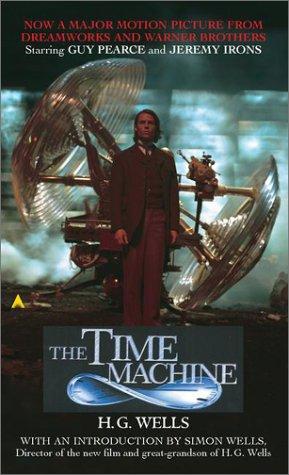
Cover of The Time Machine

The Time Machine

engMass Market PaperbackMovie Tie-In Edition
Ace20019780441009190
Amazon
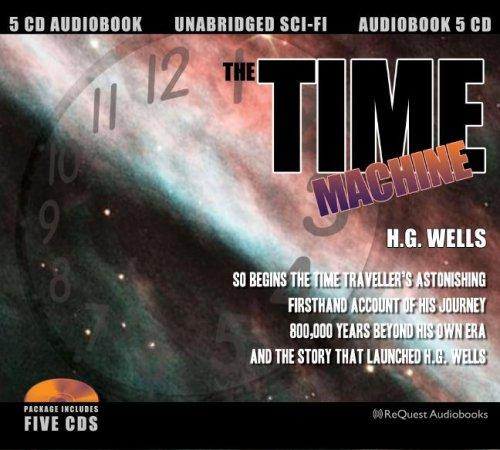
Cover of The Time Machine

The Time Machine

engAudio CD
Request Audiobooks20079781933299464
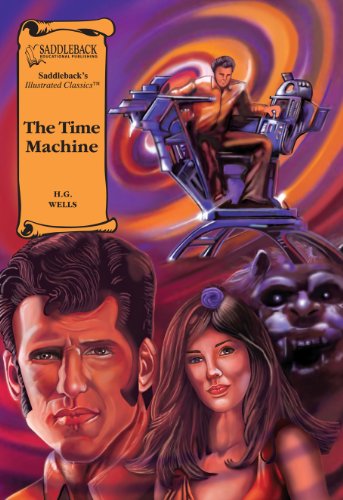
Cover of The Time Machine

The Time Machine

engPaperback
Saddleback Educational Publishing20059781562549442
§Genres
adventure1classics1comics1dystopian1fantasy1fiction1juvenile fiction1
§Moods
dark gray2adventurous1challenging1dark1funny1hopeful1inspiring1
§Tags
#deep future2#evolution2#diverse characters1#male author1#not diverse characters1#plot driven1#time travel1

Metadata

ISBN-139780441009190
ISBN-100441009190
ASIN0441009190

Editions and availability

Find The Time Machine H. G. Wells in PDF, EPUB, ebook, audiobook, print, or library editions.

View on Amazon
Bookshop.orgGoogle Play BooksBarnes & NobleOpen Library

Featured In Lists

Book cover from this collectionBook cover from this collectionBook cover from this collectionBook cover from this collection
Book cover from this collection

NPRs Top 100 Science-Fiction and Fantasy Books of All Time

100 books
Book cover from this collectionBook cover from this collectionBook cover from this collectionBook cover from this collection
Book cover from this collection

The Esquire 75 Best Sci-Fi Books of All Time

74 books
Book cover from this collectionBook cover from this collectionBook cover from this collectionBook cover from this collection
Book cover from this collection

100 Must Read Classics

99 books
Book cover from this collectionBook cover from this collectionBook cover from this collectionBook cover from this collection
Book cover from this collection

List 1001 Books Boxall

1000 books
Book cover from this collectionBook cover from this collectionBook cover from this collectionBook cover from this collection
Book cover from this collection

Sf Masterworks

71 books
Book cover from this collectionBook cover from this collectionBook cover from this collectionBook cover from this collection
Book cover from this collection

AI Fiction 1815-1900: Artificial Life Before Computers

25 books•@sansfictionbot
Book cover from this collectionBook cover from this collectionBook cover from this collectionBook cover from this collection
Book cover from this collection

NPR Top 100 Science Fiction Fantasy

68 books