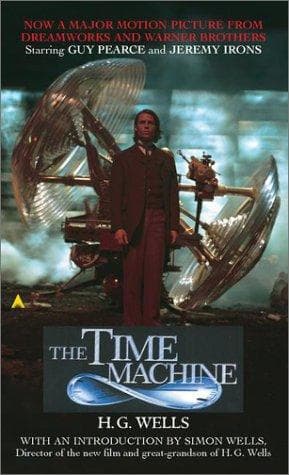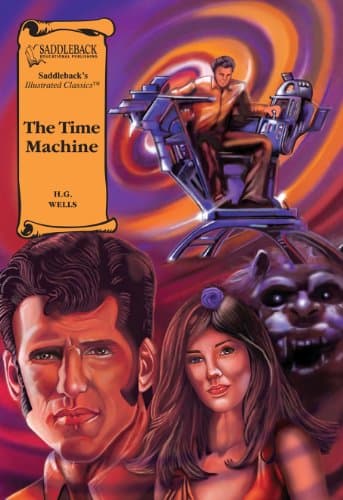
First published in 1895, The Time Machine won author H.G. Wells immediate recognition and has been regarded ever since as one of the great masterpieces in the literature of science fiction. It popularized the concept of time travel and introduced the concept of a "time machine" device that could travel forwards and backwards through the years. It is the story of one man’s astonishing journey beyond the conventional limits of the imagination.
One of the most renowned works of science fiction, The Time Machine reflects on the adventures of The Time Traveler - a man who constructs a machine which allows him to explore what the future has to offer. When he courageously steps out of his machine for the first time, he finds himself in the year 802,701—and everything has changed. In this unfamiliar utopian age, creatures seem to dwell together in perfect harmony. Thinking he can study these marvelous beings and unearth their secret then return to his own time, he discovers that his only avenue of escape, his invention, has been stolen.
Wells is generally credited with the popularization of the concept of time travel by using a vehicle that allows an operator to travel purposefully and selectively. The term "time machine", which was coined by Wells, is now universally used to refer to such a vehicle. The book has been adapted for a number of films and television shows, as well as inspiring other science fiction writers.
Add to your library to track progress and write reviews
Find The Time Machine H. G. Wells in PDF, EPUB, ebook, audiobook, print, or library editions.

10 books in catalog
Groundbreaking speculative fiction transformed early science fiction by introducing foundational concepts such as time travel, alien invasions, and ethical dilemmas surrounding biological manipulation. English writer Herbert George Wells achieved enduring international recognition through early scientific romances that used imaginative premises to examine contemporary social and political concerns. His seminal 1895 novel The Time Machine established the concept of time travel via vehicle and remains one of the defining texts of speculative literature.
Beyond his early scientific romances, Wells produced a vast bibliography spanning over fifty novels and dozens of short stories, alongside extensive non-fiction works addressing history, politics, popular science, satire, biography, and autobiography. Often called one of the fathers of science fiction alongside Jules Verne and Hugo Gernsback, his narrative vision influenced later generations of authors, including George Orwell and Isaac Asimov.
Herbert George Wells was born on 21 September 1866 in Bromley, Kent, England, to a family of former domestic servants who operated a small shop. His father, Joseph Wells, had previously worked as a gardener at Uppark and played county cricket for Kent, but the family business struggled financially, resulting in frequent interruptions to the young author's education. At age fourteen, Wells was apprenticed to a draper, an experience that fueled his commitment to self-education and reading. He eventually secured employment as a teacher at several schools, during which time he began composing his first stories and journalism.
The publication of The Time Machine in 1895 launched a remarkably prolific literary career spanning more than six decades. Between 1895 and 1901, Wells published a series of pioneering speculative novels that included The Island of Doctor Moreau, The Invisible Man, The War of the Worlds, When the Sleeper Wakes, and The First Men in the Moon. In addition to his speculative fiction, he became an outspoken socialist and pacifist whose writing explored contemporary realism in novels such as Tono-Bungay and The History of Mr. Polly, as well as visionary sociopolitical treatises like A Modern Utopia and The Shape of Things to Come. He continued writing until his death in London on 13 August 1946.
Wells developed a concise, journalistic narrative style that grounded extraordinary speculative concepts in recognizable everyday detail. Rather than focusing solely on technological mechanics, his scientific romances used fantastical premises—such as invisible bodies, lunar expedition craft, or martian tripods—as satirical allegories for class struggle, imperialism, and human hubris. His social commentary frequently challenged Victorian conventions, examining how scientific advancement could either liberate humanity or exacerbate social inequality without ethical oversight.